
#MD49
1872
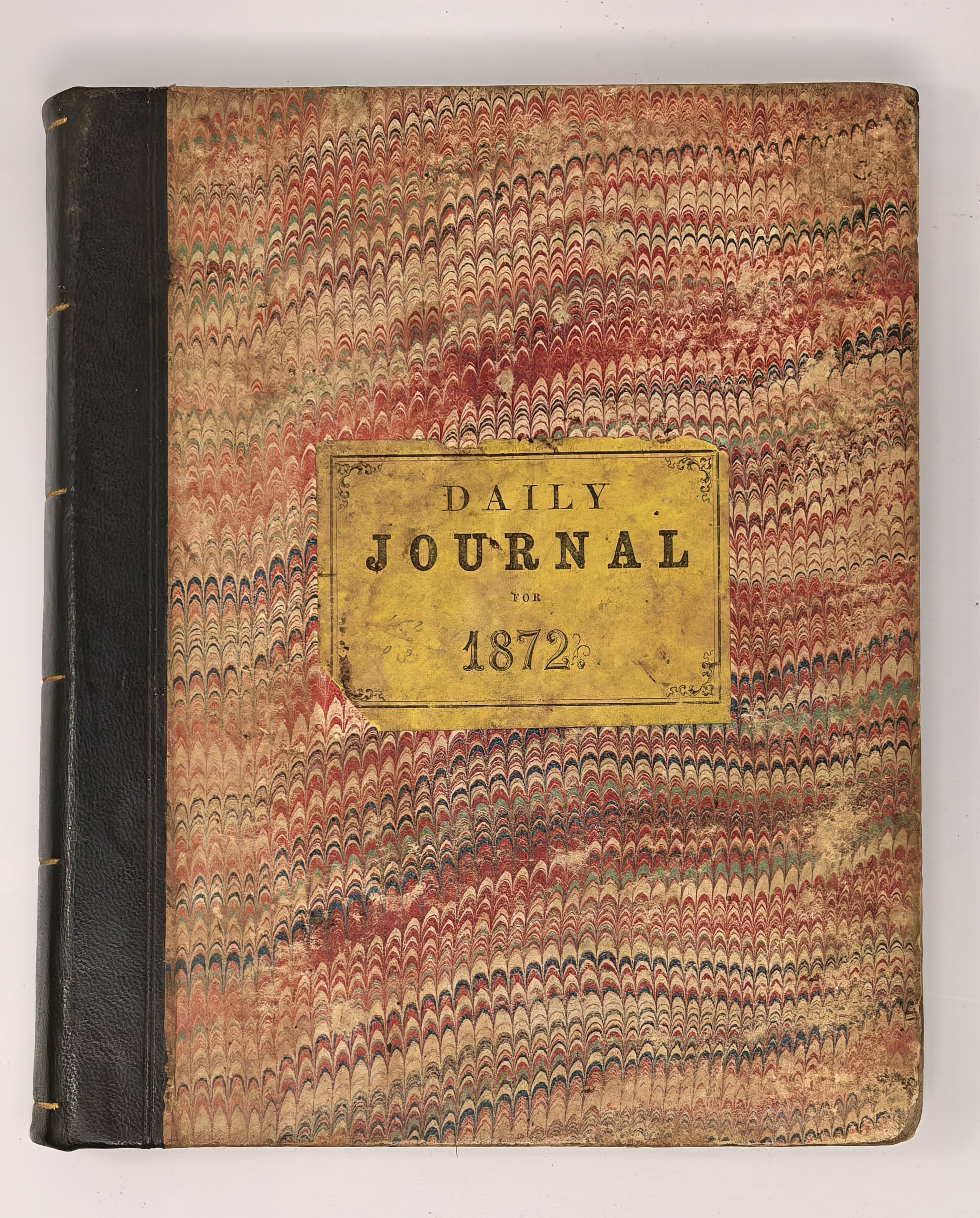
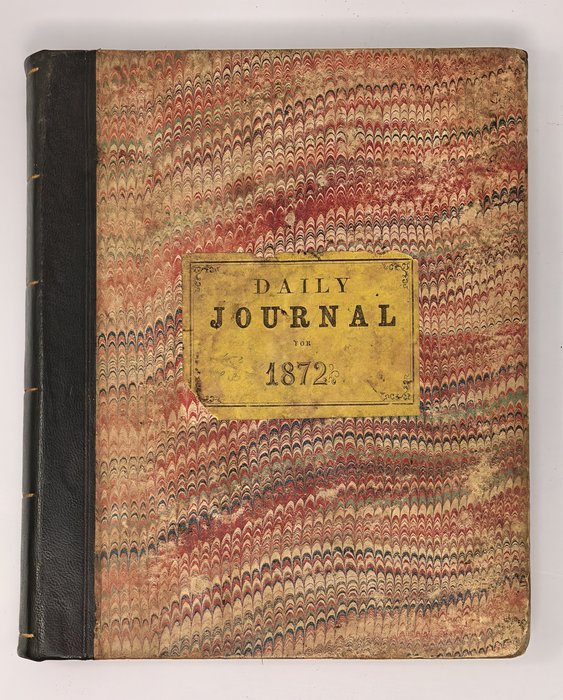
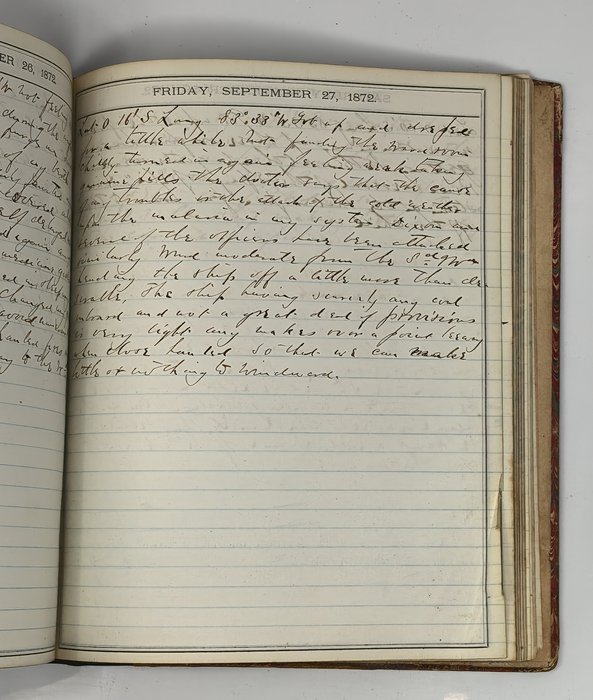
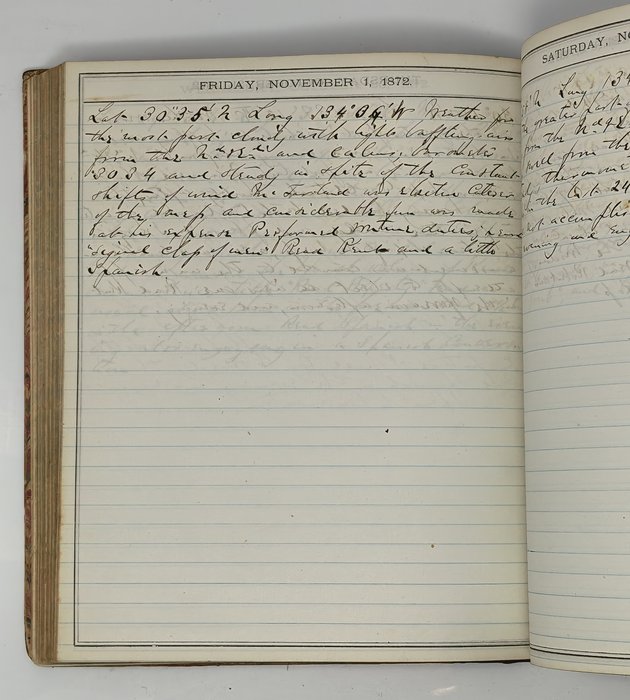
Octavo journal (ca. 20,5x16,5 cm or 8 x 6 ½ in). Ca. 366 unnumbered pages with printed dates on the upper margins (for each day of 1871), with manuscript text on recto and verso; 1 blank leaf for “Memoranda” at the rear. Brown ink on lined paper. Entries of various size, from two lines to two or three pages. Two identical manuscript notes by the compiler on the front endpaper (in ink and pencil): “S. Ames, San Francisco, November 24th, 1871.” Original marbled papered boards neatly rebacked in brown sheep; front cover with the original printed label “Daily Journal for 1872.” Covers slightly rubbed, endpapers slightly age-toned, but overall a very good internally clean and sound journal.
Historically significant, content-rich, original private diary, compiled by a young U.S. naval officer, Samuel Ames, who served as the Master of the U.S.S. “California,” the flagship of the U.S. Pacific Squadron, during her 1872 cruise to Hawaii, South and Central America. Launched in 1867 in Portsmouth (Maine) as “Minnetonka,” she was renamed “California” and commissioned in 1869. The ship went on two Pacific cruises: to Honolulu, Valparaiso and Panama (November 28, 1871 – November 13, 1872; Captain M.B. Glitz, flagship of Admiral J.A. Winslow) and to Honolulu (December 30, 1872 – May 25, 1873; flagship of Rear Admiral A.M. Pennock). Built during the American Civil War with the use of lower-quality timber, “California” showed signs of deterioration already during her first voyage and was decommissioned in July 1873, just about four years after her completion.
The author of the diary, Samuel Ames, belonged to the upper-class Rhode Island society. He “was the youngest son of the late Samuel Ames, chief justice of the Supreme Court from 1856 until his death in 1865, and of Mary Dorr, daughter of Sullivan Dorr, and sister of Thomas W. Dorr, leader of the People’s party and of the Dorr Rebellion of 1842. <…> [He graduated from] the United States Naval Academy in Annapolis <…> in 1868. He was passed through the grades of midshipman, ensign and master before he became convinced that his tastes were not for the sea, and after five years in the navy he resigned. [Ames graduated from the Harward Law School in 1875 and was admitted to the Rhode Island bar.] He was a leader in the reform movement that brought forth the Municipal League and was one of the founders of that organization. With its endorsement, he served one term in the General Assembly as a representative in 1879-78” (Recent Deaths: Samuel Ames, Providence Lawyer// Boston Evening Transcript. October 26, 1900, p. 9).
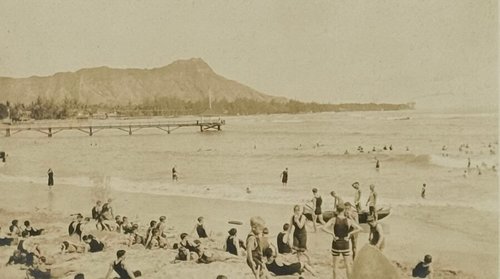
The diary closely follows “California’s” voyage, starting with her stay in Honolulu (January 1-4). Four extensive entries record Ames’ taking part in a “native feast” in Waimea Valley in the company of members of Hawaiian Royal family “Mrs. Dominis” (Lili’uokalani, the last sovereign of the Hawaiian Kingdom) and “Mrs. Cleghorn” (princess Likelike, the wife of Archibald Cleghorn, future member of the Hawaiian Privy Council and governor of Oahu), King Kamehameha V, Queen Emma and their retinue visiting “California,” Ames’ remarks on the poor health of the king, the beauty of Queen Emma, “Colonel Kalakaua” (David Kalakaua, the last king of Hawaii in 1874-1891) drinking “several bottles of Californian champaign,” Hawaiians being “the most romantic in their ways of any people,” &c.
A short stop at the Island of “Rimetera” on January 23-25 (Rimatara, Austral group of French Polynesia) resulted in “California” sending mail to San Francisco with the schooner “Henriette” and “His serene Majesty Tamaeva III, autocrat of Rimetera” visiting the ship. “His Majesty had never seen a ship as fine as ours and was therefore much pleased with his visit. <…> His garb consisted of a felt hat, a stripped calico shirt and a blue and white cloth wrapped around his body, not falling quite to the knees.”
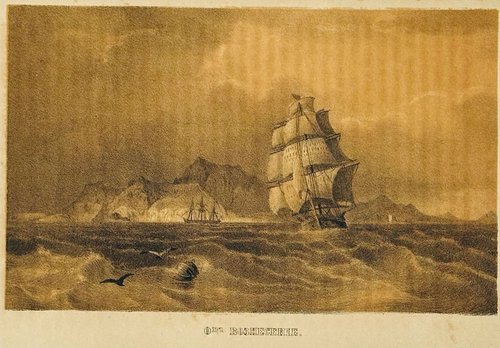
After a month-long voyage, “California” briefly stopped at Juan Fernandez Island (February 23-25), where Ames and other crew members went fishing, hunting wild goats and hiking “the hills towards the ‘Anvil’ (the highest peak on the island which resembles very much a block with anvil).”
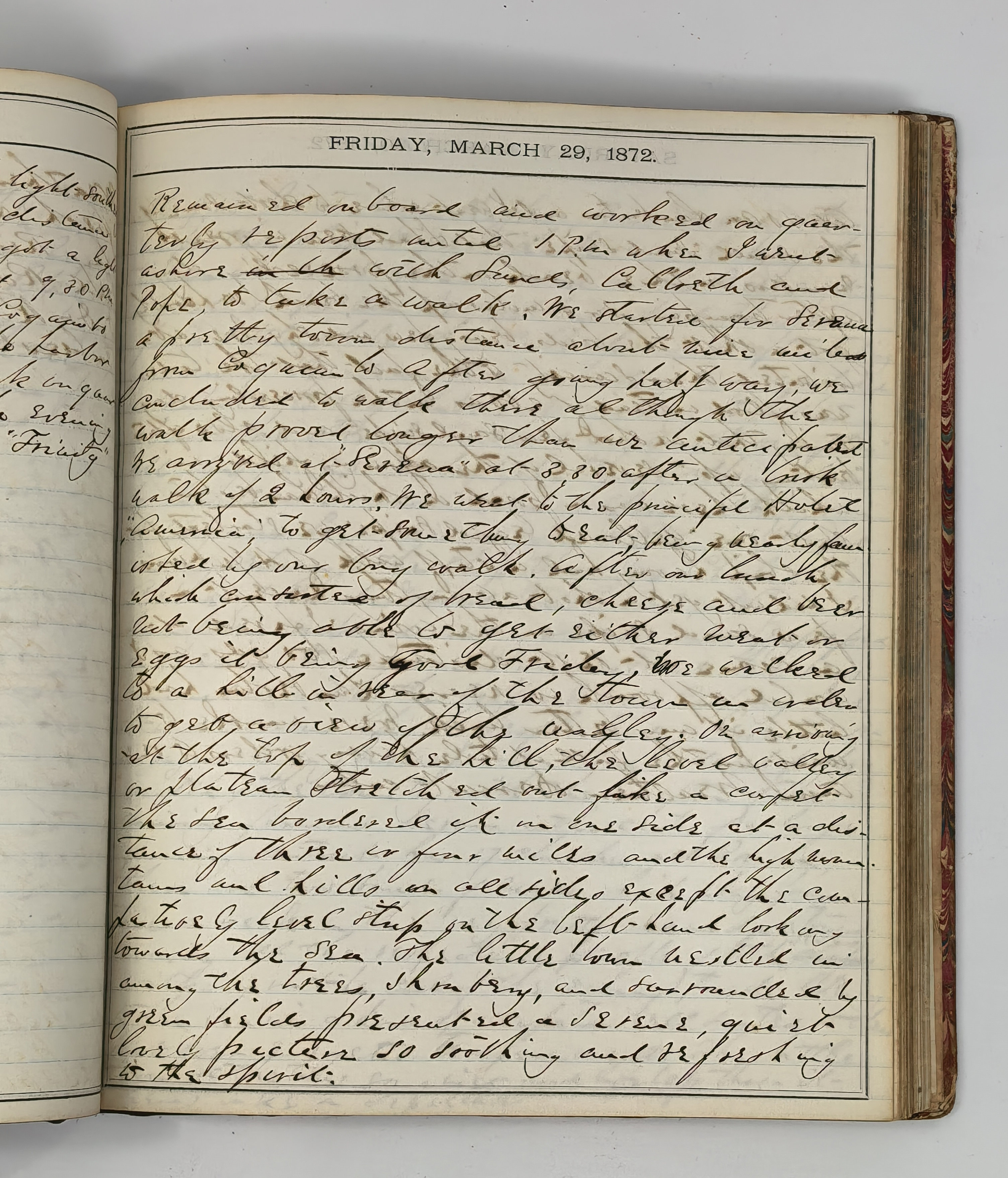
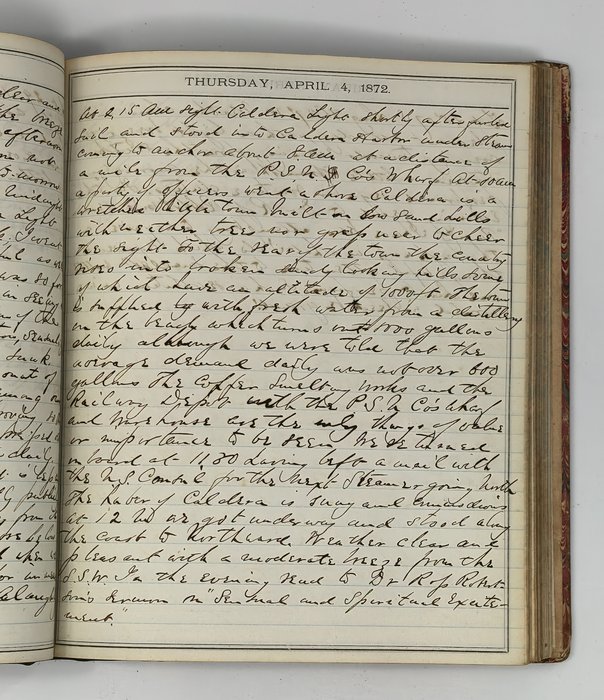
The other stops included almost a month-long layover in Valparaiso (February 29 – March 25), calls in the Chilean Coquimbo (March 28-31), Caldera (April 1) and Arica (April 10-11), the entry about the latter contains a valuable observation of the city destruction during the 1868 Arica earthquake and tsunami. Then follow the calls in Callao-Lima (April 17 – May 3) and almost a three-month stay in the Panama Bay (May 16 – September 9). During the return voyage, “California” cruised around the Galapagos Islands (September 30 – October 4, with notes about the islands’ relief and settlements), passed the Clarion Island belonging to Mexico (October 19) and arrived in San Francisco on November 13.
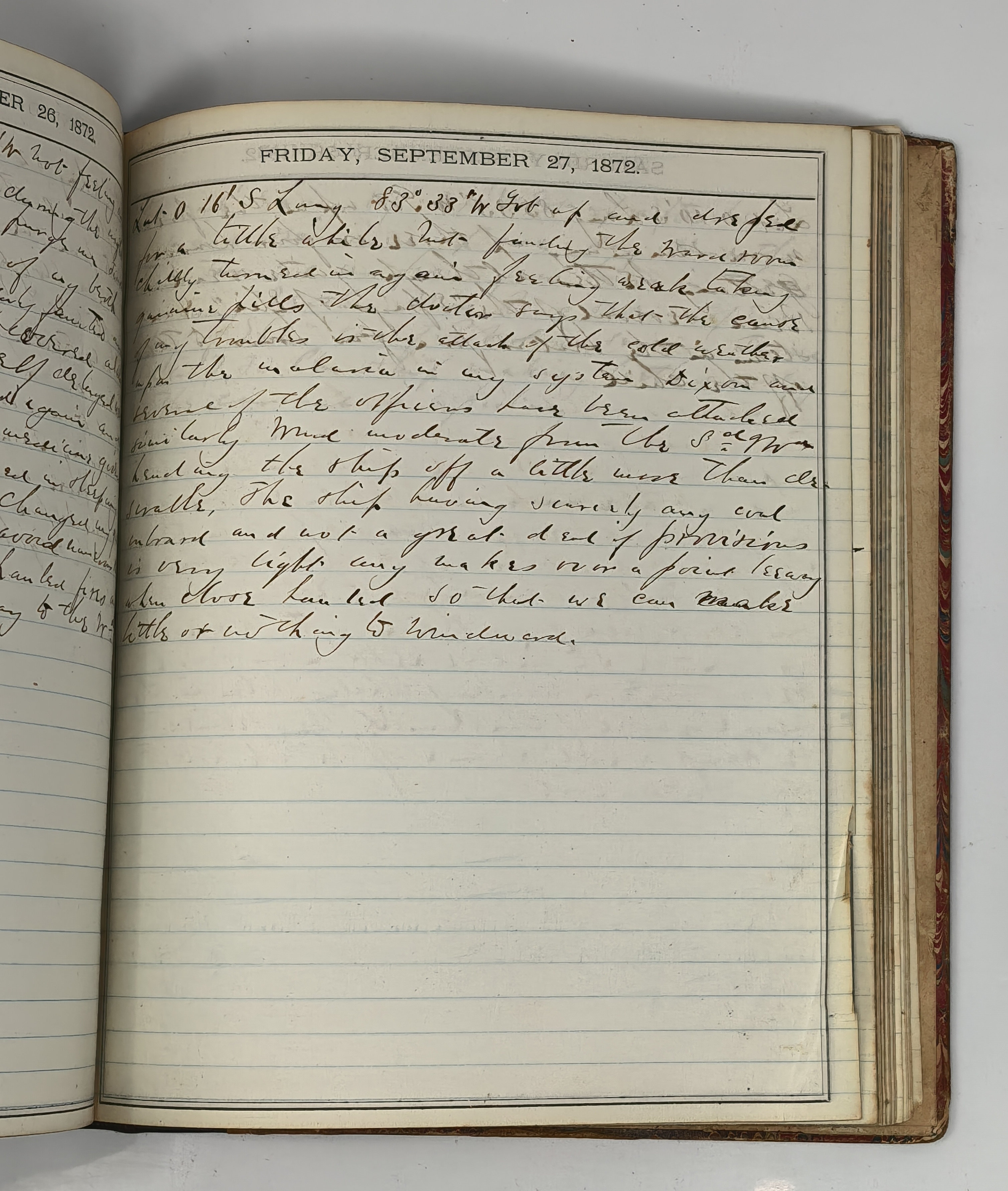
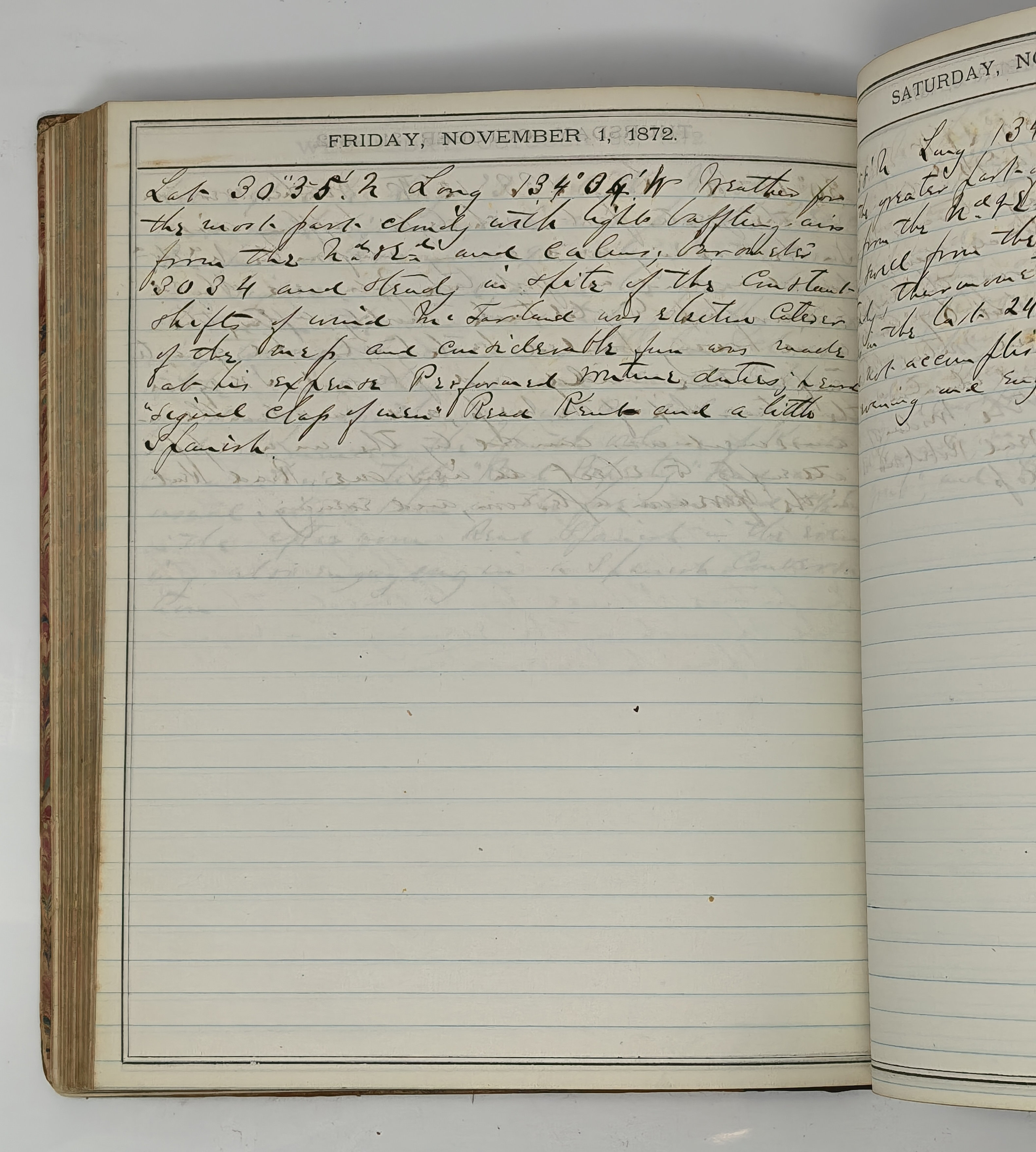
The diary meticulously documents the “California’s” voyage day by day, recording her geographical position, weather, winds, currents, geographical objects passed, marine fauna encountered, operations with sails, endured storms and squalls, barometer readings, divine services on Sundays, names of encountered ships and sometimes of their captains, official receptions, visits by state leaders and government officials, the ship not being in good shape and sundry repair works on board, &c. A large part of text is occupied with the author’s impressions and observations of the people and places he saw, personal notes on the books he read, studies of Spanish, continuous reflections on his Chistian faith, frequent notes on him being “much depressed in spirit” (January 17 and others) and numerous thoughts on resignation from the navy, which he finally applied for on December 13.
Overall, an overwhelmingly content-rich, well-written original diary, showing Hawaii, the Eastern Pacific and the South and Central American coast as seen by a young U.S. naval officer in the early 1870s.
Excerpts from the diary:
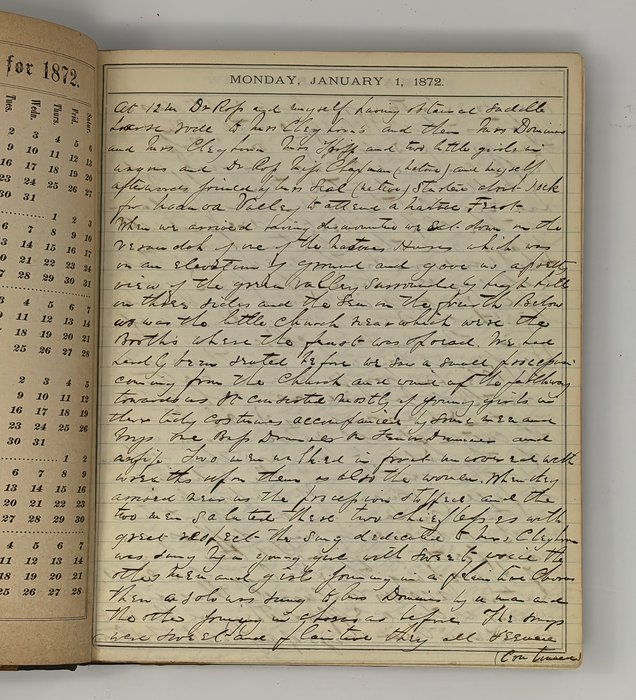
Monday, January 1.
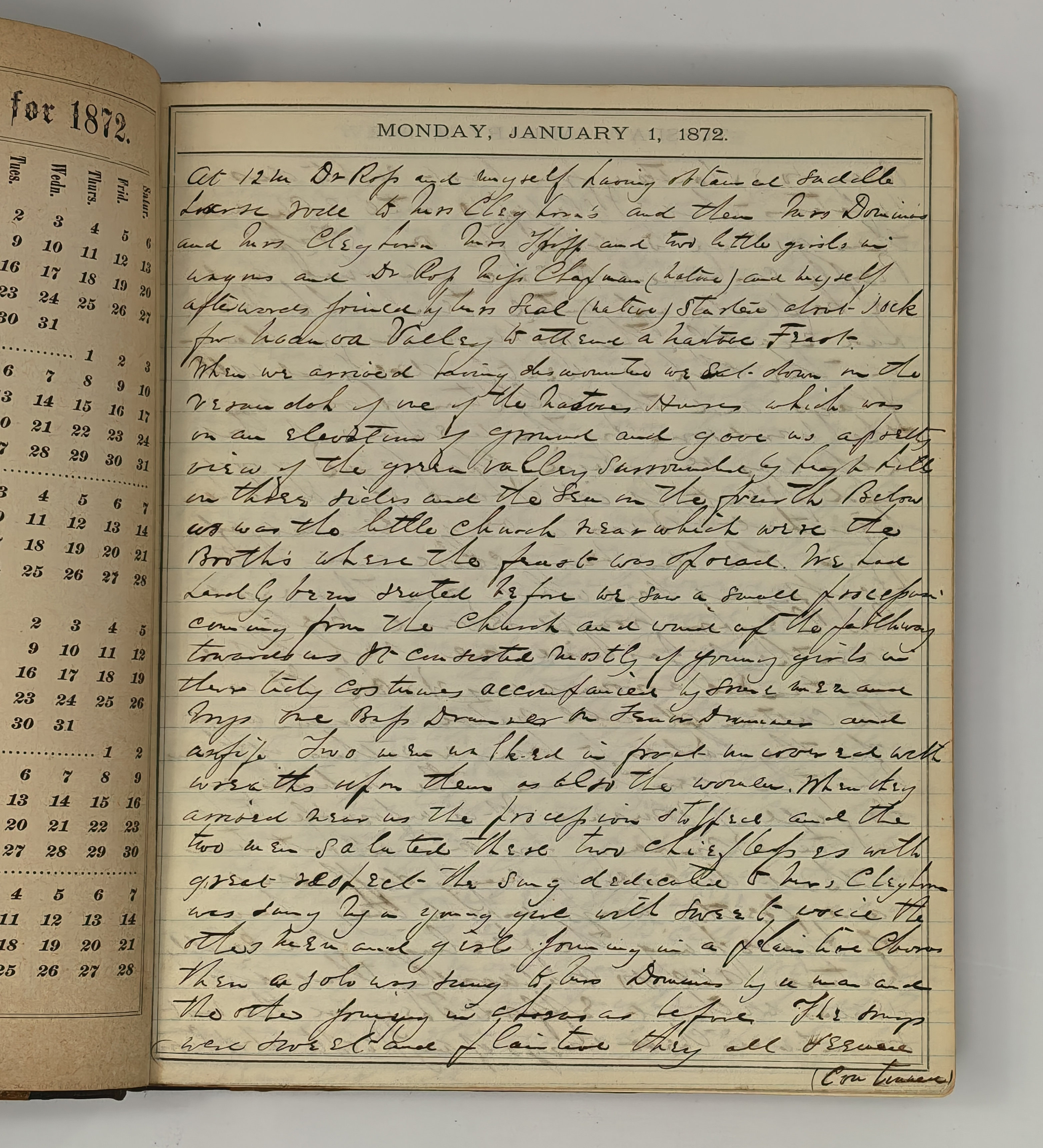
At 12 am Dr. Ross [J.W. Ross, Assistant surgeon on U.S.S. California] and myself having obtained saddle horse rode to Mrs. Cleghorn’s and then Mrs. Dominis, Mrs. Cleghorn, Mrs. [?] and two little girls in wagons and Dr. Ross, Miss [Chapman?] (native) and myself afterwards joined by Mrs. [Seal?] (native) started about 1 o’clk for [Waimea?] Valley to attend a native feast.
When we arrived having [dismounted?] we sat down in the verandah of one of the native houses which was on an elevation of ground and gave us a pretty view of the green valley surrounded by high hills on three sides and the sea in the fourth. Below us was the little church near which were the booths where the feast was [spread?]. We have hardly been seated before we saw a small procession coming from the church and wind up the pathway towards us. It consisted mostly of young girls in their tidy costumes accompanied by some men and boys <…>. Two men walked in front [were?] covered with wreaths upon them as also the women. When they arrived near us the procession stopped and the two men saluted these two chiefess with great respect. The song dedicated to Mrs. Cleghorn was sung by a young girl with sweet voice, the other men and girls joining in a plaintive chorus. Then a solo was sung to Mrs. Dominis by a man and the others joining in chorus as before. The songs were sweet and plaintive <…>.
Tuesday, January 2.
Being so exhausted from last night’s dissipation that I slept from 10 until 3 pm and then got up to dress for our “[…?].” People commenced to come at five and we kept it up until ten o’clk. We had exactly the right number for [dancing?], the ship was neatly dressed with flags and the collation given in the wardroom <…> was very nice champagne, good and plenty of it. I have reason to believe that it was a very pleasant affair. <…> Mrs. Cleghorn brought several pretty wreaths of jasmine, one of which she fastened around my neck. It is the custom of all native entertainments for the ladies to bring wreaths of flowers for the gentlemen. The natives are so full of romance. It is impossible to be in their company for only short time without discovering many different and pretty ways which they have of expressing the feelings of a kindly nature, all so naturally that it issues without effort. They are the most romantic in their ways of any people out of story.
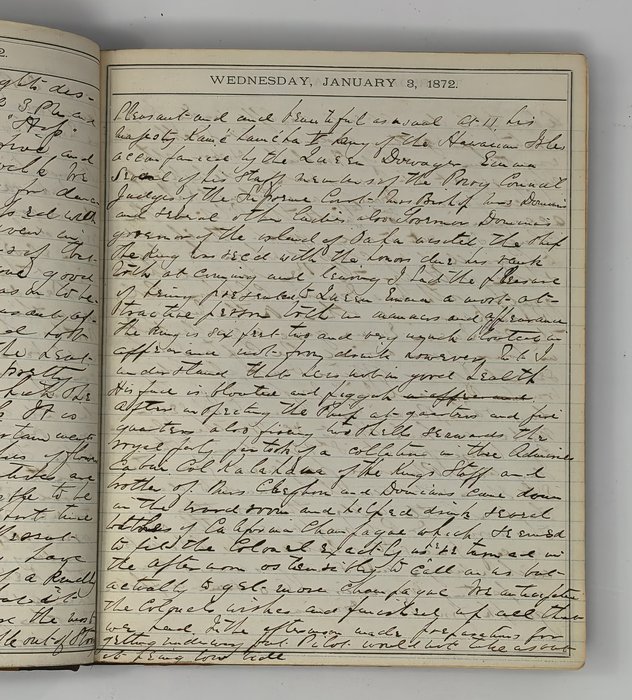
Wednesday, January 3.
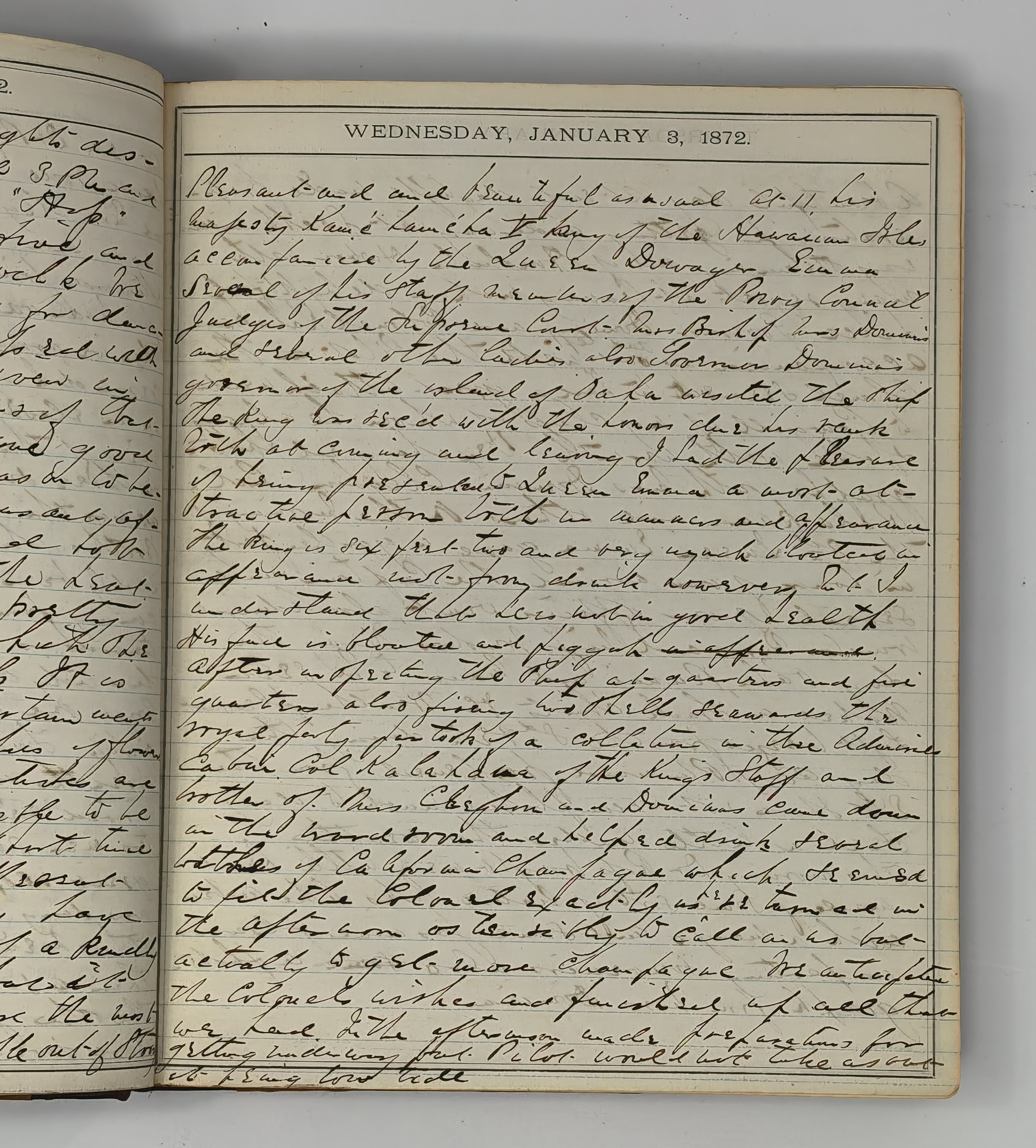
Pleasant and beautiful as usual. At 11 His Majesty Kamehameha V, King of the Hawaiian Isles, accompanied by the Queen Dowager Emma, several of his staff, members of the Privy Council, judges of the Supreme Court, Mrs. Bishop, Mrs. Dominis and several other ladies, also […?] Dominis, Governor of the island of Oahu, visited the ship. The kind was [received?] with the honor due to his rank. <…> I had the pleasure of being presented to Queen Emma, a most attractive person both in manners and appearance. The king is six feet two and very bloated in appearance, not from drink however but I understand that he is not in good health. <…> After inspecting the ship at quarters and fire quarters, also firing two shells seaward, the royal party partook in a collation in the Admiral’s cabin. Col. Kalakaua of the King’s Staff and brother of Mrs. Cleghorn and Dominis came down in the wardroom and helped drink several bottles of California champagne which seemed to fill the Colonel exactly as he estimated in the afternoon ostensibly to call […?] but actually to get more champagne. We anticipated the Colonel’s wishes and furnished up all that we had. In the afternoon made preparations for getting underway but pilot would not take us out, it being low tide.
Thursday, January 4.
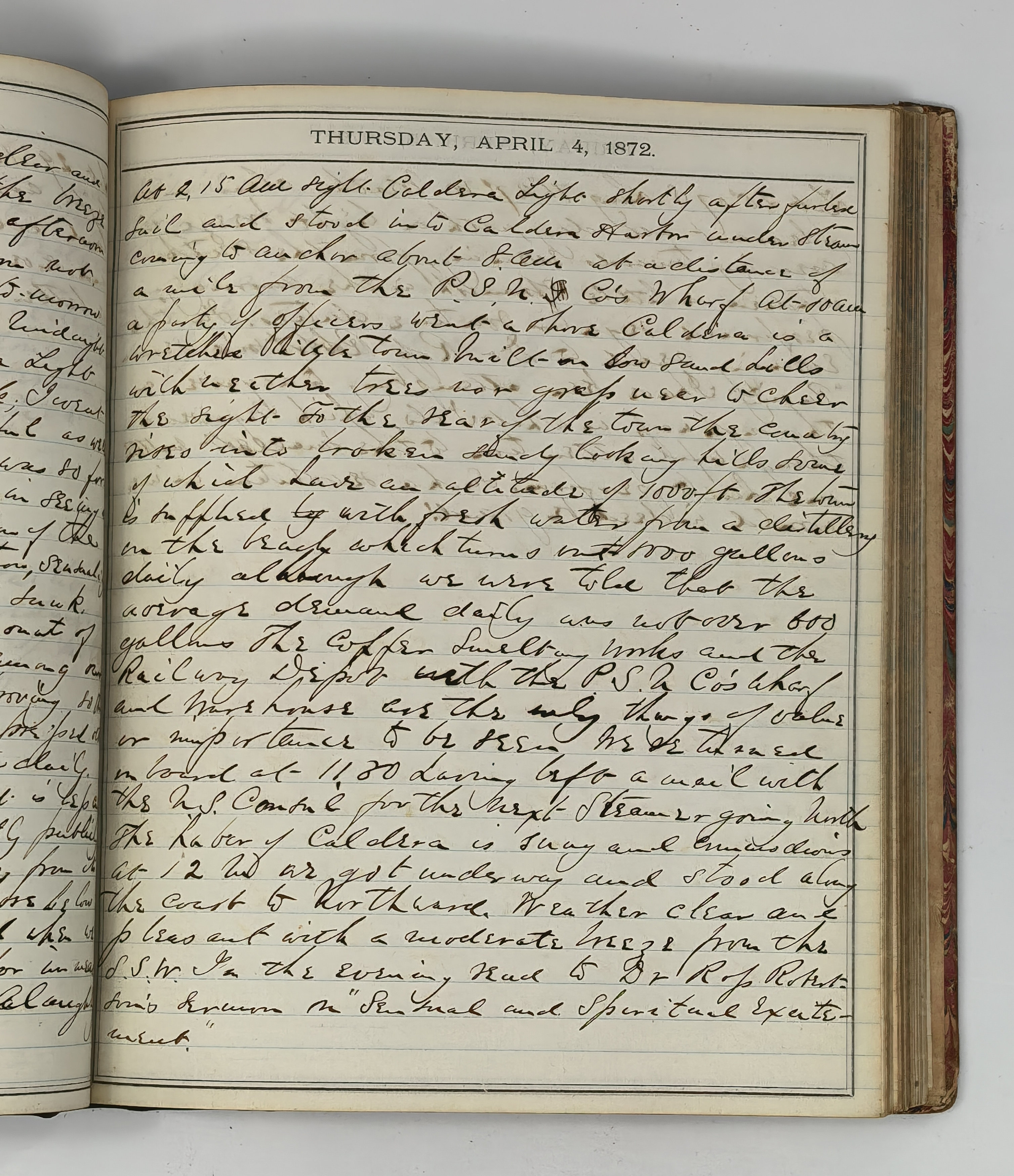
A beautiful day. At early daylight made preparations for getting underway. At 8 o’clk underway steaming out of Honolulu harbor with many regrets at leaving such a delightful place. Governor Dominis and Colonel Kalakaua accompanied us out and left with the pilot. The Colonel seemed to have a great attachment to Cowgill of my class of whom he always spoke with warmth. I exchanged photographs with Mrs. Dominis, Cleghorn, Col. Kalakaua and others. On the morning of the 3rd Queen Emma gave a garden party in honor of our arrival. The Captain and several of our officers went, also Admiral Winslow, Mrs. and Miss Winslow. During the day Oahu, Kauai and Maui to be seen. Worked on trade charts &c. <…> Have not accomplished much today, feel a little under the weather. This morning Dr. Ross brough me a little heart made of some sort of native looks like amber with a mango and some jasmine flowers as parting souvenirs, also a photograph from Mrs. Dominis.
January 27. “<…> Miss Mary [Admiral Winslow’s daughter] brough out the little parroquette which I had presented to her. The little bird appeared not to be in the best of spirits. He seemed to have a singular attachment for me, constantly leaving Miss Mary and perching upon my shoulder. I suddenly remembered that my jacket was impregnated with the fragrance of his native flowers which the little bird recognized and instinctively longed to be among again…”
February 22.
“<…> Mas a Tierra seems to be a great rock rising abruptly from the sea, the greatest altitude is about 2500 ft., the outline not being rugged but running nearly parallel with its water line. Weather rainy and unsettled all day and night. Wind unsteady in force and direction. Our being leeward of these islands, seems to point perhaps towards the unsettledness of the weather. It has been generally remarked by writers what a wonderful and powerful disturbing effect the low Polynesian Islands have upon the trade winds in that quarter.”
April 1.
<…> Talked with Dr. Ross on the narrowing tendency of naval life if one fairly surrender himself to its influences, this is partially true of all professions but especially so I think of military. It seems to cultivate the custom at the expense of individuality.
April 10. <…> Today my birthday; having reached the age of 23 years.
April 11. <…> The town [Arica] which before the earthquake contained twelve thousand inhabitants now only contains two or three. The houses are mostly miserable shanties, many of them patched up and partly repaired since the earthquake of 1868, but by far the greater part of the town lies in ruins. The old church shows more strikingly the effects of the earthquake than any other building I saw. It must have been a solid and good-sized edifice, but all that remained of this […?] structure were a few of its solid arches which were shattered <…> like a tree struck by lightning…