
#NY004
1853
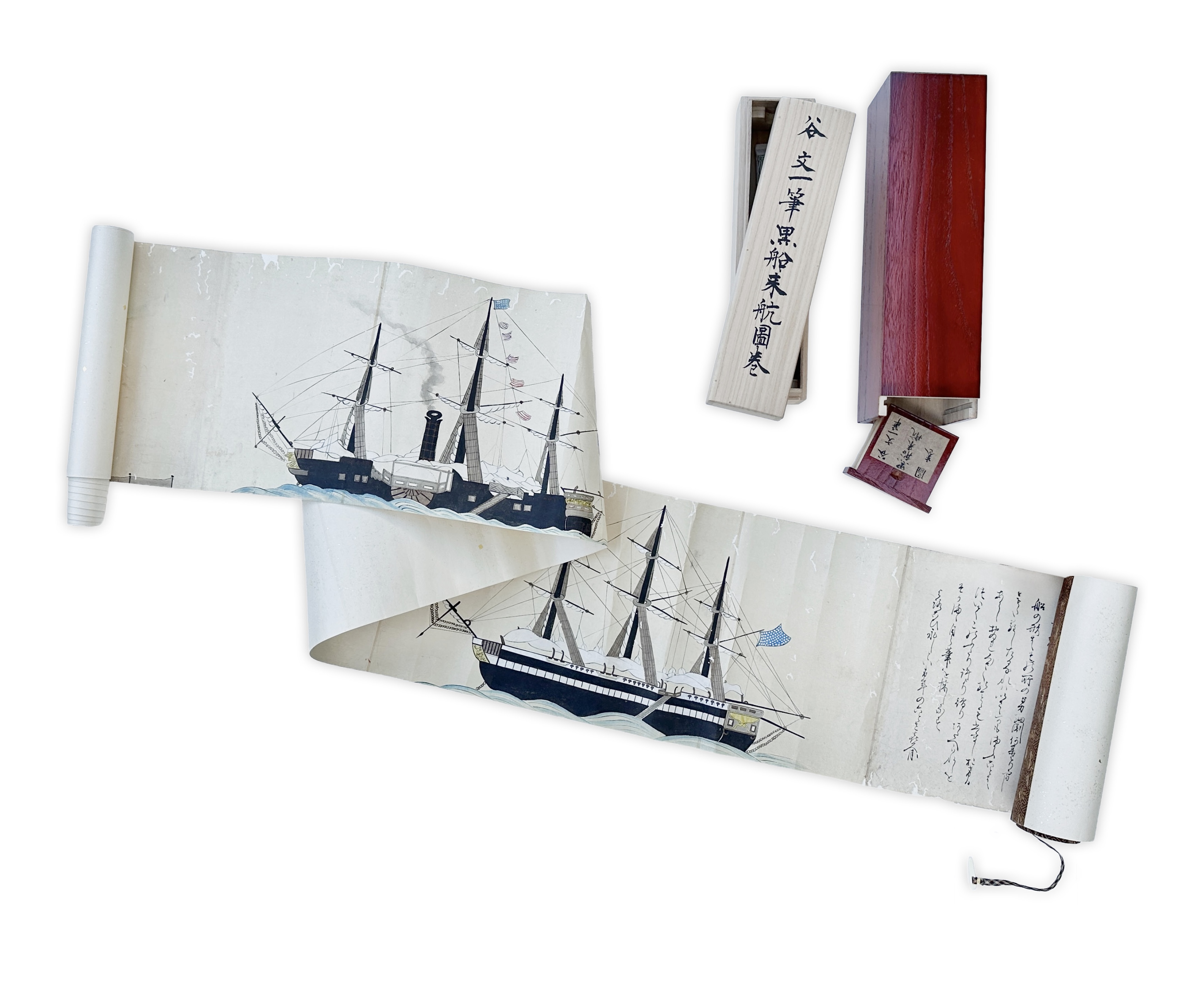
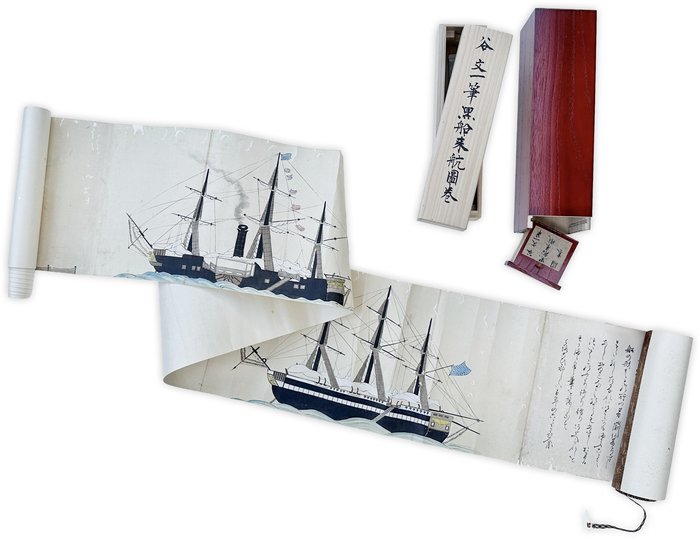
One handscroll (emakimono), 27 × 483 cm. Colored manuscript on paper. Overall condition: very good to near fine, considering age and the extent of historical damage and restoration. Few wormholes masterfully restored and backed with paper. Gold-patterned mounting, most likely executed in the second half of the twentieth century, comes together with a later silk brocade binding, presumably dating from the same restoration campaign. The scroll is paginated, with several leaves now missing: presumably pages 1–6; it begins with an unpaginated introductory section, followed by the main sequence starting from page 7. It is housed in two custom-made signed wooden kiribakko and one paper box, accompanied by a protective paper wrapper and a separate descriptive sheet.
This handscroll records Commodore Perry’s arrival in Japanese waters through a continuous narrative sequence unfolding across multiple sections.
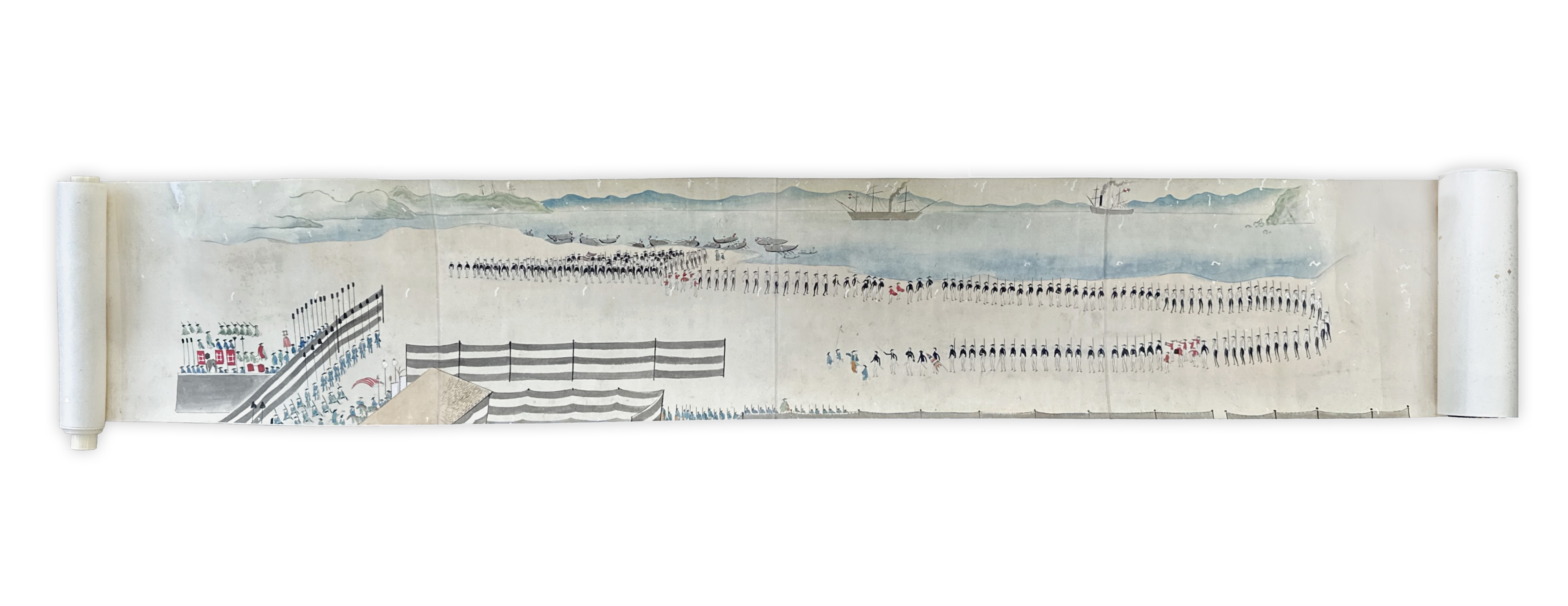
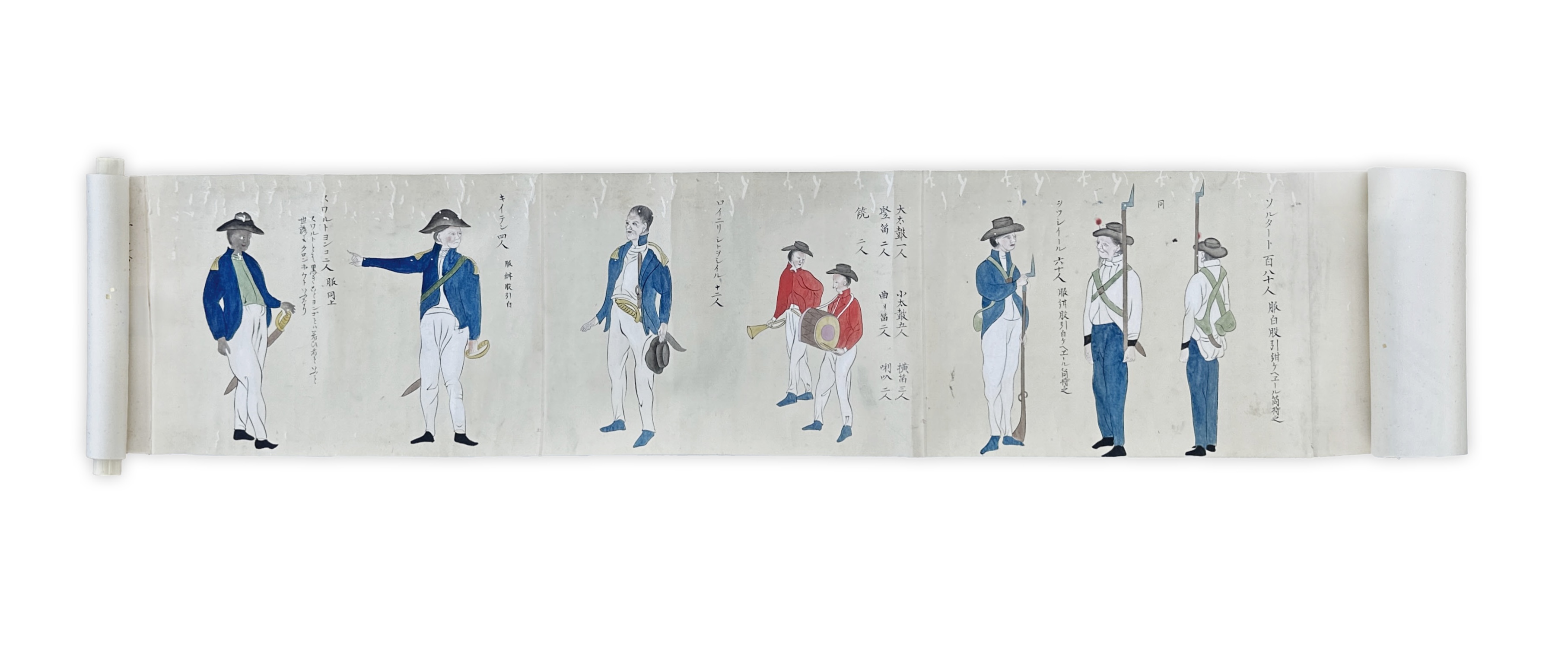
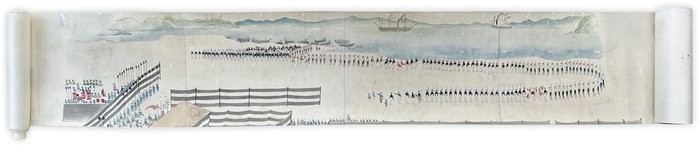
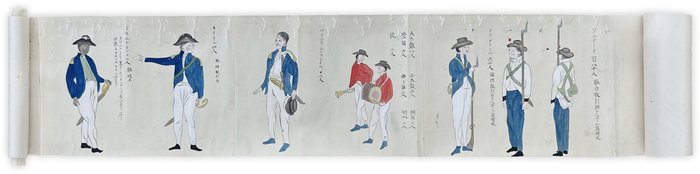
The opening panels present detailed costume studies of foreign officers and sailors, identifying ranks, uniforms, weapons, and musical instruments, functioning almost as a visual ethnography of the Western “barbarians.” These analytical sheets prepare the viewer for the central panoramic scenes, in which long files of foreign troops disembark, assemble, and march along the shoreline under Japanese surveillance.
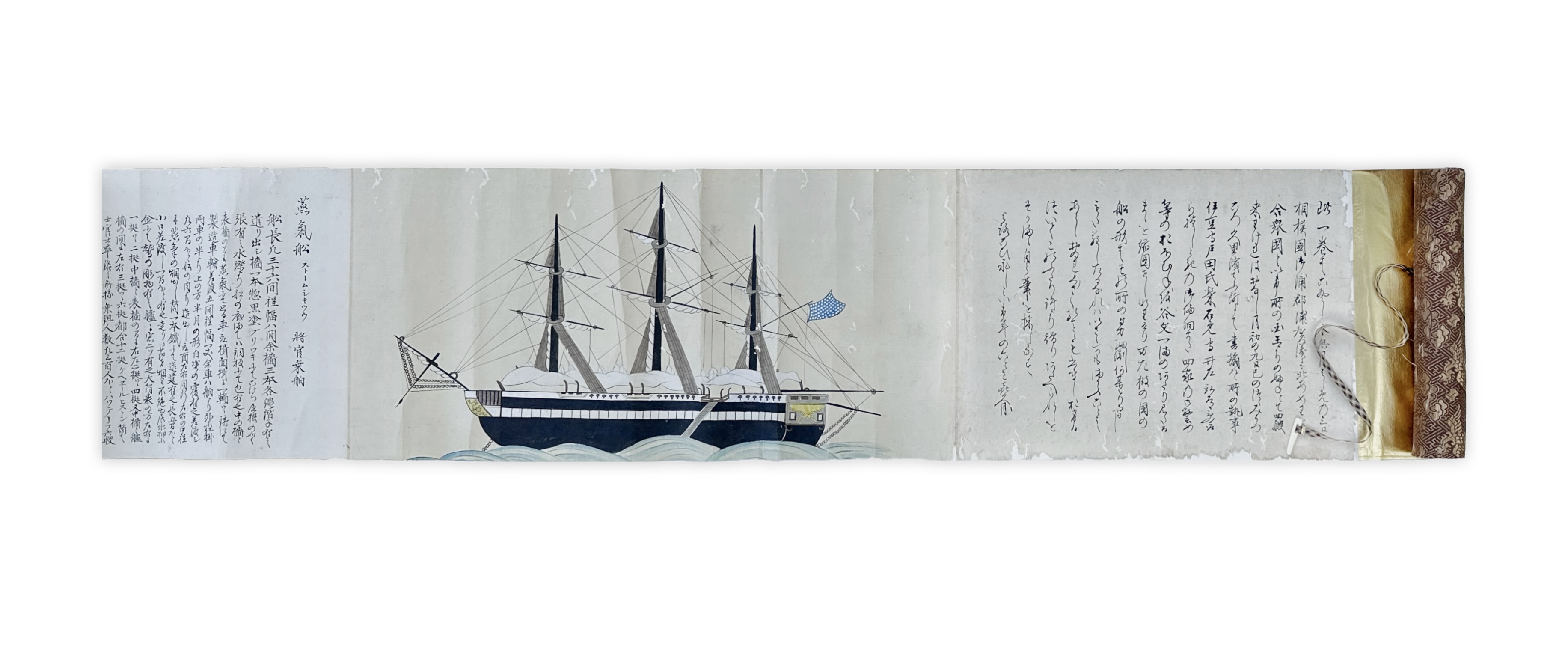
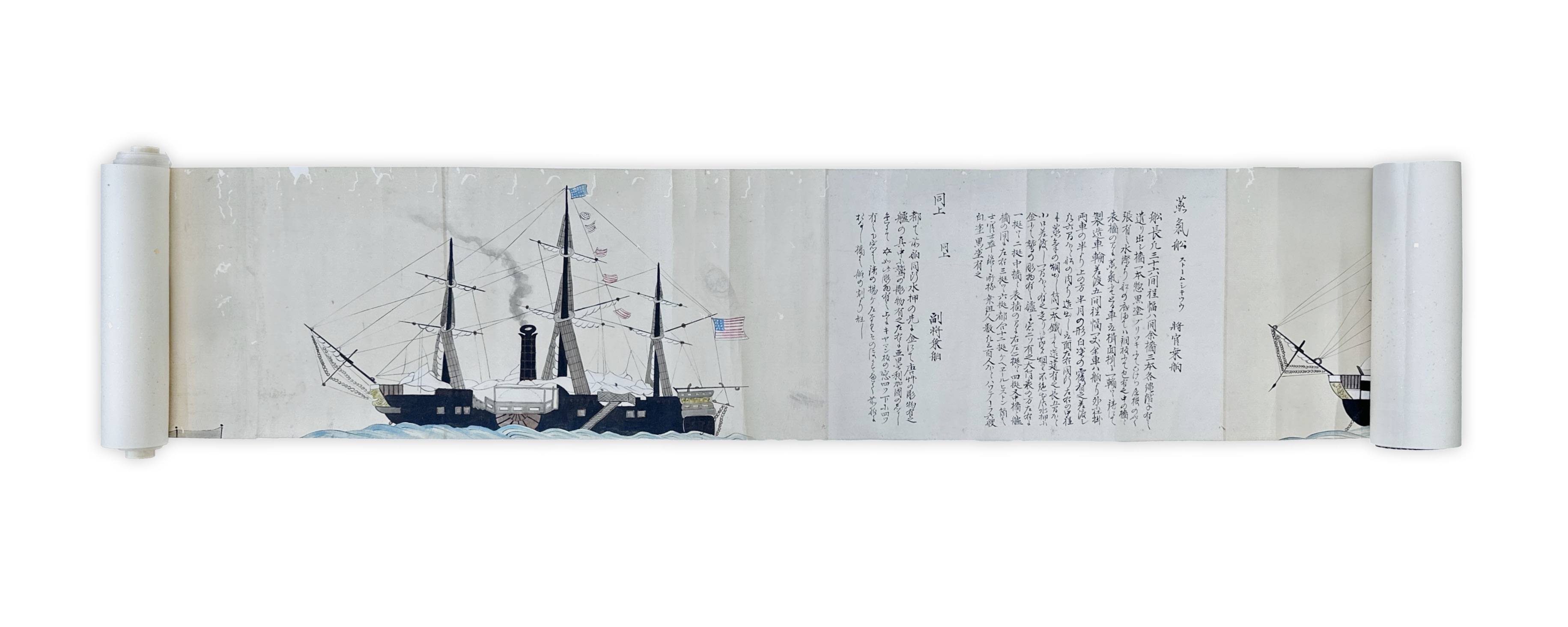
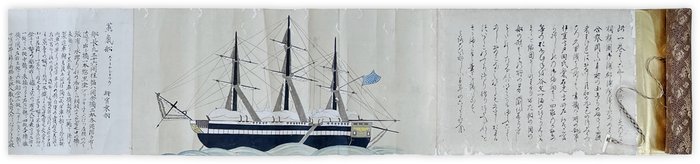
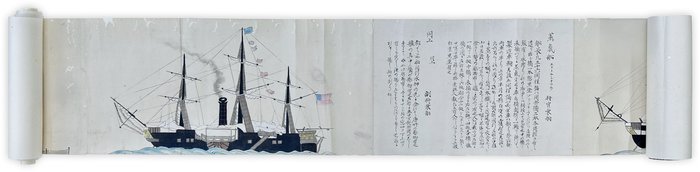
The core of the scroll is dominated by wide coastal views animated by the rhythmic repetition of marching figures, signal flags, musicians, and guards, culminating in a dramatic rendering of the Black Ships themselves. The steam-driven warship, with its towering masts, smoke-belching funnel, paddle wheels, and prominently displayed American flags, is shown as a technological and symbolic rupture — a floating embodiment of the new global order intruding into Tokugawa Japan.
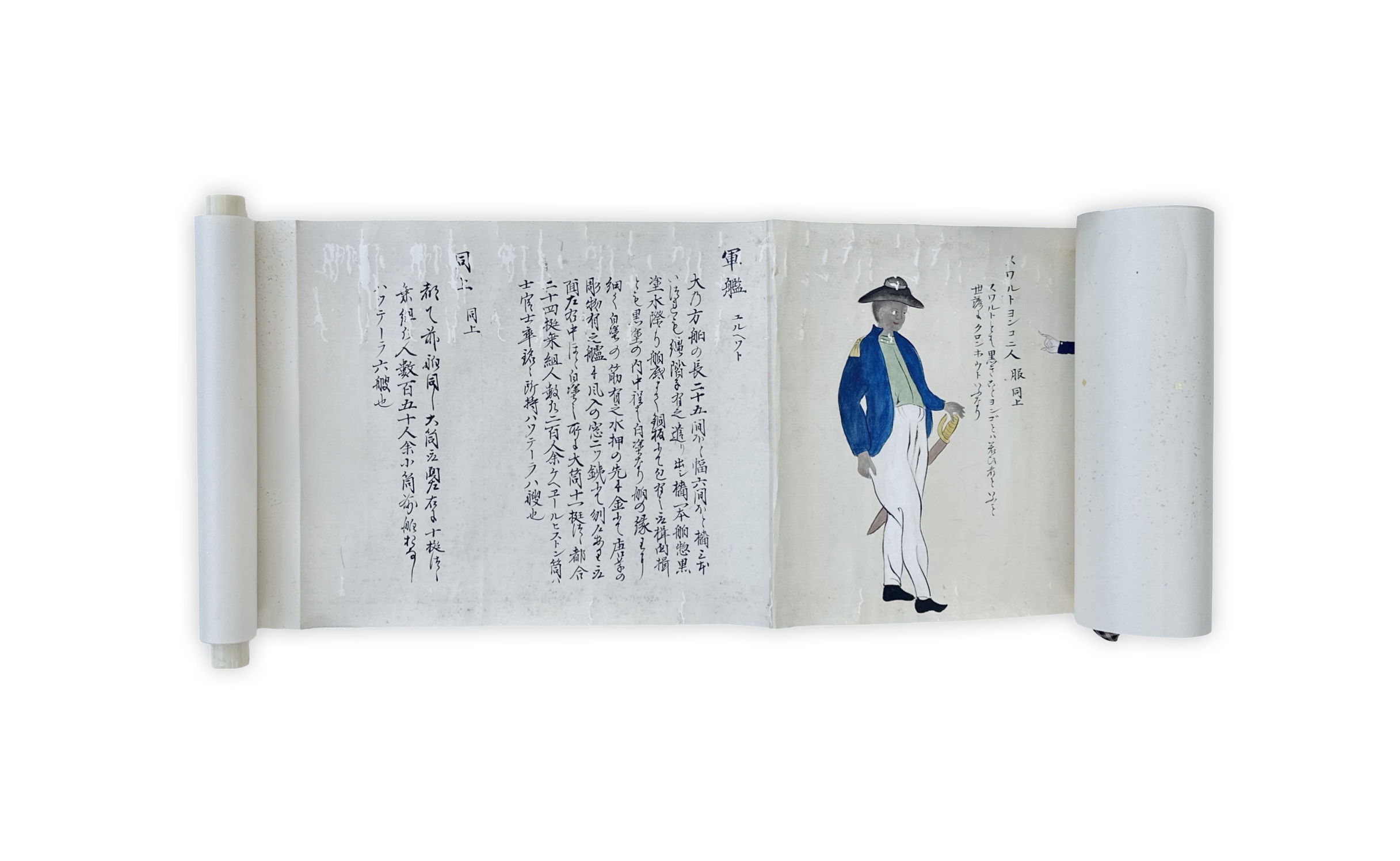
The final sections consist of dense manuscript commentary explaining the scene in detail, including measurements of the vessels, numbers of crew, armaments, colours of hulls and fittings, and notes on the protocol of the landing. The scroll thus oscillates between image and text, spectacle and documentation, revealing the Bakumatsu impulse to transform an unprecedented political shock into an ordered archive of visual knowledge.
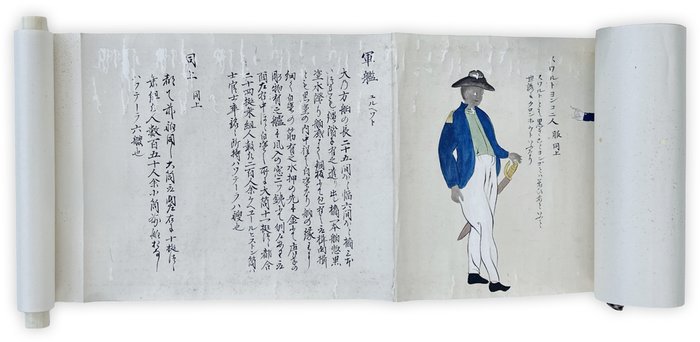
Particularly striking is the inclusion of a portrait of a Black officer serving in Perry’s crew — a rare and powerful visual record that testifies to the presence of African Americans in the U.S. expedition. His figure is annotated “スアルトヨンコ二人” [i.e. steward yunker two man], but is depicted with full officer attributes — epaulettes, sabre, and command posture — clearly distinguishing him from servants or cabin boys. This challenges both contemporary American racial hierarchies and later historiography, making the scroll a uniquely radical document of cross-cultural perception at the moment of Japan’s forced opening.
According to the accompanying manuscript, the events depicted in the scroll took place in Uraga Port in Miura County, Sagami Province, where on 3 June 1853 (Ka’ei 6, 6th month, 3rd day) four ships of the United States fleet entered Japanese waters. The American landing was permitted at Kurihama on the 9th day at the Hour of the Snake (ca. 9:00 a.m.), when the letter of sovereignty from President Fillmore was formally received. The negotiations were conducted by the Uraga magistrates Toda Izunokami Ujiei and Ido Iwaminokami Hiromichi, while security was provided by the “four houses”: Aizu (Hoshina-Matsudaira), Oshi (Okudaira-Matsudaira), Hikone (Ii), and Kawagoe (Echizen-Matsudaira), with approximately 130 samurai from the Ōgaki domain acting as guards. The manuscript further notes that the shapes of the vessels were copied from information supplied by a police officer named Hosobuchi, and that the scroll was completed and inscribed in September 1853, only months after the historical events it records.
Executed by Tani Bun’ichi, heir to the documentary and encyclopaedic ethos of his adoptive father Tani Bunchō, this Kurofune raikō zu-maki belongs to a small corpus of semi-eyewitness visual records that circulated privately among samurai, scholars, and urban intellectuals in the 1850s. It is not a mere illustration of a historical episode but an attempt to comprehend historical rupture itself: Japan’s forced opening to the West translated into the continuous pictorial language of the emakimono.
As such, the scroll stands as a rare and highly evocative artefact of the moment when Edo-period visual culture confronted the modern world.