
#NY005
Ca. 1853-1860
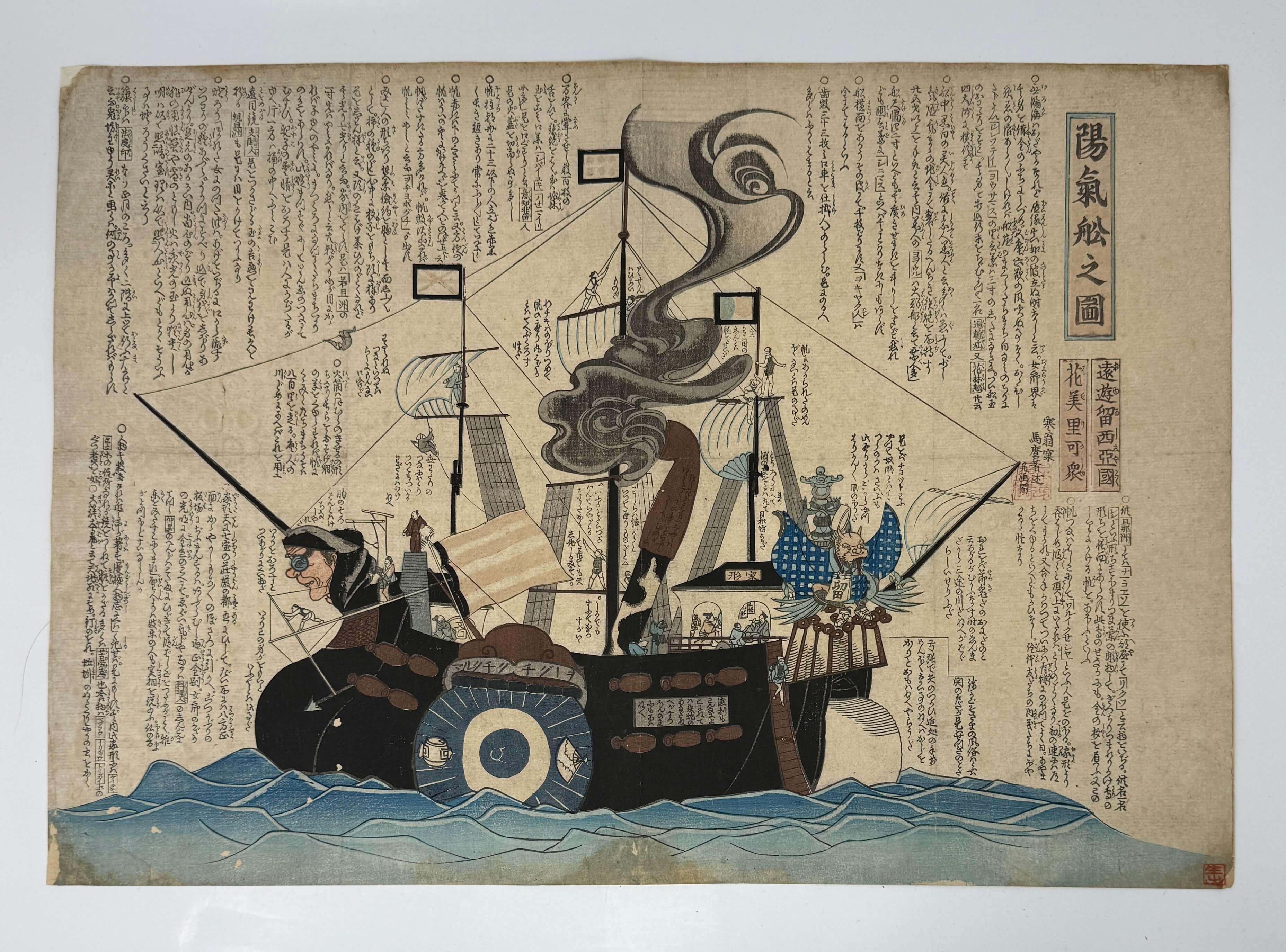
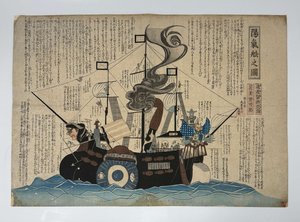
1 sheet. 35,7×50,5 cm. Polychrome woodblock print. Backed on paper. Few losses to the corners. The lower edge has a dark oily stain. Two red ex-ownership stamps. Several minor worm tears, repaired. Very good condition.
In 1853 Commodore Matthew Perry arrived in Japan with a squadron of American warships, forcing the Tokugawa shogunate to open negotiations with the United States. These unfamiliar steam-powered vessels, emitting thick black smoke from their funnels, quickly became known in Japan as the “Black Ships” (kurofune, 黒船). Their dramatic arrival provoked a wave of popular visual responses, including satirical and explanatory prints depicting Western ships and the social upheaval they represented. Many of these images circulated as kawaraban broadsheets—cheaply produced woodblock-printed news sheets sold on the streets and often read aloud by vendors—most of which were printed quickly and in monochrome to satisfy public curiosity about foreign technology and political change.
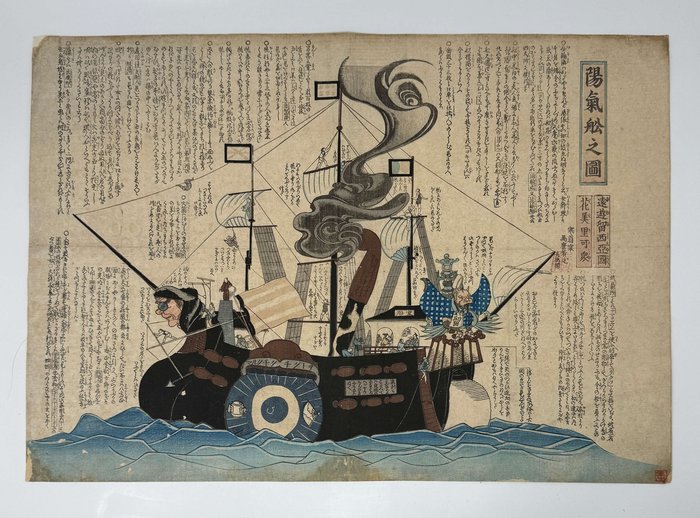
The present sheet is unusual and extremely rare: instead of portraying a realistic vessel, it presents a humorous allegorical parody in which the ship becomes a fantastical, almost yōkai-like craft filled with symbolic figures and scenes. The inscriptions on the sheet employ playful ateji and comic pseudonyms typical of satirical kawaraban. The line 遠遊留西亜国 花美里可衆 is not a literal place or publisher but a humorous, pseudo-Chinese expression: 遠遊留西亜国 [Enyū Ryūsei-a koku] refers to the distant land of Russia, while 花美里可衆 [A-me-ri-ka], an ateji rendering of America, alludes to the people of Japan, playfully juxtaposing foreign powers and the domestic audience. Likewise, the signature 寒翁窠馬曆著画 [illustrated by Kan-ō Kamareki] appears to be a fictitious artist’s name rather than a documented individual, constructed in the style of joking pen names often used in popular satire. The imagery reinforces this layered parody. At the bow sits a caricature of Commodore Perry, while at the stern appears a winged yōkai-like Russian eagle, suggesting rival foreign forces surrounding Japan. The ship itself is assembled from fragments of Japanese culture: coins, stone shrine lanterns, teahouses, a paper lantern serving as the keel, ceramic bottles replacing cannons, and sailors portrayed as kabuki actors. Even the smokestack becomes a giant kiseru (smoking pipe), completing this fantastical vessel. Such deliberately playful and densely symbolic compositions were characteristic of political caricatures of the Bakumatsu period, using humor and visual allegory to comment on the disruptive arrival of Western powers.