
#MD82c
1865
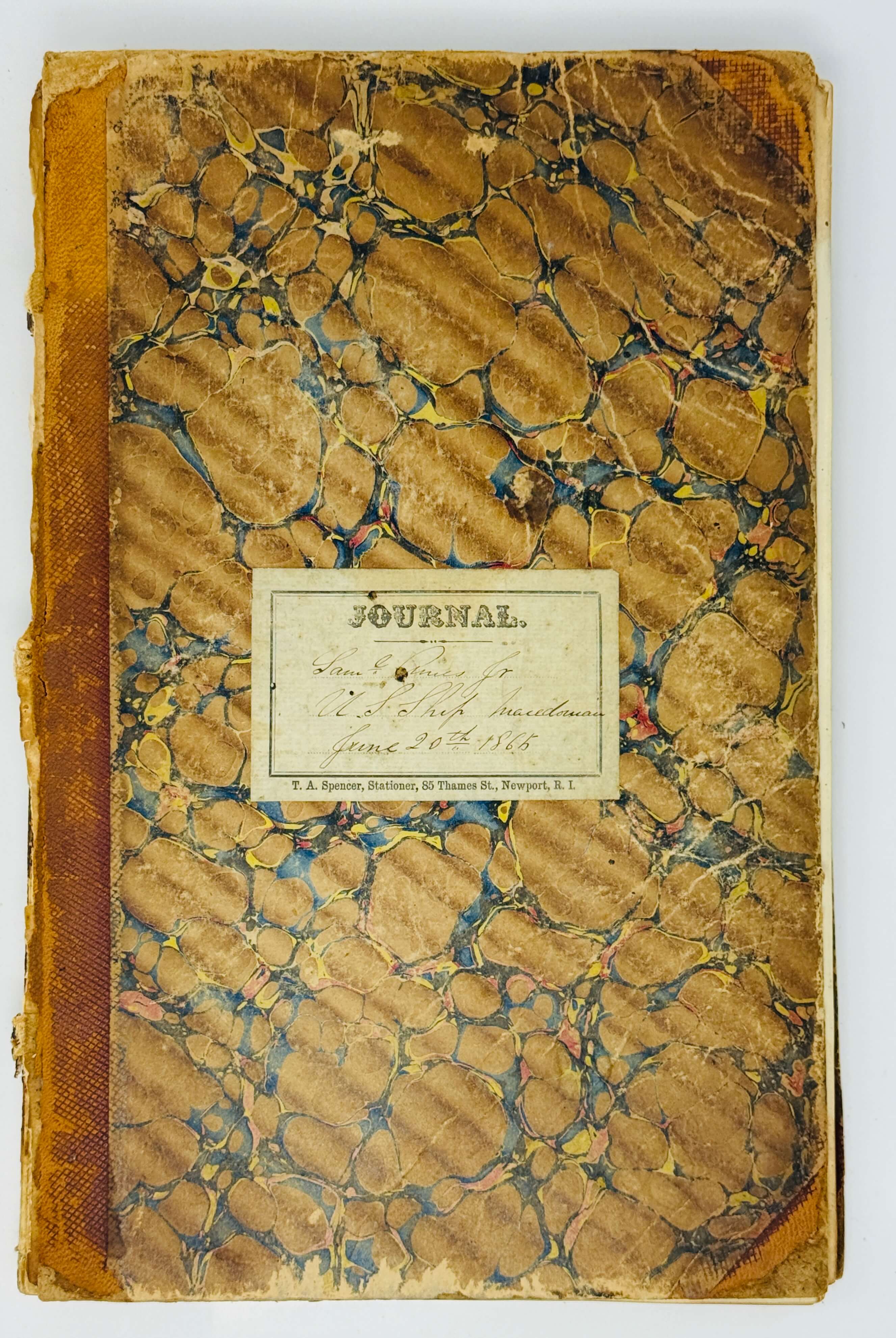
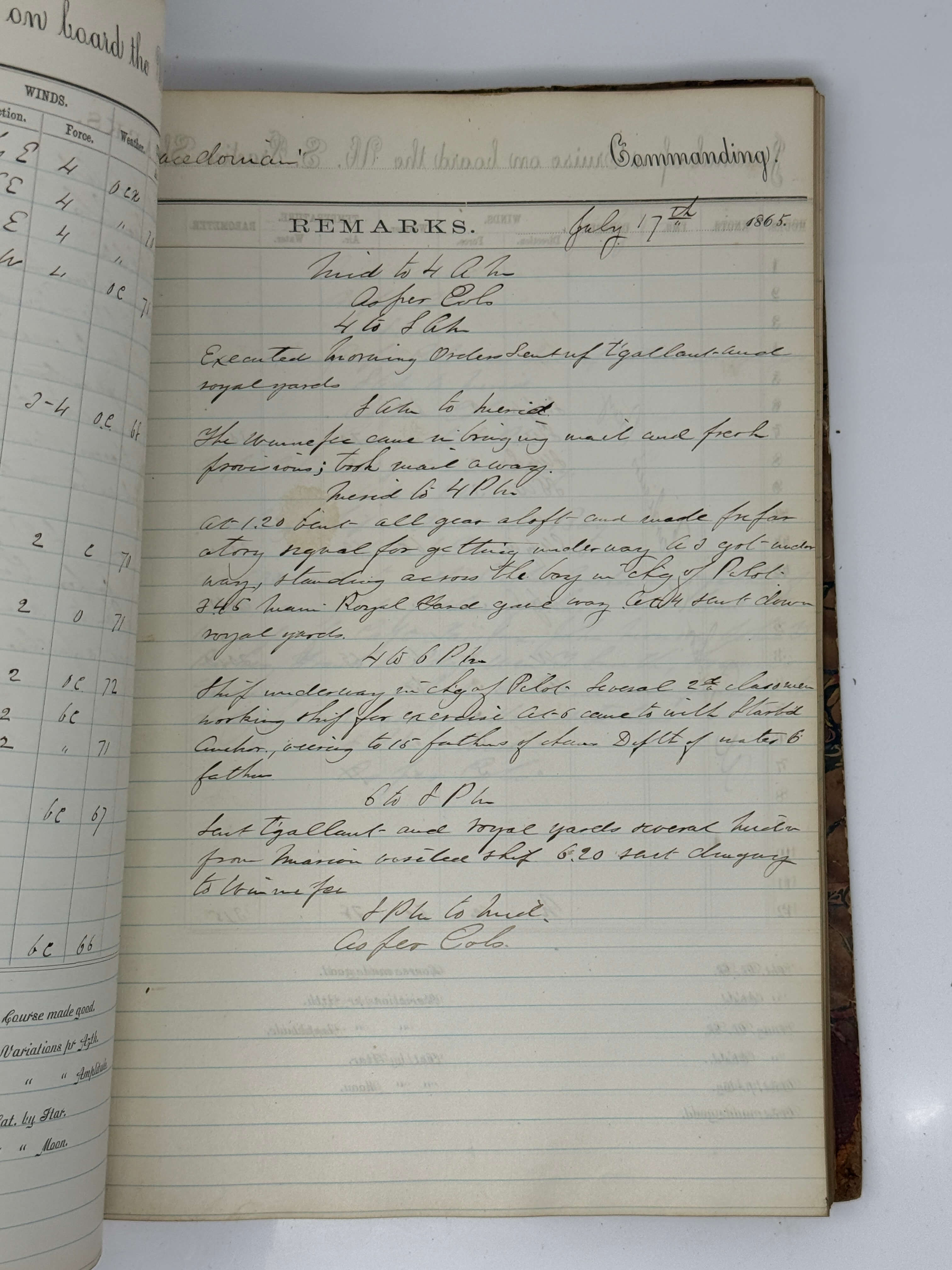
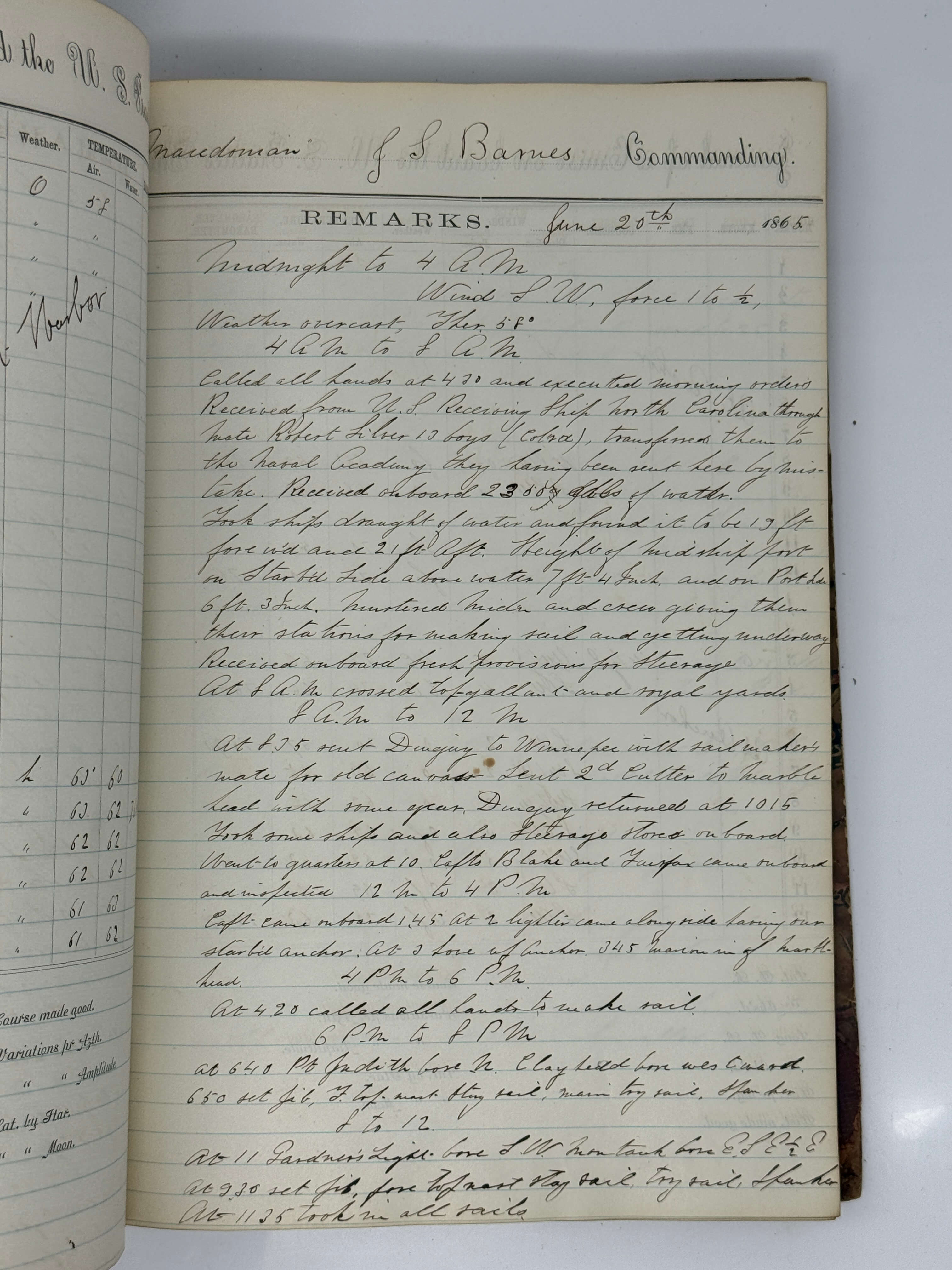
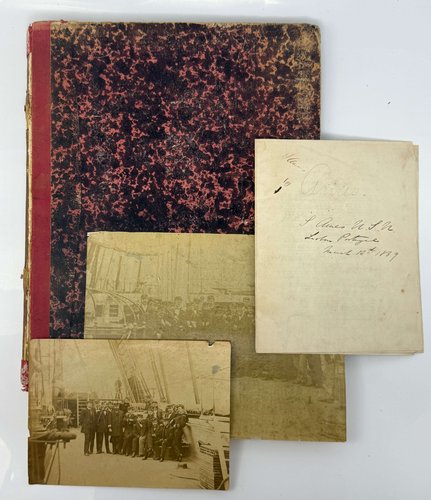
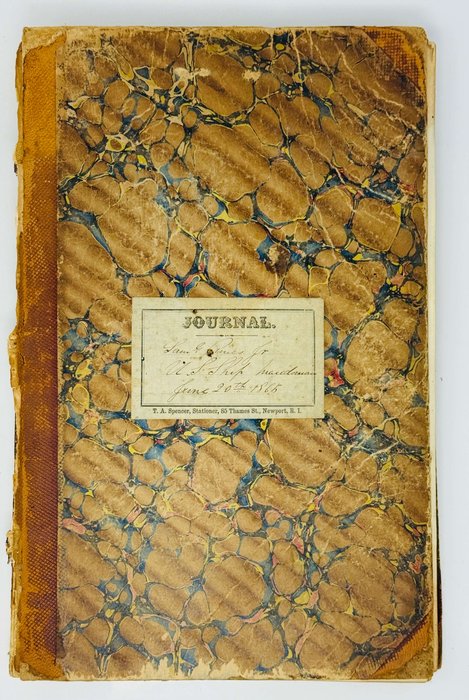
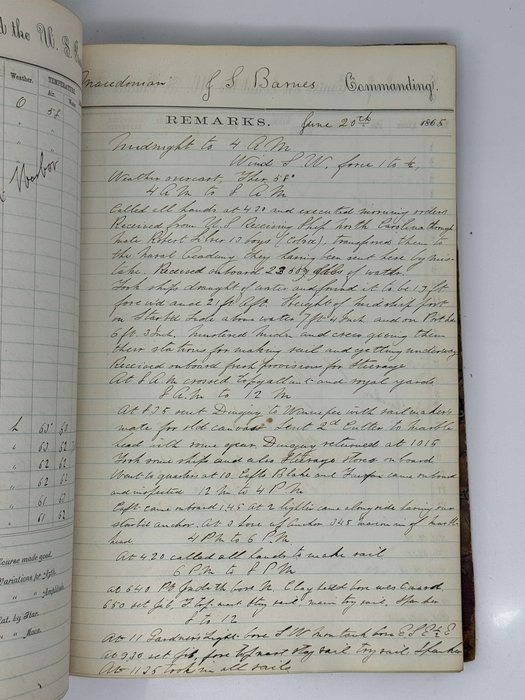
Folio logbook (ca. 33,5x21 cm or 13 ¼ x 8 ¼ in). Ca. 92 leaves with printed forms completed in hand, filled in on recto and verso; in all ca. 180 pp of text; with ca. 36 blank leaves at the rear. Brown ink on lined paper. Original light brown quarter sheep journal with marbled papered boards; front cover with an original printed label “Journal” and manuscript text “Saml. Ames Jr., U.S. Ship Macedonian, June 20th, 1865;” the compiler’s handwritten name (“Saml. Ames Jr.”) on one of the first blank leaves. Binding rubbed on extremities, from cover detached from the stub, ink of the text slightly faded, but overall a very good, internally clean journal with legible text.
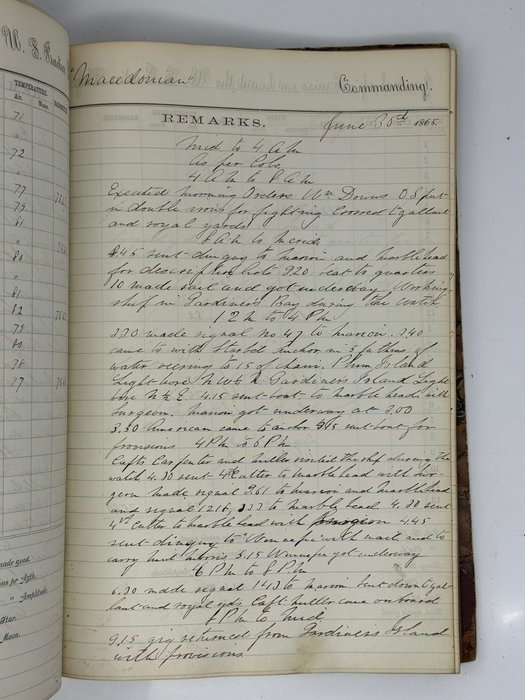
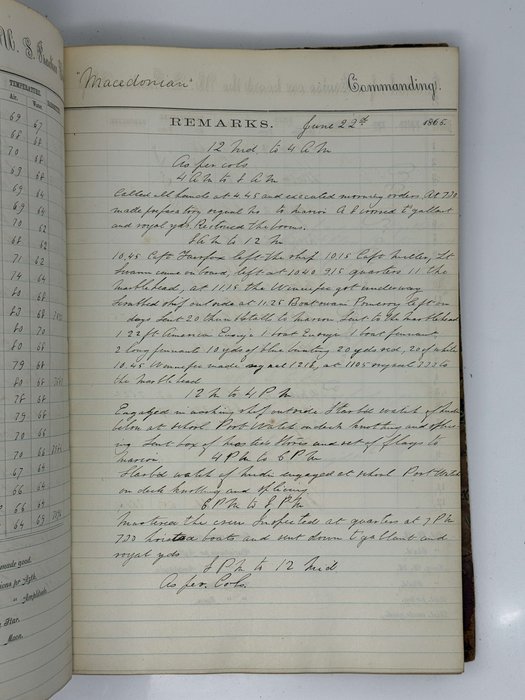
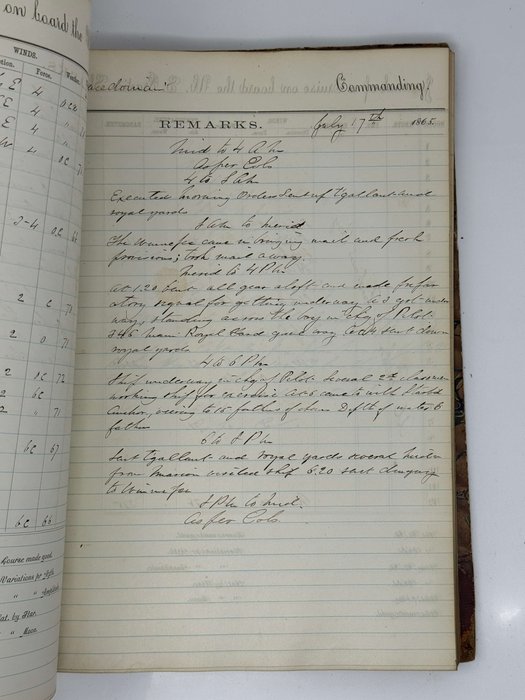
Historically significant original logbook of U.S.S. “Macedonian” - a participant of Commodore Matthew Perry’s expedition to Japan (she was one of the ten American ships entering Edo Bay, Japan on February 13, 1854), a part of the U.S. West Indies Squadron during the American Civil War, and in 1863-1870 - a practice ship of the United States Naval Academy. The logbook documents her voyage from Newport, Rhode Island, to Annapolis, in June-September 1865, just weeks after the end of the American Civil War. At the beginning of the war, the Academy evacuated to Newport and returned to its original location in the summer of 1865, with all its staff, ships and students.
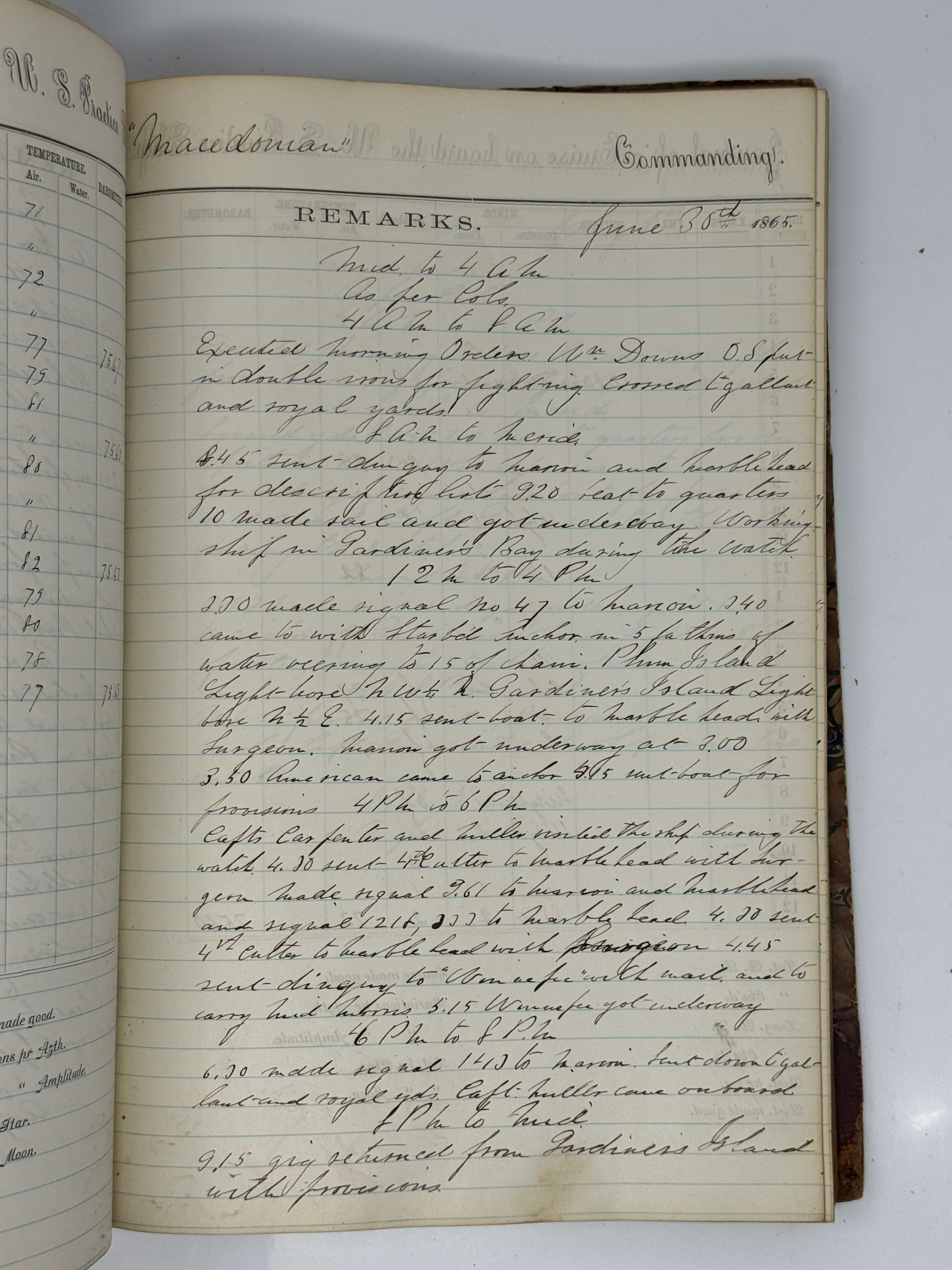
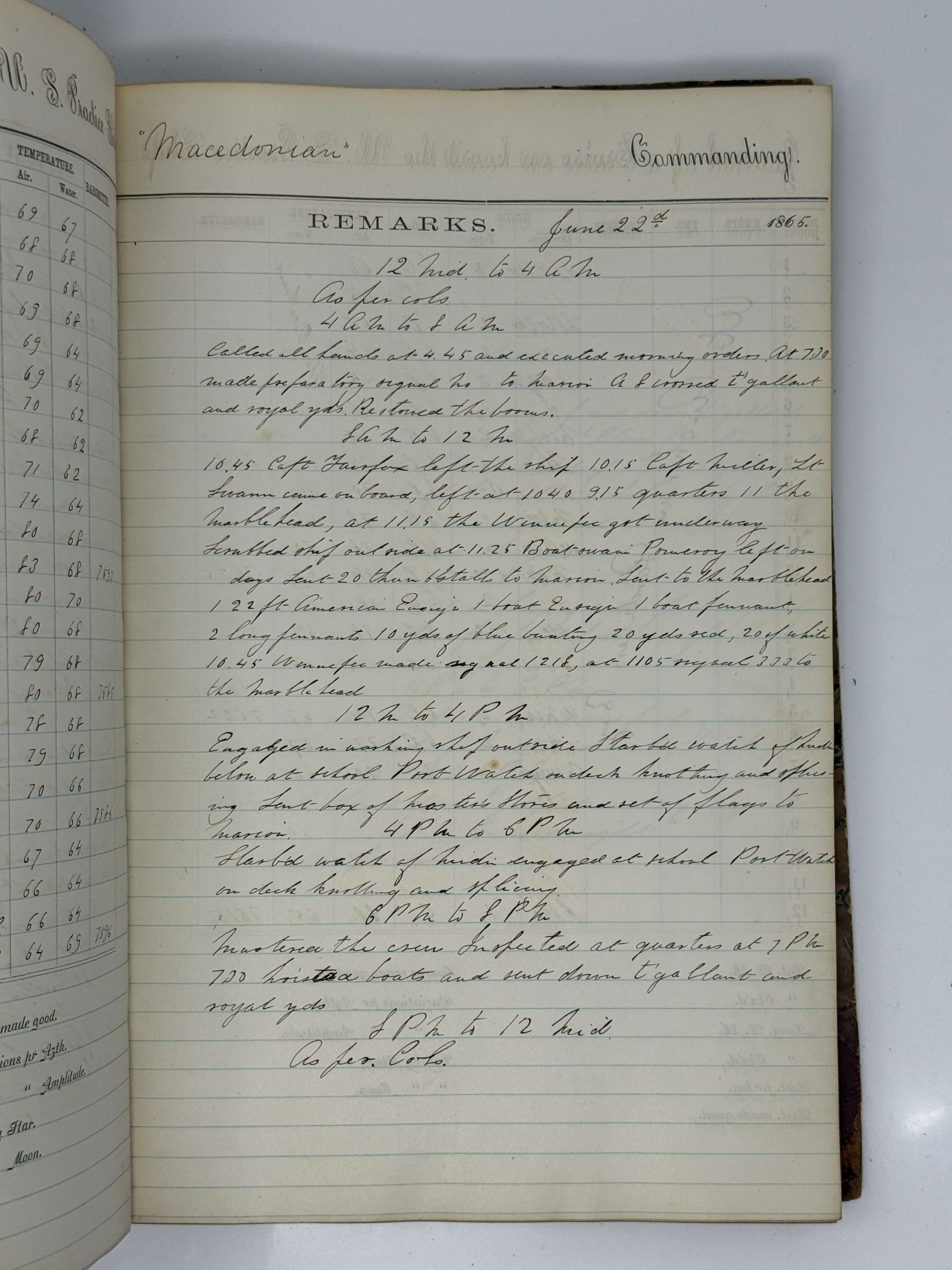
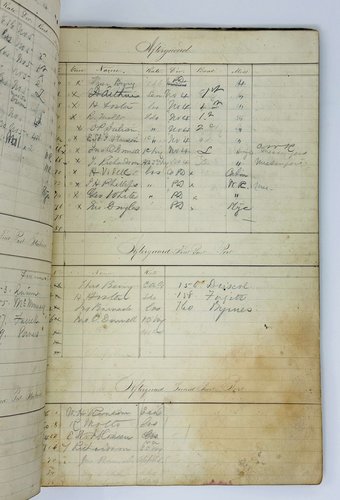
The logbook starts on June 13, 1865, when the “Macedonian” was preparing for her departure, and ends with her arrival at Hampton Roads and Chesapeake Bay on September 10-13. Most of the summer she spent in the Gardiner and Buzzards Bays off the coast of New England, with several visits to New London and New Bedford. The logbook contains the data about the ship’s course and position, winds, air temperature, barometer readings, operations with sails; records all midshipmen leaving for shore and returning, officers visiting the ship, received or sent stores, supplies and equipment; studies, exercises and drills on board (using sextant, “tacking & wearing ship”, “reefing top sails,” “practical seamanship,” “infantry drill,” firing exercises, &c.), cleaning and coaling the ship, taking observations, &c. There are also frequent notes on punishments (extra duty hours, putting on “blacklist,” solitary confinement, confinement in single or double irons, &c.), given for various violations - disorderly conduct, disobeying orders, skulking work, leaving ship without permission, “being late with hammocks,” not being at their stations, “being under the infliction of liquor,” bringing liquor on board, intoxication, abusing other midshipmen, &c. There is also a case of court martial of midshipman William Smith (July 25), who was found guilty of “bringing liquor on board [&] drunkenness” and was “sentenced for 20 days confinement in double irons and reduced rations with loss of 1 month pay.”
The logbook also mentions the “Macedonian” receiving “2 howitzers and equipment, 60 Sharp’s rifles with equipment and 25 revolvers” (June 17), arrival of “Marine Guard of 14 men” (June 18), celebration of the 4th of July in New London, and mandatory reading out loud the “Articles for the Government of the United States Navy” (regulations of naval service). Interestingly, the compiler records the reading in the following way: “September 5, 1865. <…> Lt. Comdr. Crossman read Arts. for the better government of the U.S.A.” There are also frequent, practically daily notes about the “Macedonian” communicating or collaborating with other practice ships of the Naval Academy, who went on the same voyage - U.S.S. Santee (1855), U.S.S. Marblehead (1861), U.S.S. Winnipec (1864), U.S.S. Marion (1839), U.S.S. Constitution (1797), and others.
Overall an interesting content-rich original source on the history of the U.S. Naval Academy, its ships and personnel in the first months after the end of the American Civil War.
Samuel Ames “was the youngest son of the late Samuel Ames, chief justice of the Supreme Court from 1856 until his death in 1865, and of Mary Dorr, daughter of Sullivan Dorr, and sister of Thomas W. Dorr, leader of the People’s party and of the Dorr Rebellion of 1842. <…> [He graduated from] the United States Naval Academy in Annapolis <…> in 1868. He was passed through the grades of midshipman, ensign and master before he became convinced that his tastes were not for the sea, and after five years in the navy he resigned. [Ames graduated from Harvard Law School in 1875 and was admitted to the Rhode Island bar.] He was a leader in the reform movement that brought forth the Municipal League and was one of the founders of that organization. With its endorsement he served one term in the General Assembly as a representative in 1879-78” (Recent Deaths: Samuel Ames, Providence Lawyer// Boston Evening Transcript. October 26, 1900, p. 9).