
#MD53
Ca. 1860s-1960s
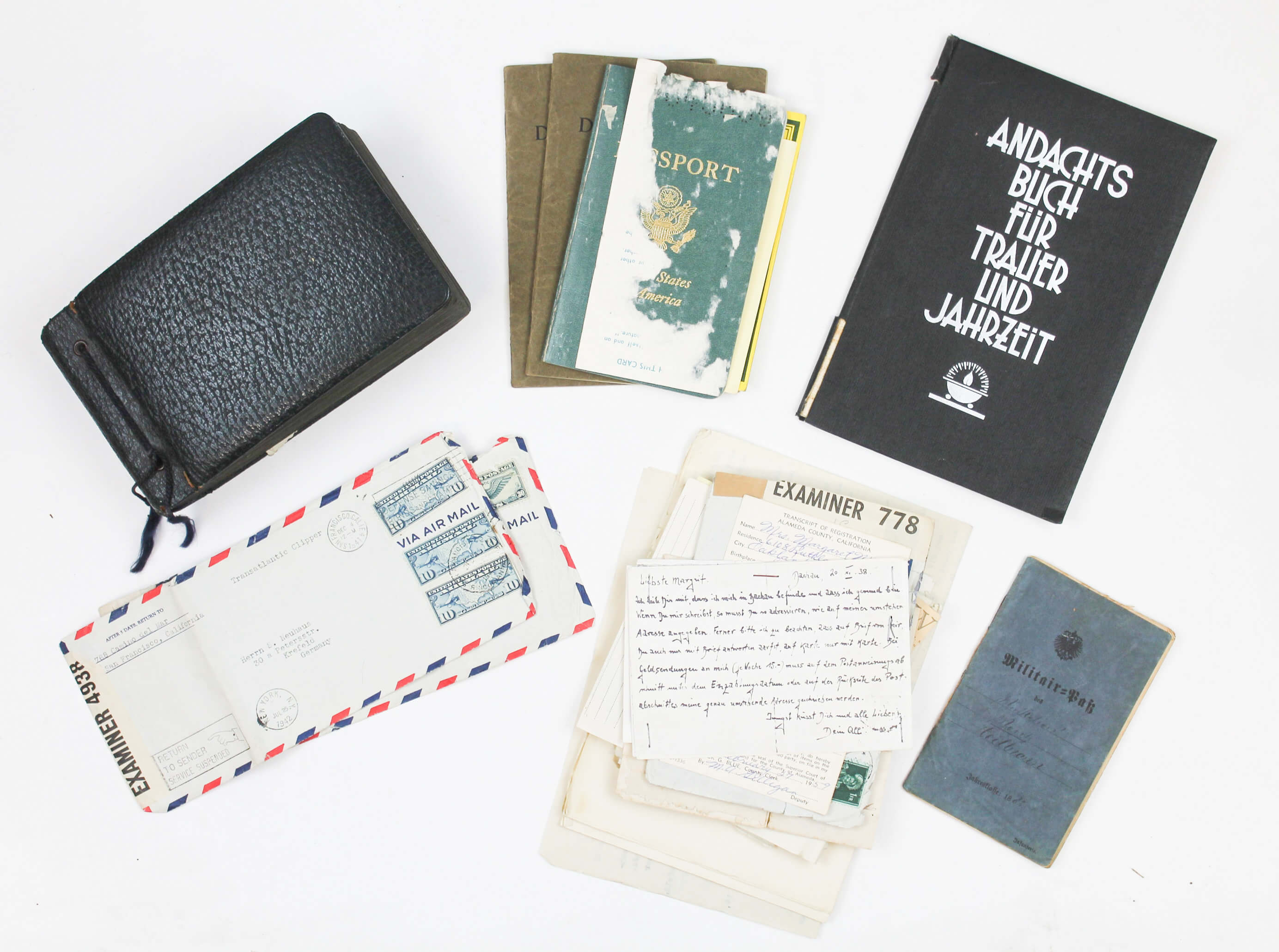
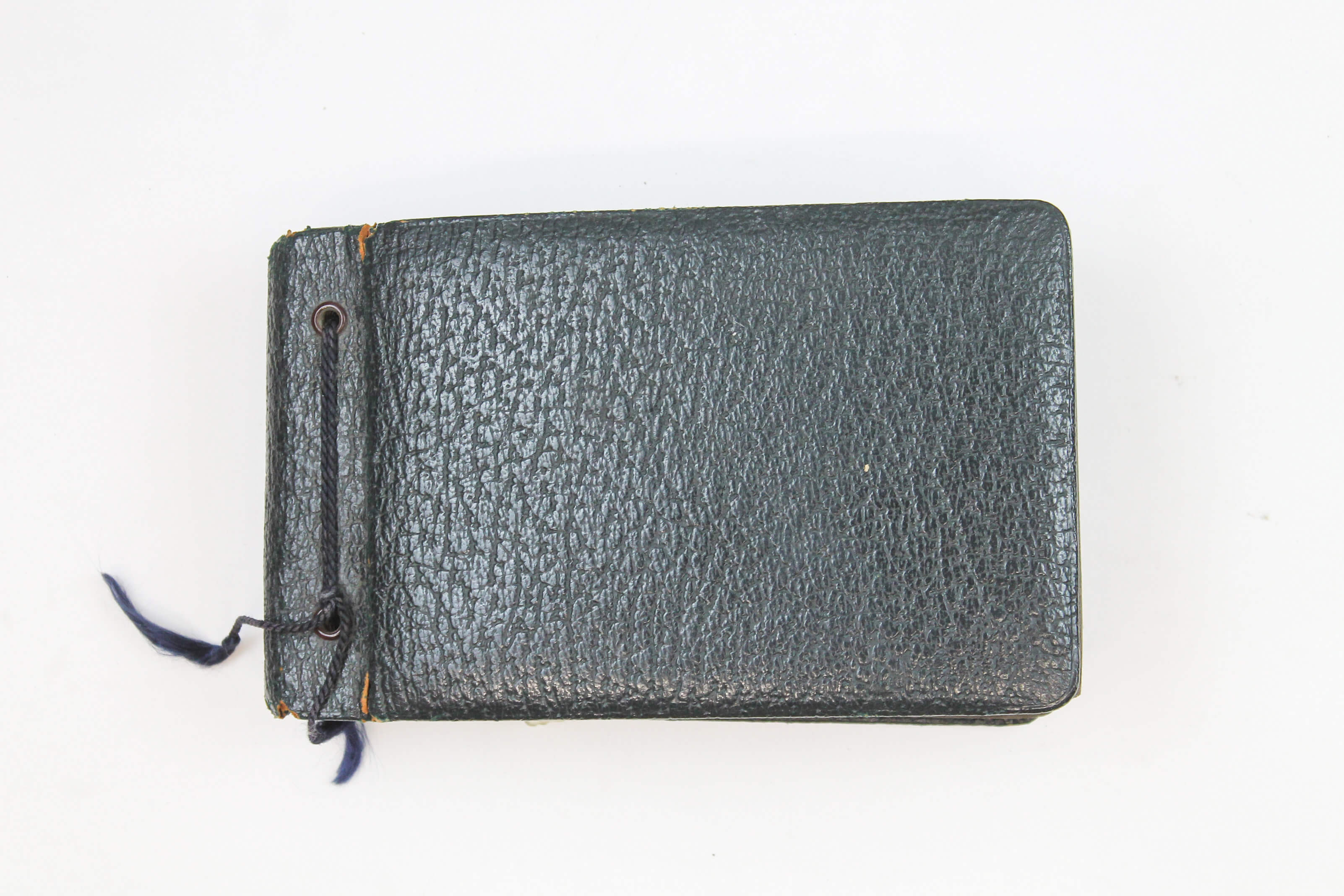
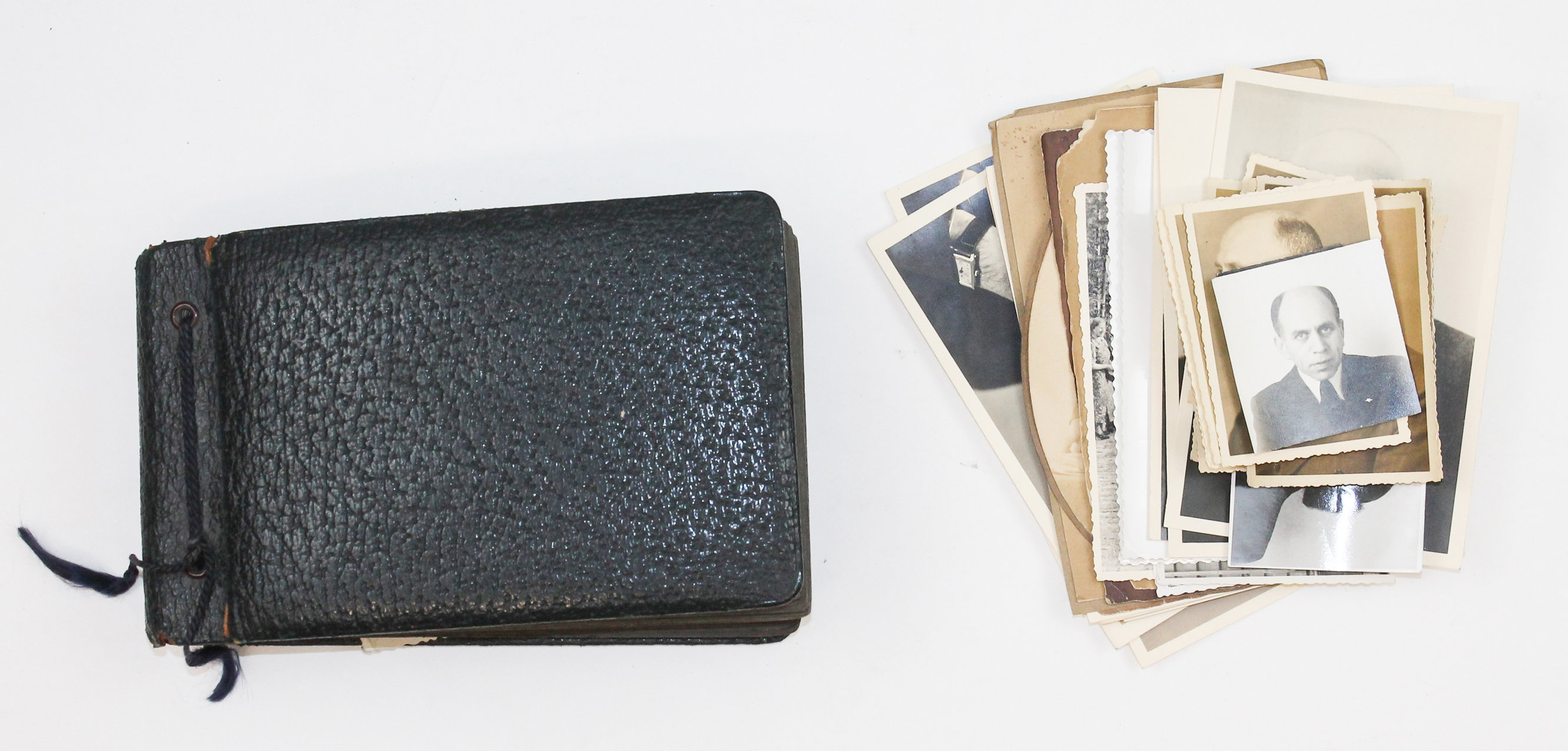
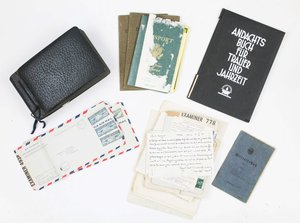
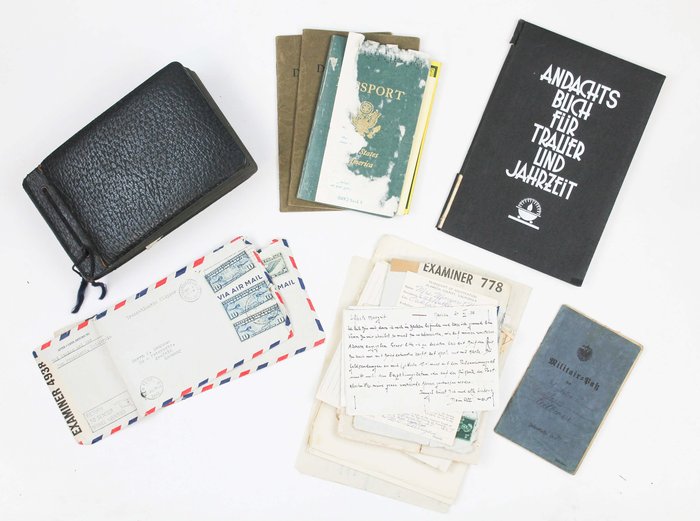
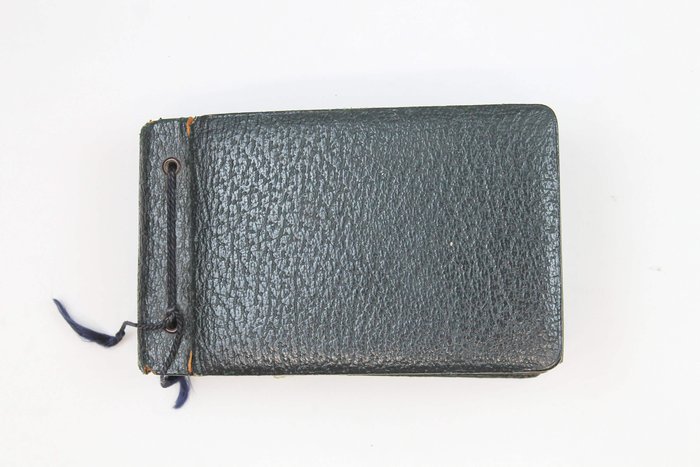
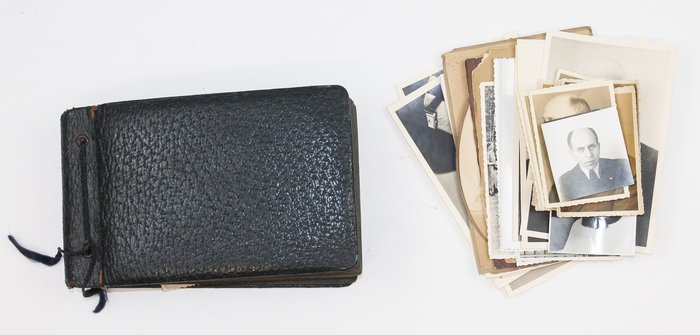
Archive: Oblong Octavo album (ca. 11,4x18,8 cm or 4 ½ x 7 ½ in). 39 card stock leaves (5 blank). With 65 original gelatin silver photographs (including one color) from ca. 13,7x8,8 cm (3 ½ x 5 ½ in) to ca. 8x5,5 cm (3 x 2 ¼ in). Ca. 44 photos with German captions or dates on the mounts, one photo captioned (in German) in negative. Period black leather album fastened with a string; spine with minor tears, images slightly age-toned, but otherwise a very good album; with ca. 44 original gelatin silver photographs and real photo postcards tipped in (including 2 unique postcards with overall five copies and 5 unique photos with overall 11 copies) from ca. 14,8x10 cm (5 ¾ x 4 in) to ca. 7,5x5,5 cm (3 x 2 ¼ in). Two postcards with Alli’s and Alexander’s brief English and German notes on the verso, 19 photos with the period stamp “Fotohaus Uebah Krefeld,” “Hollywood Studios,” “Foto Lisel Haas,” “Foto Knipscher”, and “Bear Photo” on the verso, 11 photos and postcards either dated on captioned (most in German) on the verso. One photo lacks small fragments at the left margins, but otherwise good collection; eight typewritten documents (including three original envelopes) and two handwritten letters, two German newspaper clippings, two transcripts of registration, two civilian inquiry forms, two German passports, one American passport, one memorial book, one receipt, one landing card, one business card, one copy of driver’s license, one birth certificate (cut in several pieces), one military pass (cut in several pieces), one official letter, one conduct certificate, and one military Führungs-Attest; most documents are in good condition.
Historically important extensive archive spanning the 1860s to the 1960s, and documenting the persecution of a middle-class Jewish family in Nazi Germany, their urgent efforts to emigrate to the United States, and their subsequent life in exile.
During the Nazi regime, approximately six million Jews were murdered across Europe in the Holocaust. In addition to those killed, hundreds of thousands sought to escape persecution through emigration. Between 1933 and 1945, an estimated 304,000 German Jews managed to leave Germany, with roughly 100,000 resettling in the United States. These emigrants faced restrictive visa requirements, confiscatory taxes, and complex transit routes, often leaving behind family and most of their property.
The archive belonged to the family of Dr. Alexander and Margaret Heilbronn of Krefeld, Germany. Alexander was born on April 15, 1899, in Krefeld, Prussia, to Moritz Heilbronn (ca. 1861–1938) and Rosette Lion (ca. 1863–1938). He married Margaret Neuhaus (ca. 1912-1985) on July 26, 1934, in Krefeld. Following Alexander’s imprisonment in Dachau during Kristallnacht in November 1938 and his subsequent release in late November or early December, the couple emigrated to the United States, settling in California. As follows from the archive, after their emigration, they made desperate efforts to locate and assist relatives, including Alexander’s sister Erna Heilbronn and Margaret’s parents, Sali (ca. 1878–1945) and Irene Neuhaus (ca. 1886–1945). According to archival records and FamilySearch, all three perished in the Holocaust in Riga. Alexander established a successful career as a gynecologist, eventually building a large practice in Oakland. He joined the staff of Herrick Memorial Hospital in Berkeley with Margaret, who served on the hospital’s board. The couple had one daughter, Joan. Alexander passed away in 1966, in Berkeley, California, at the age of 67, and was buried in Oakland.
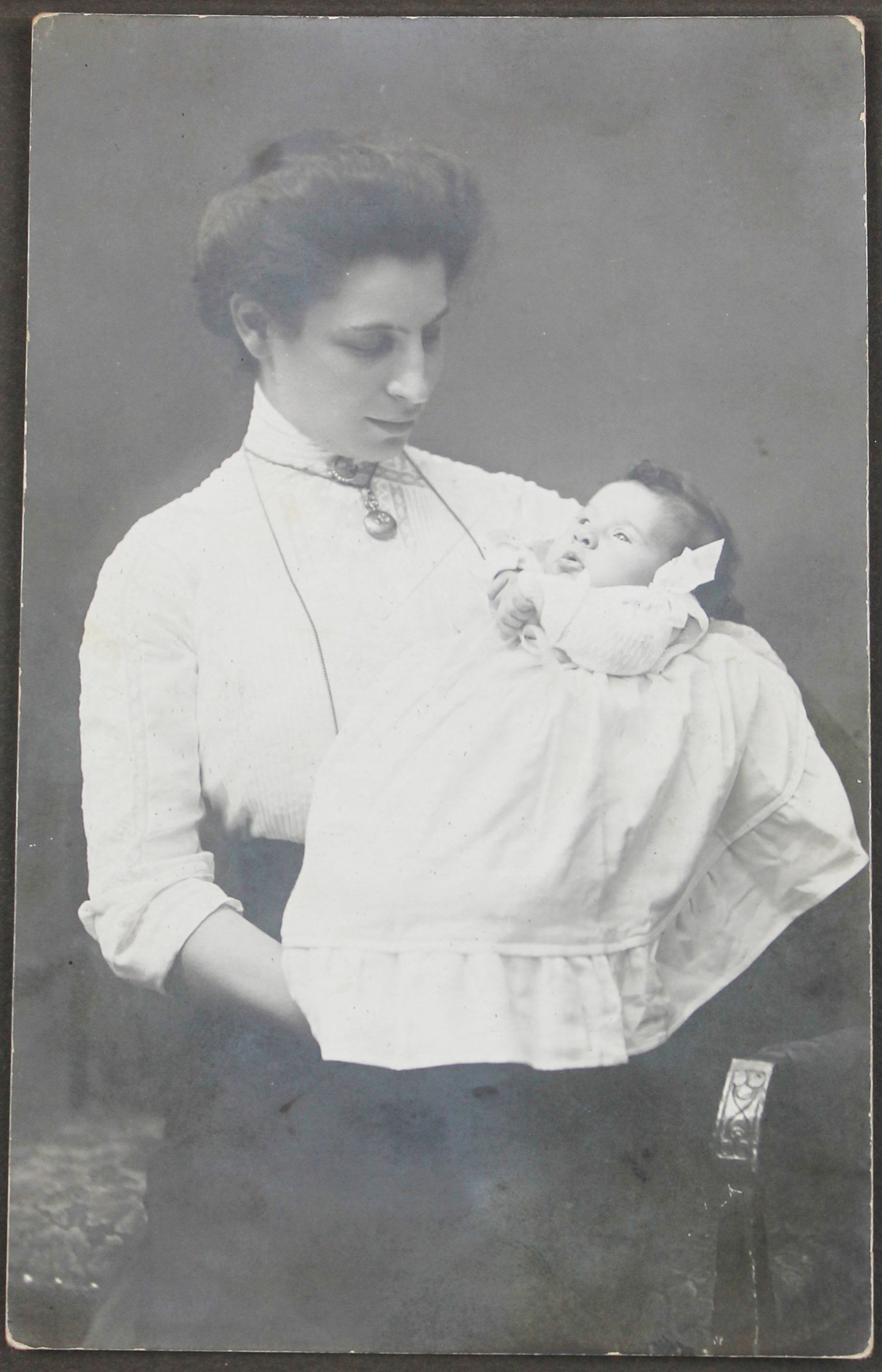
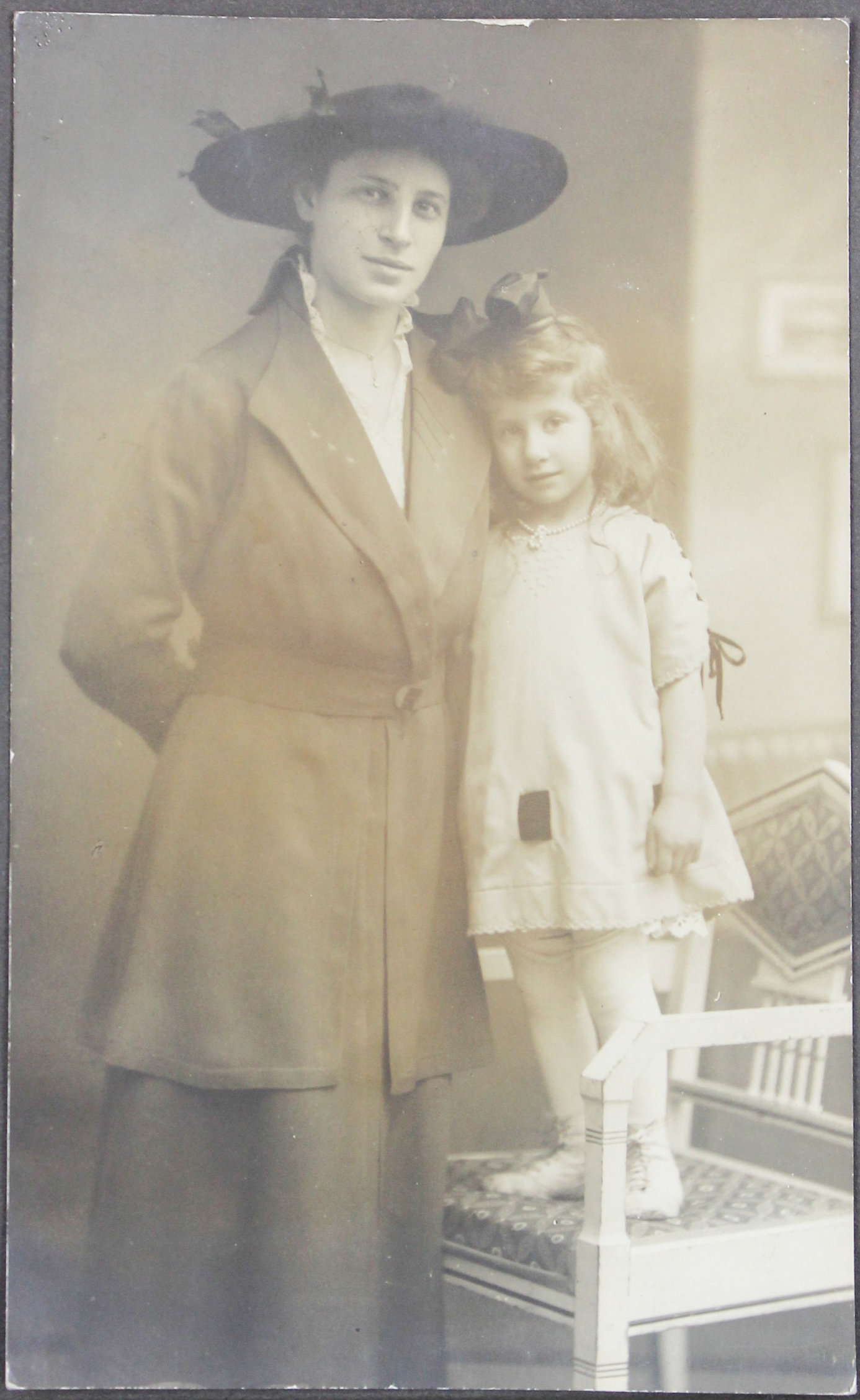
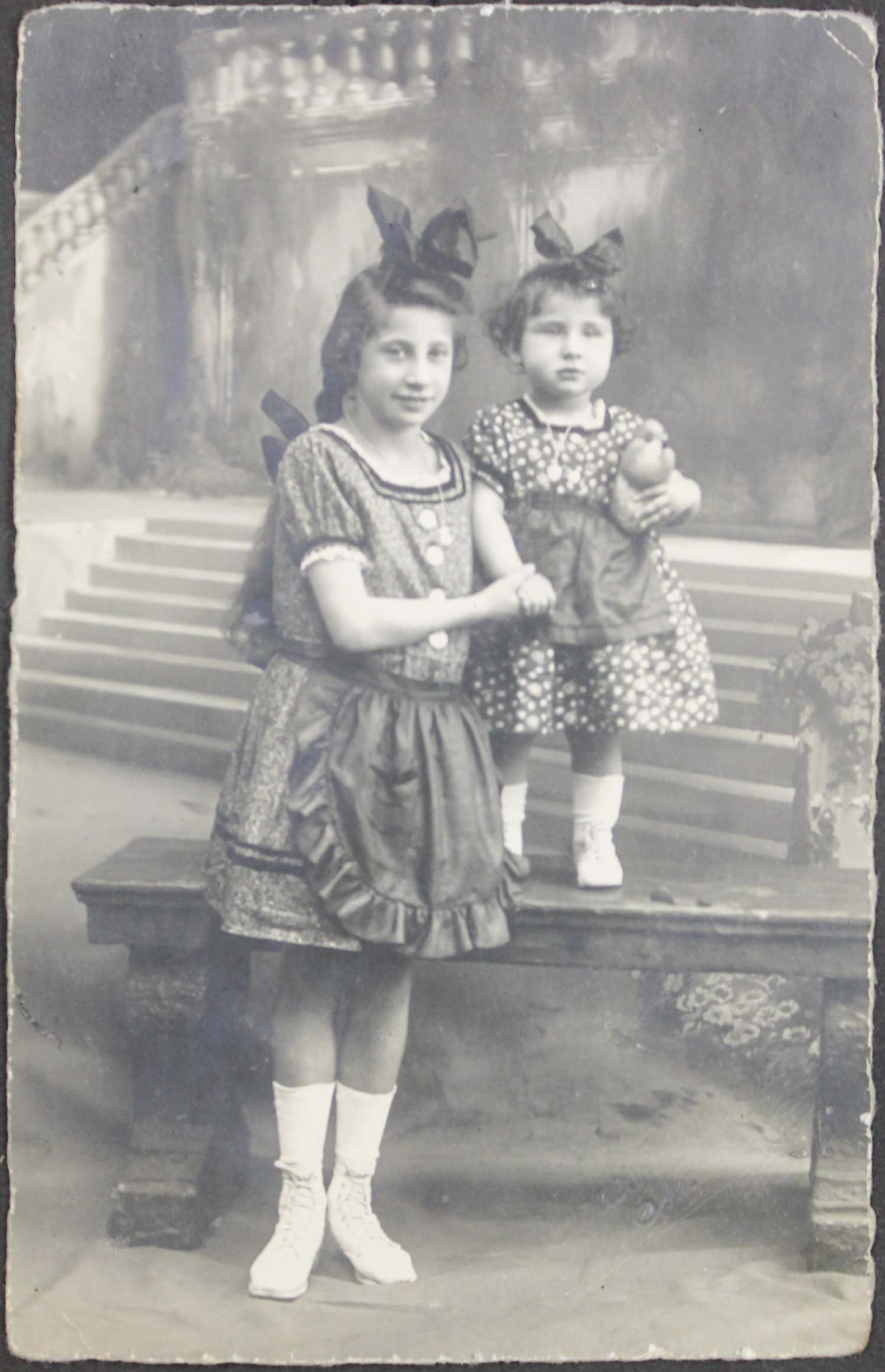
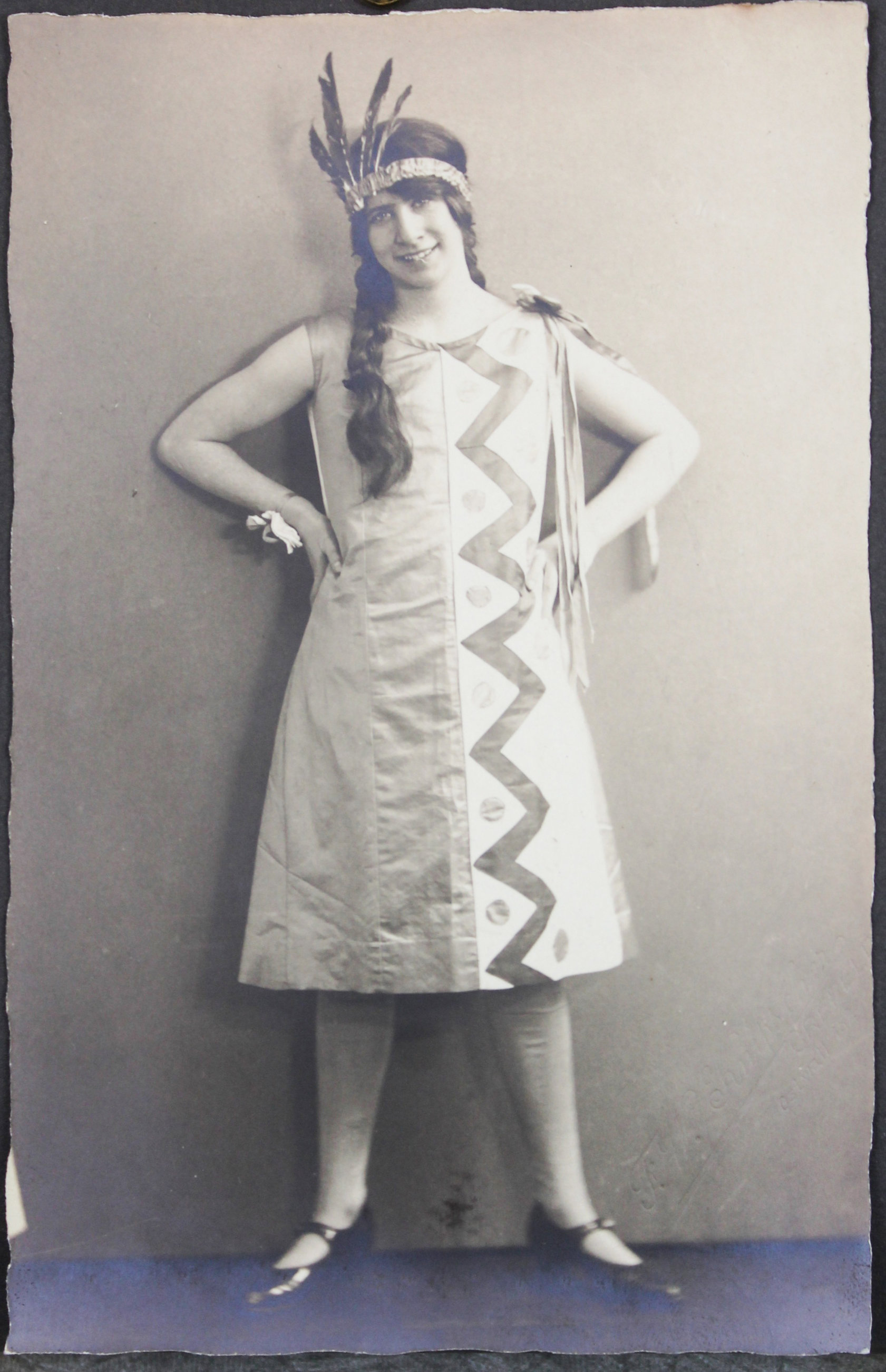
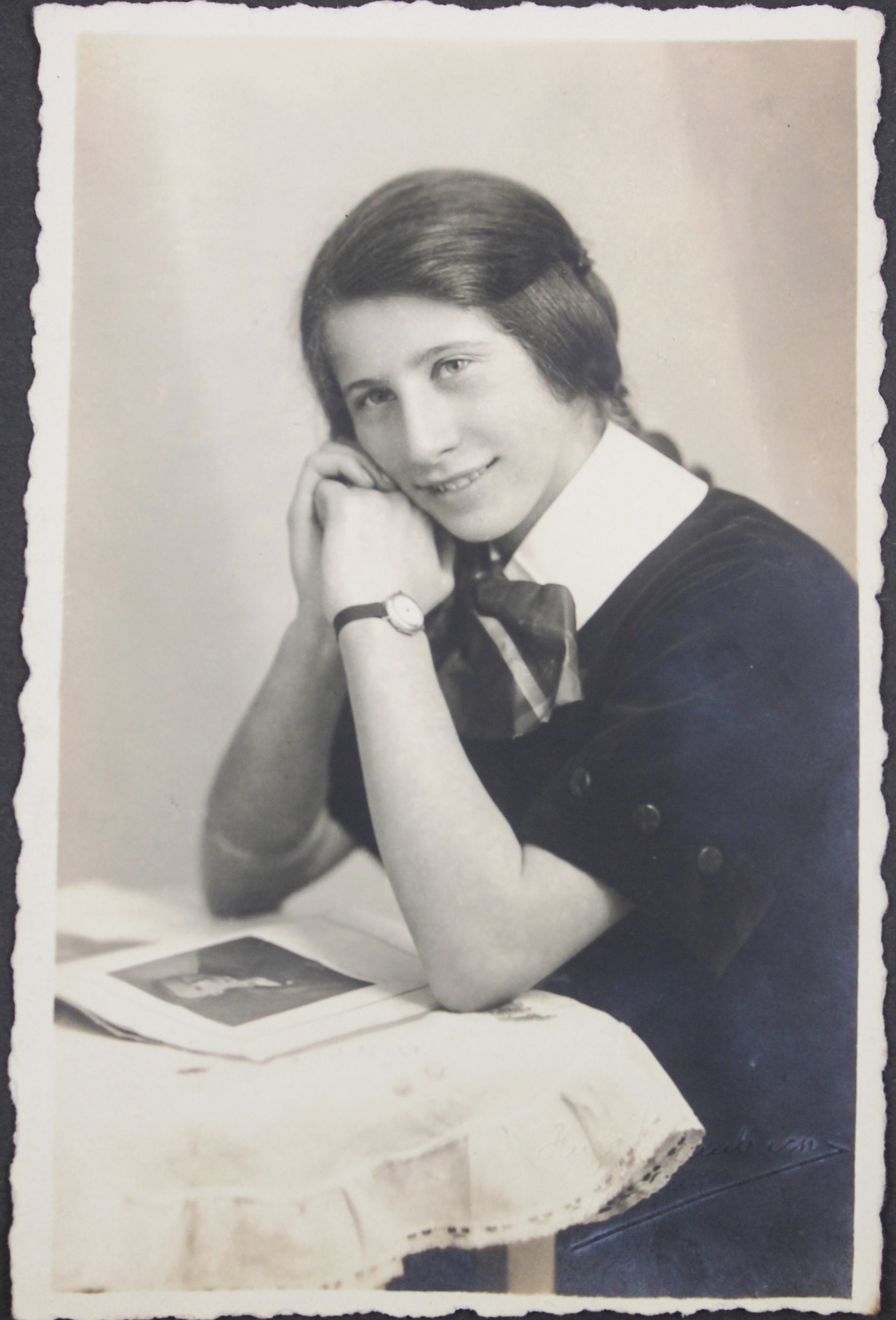
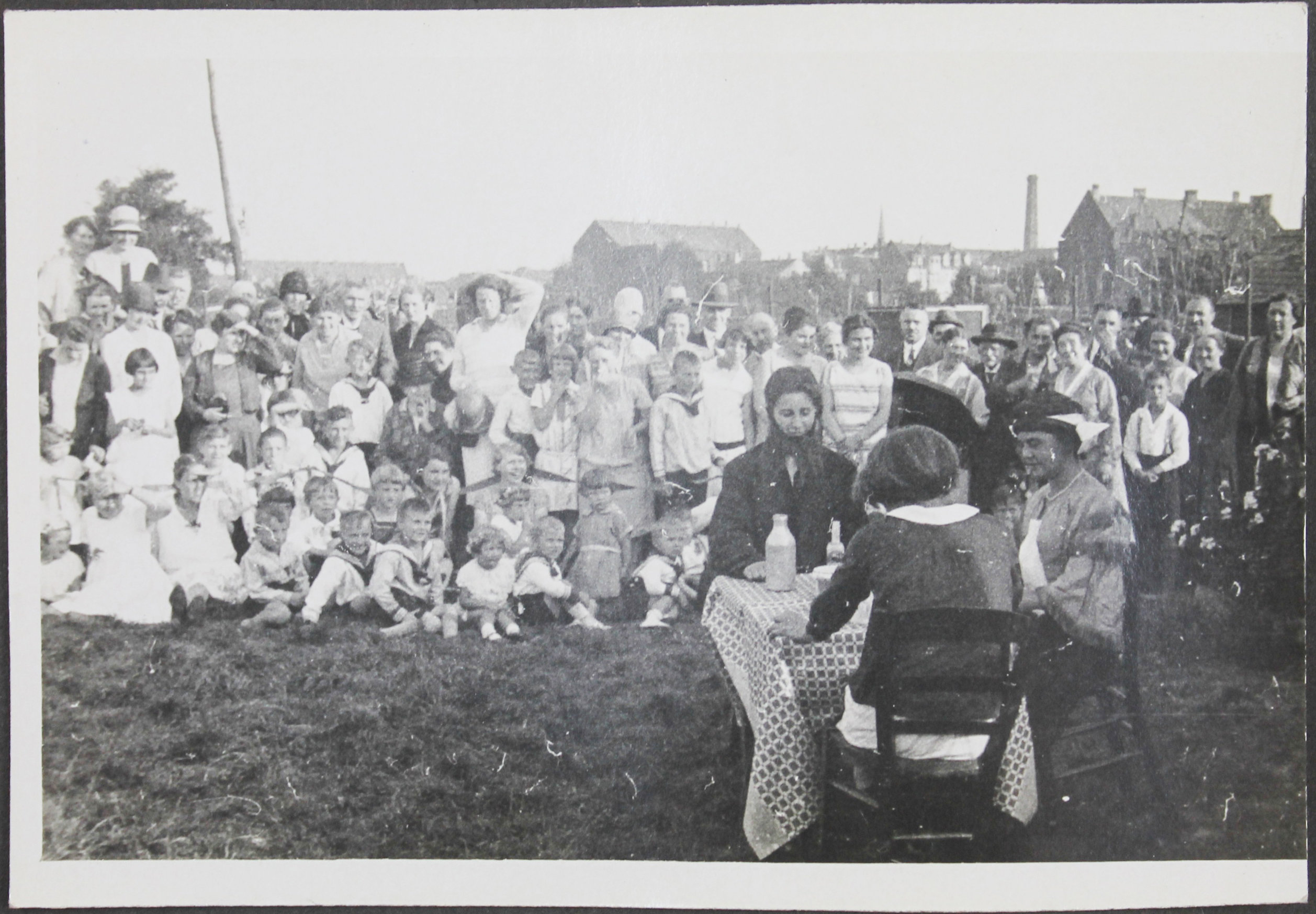
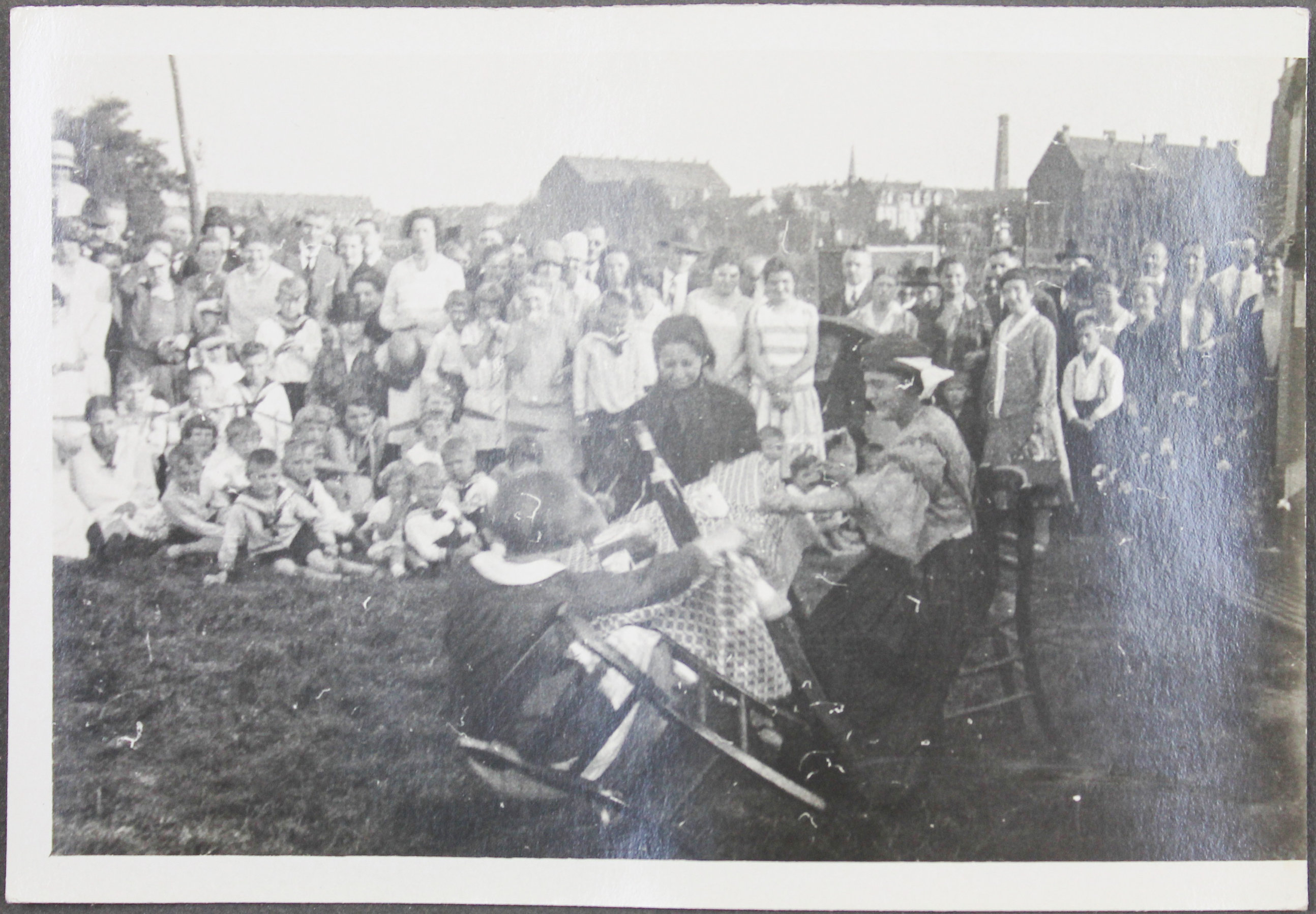
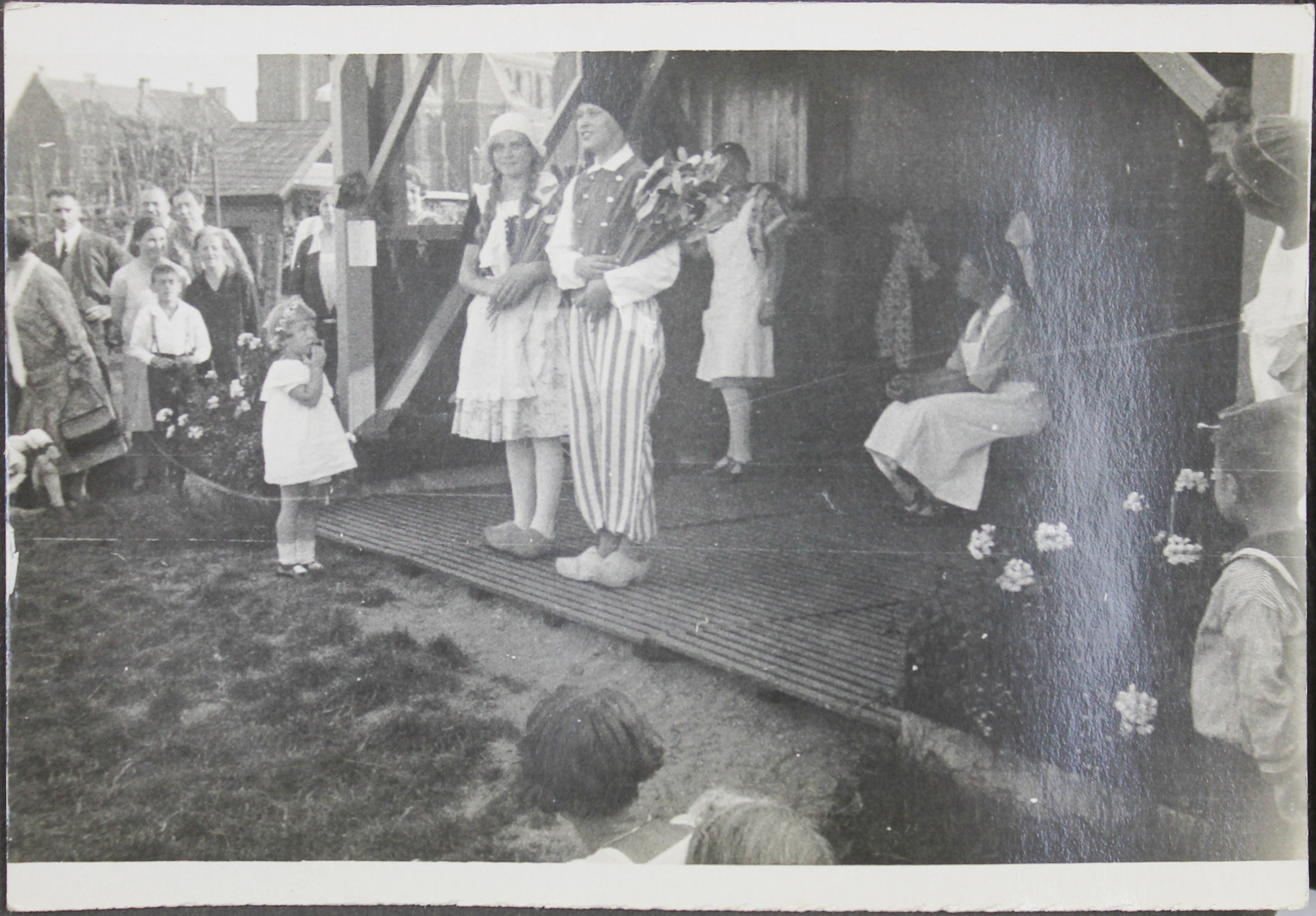
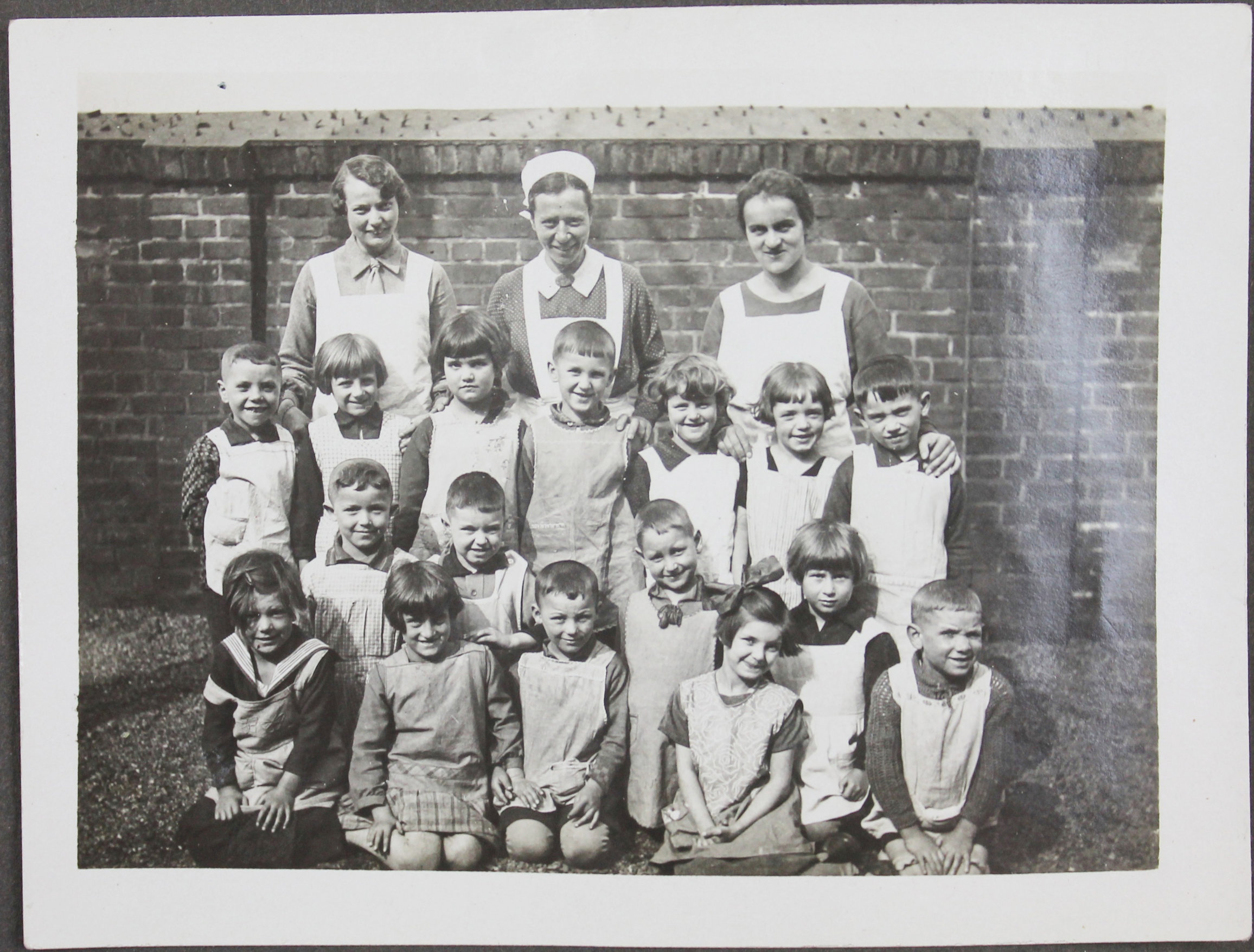
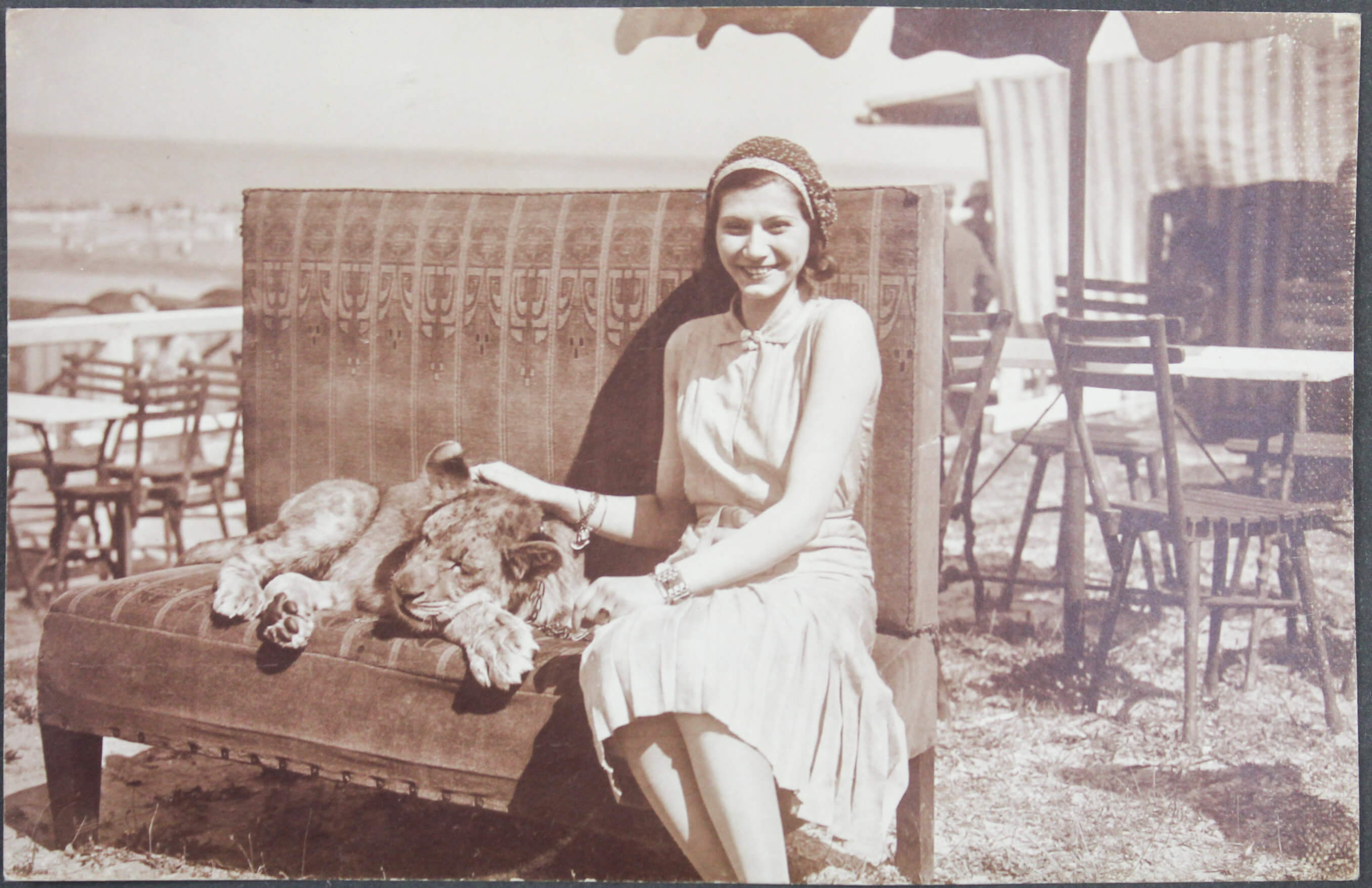
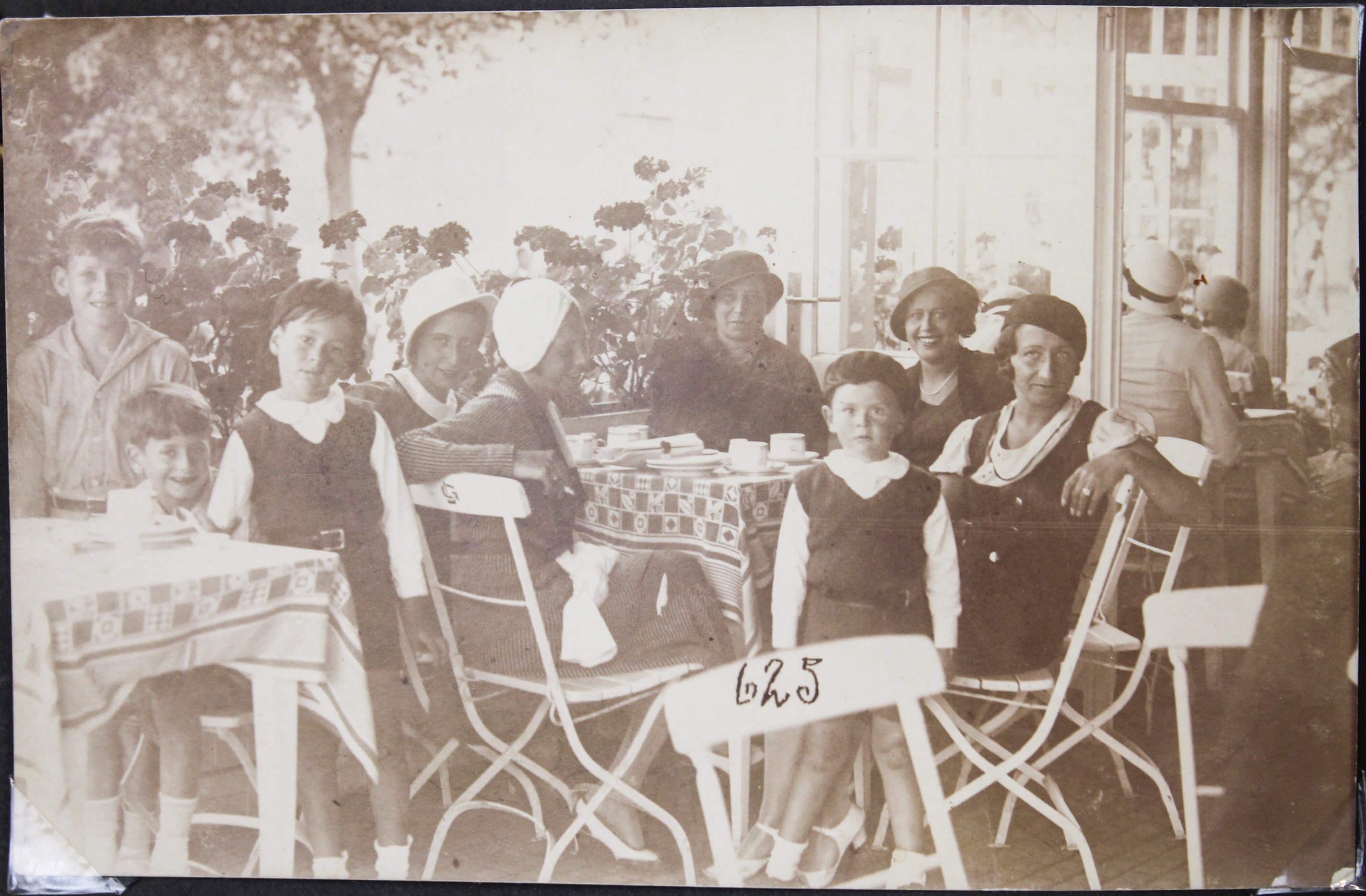
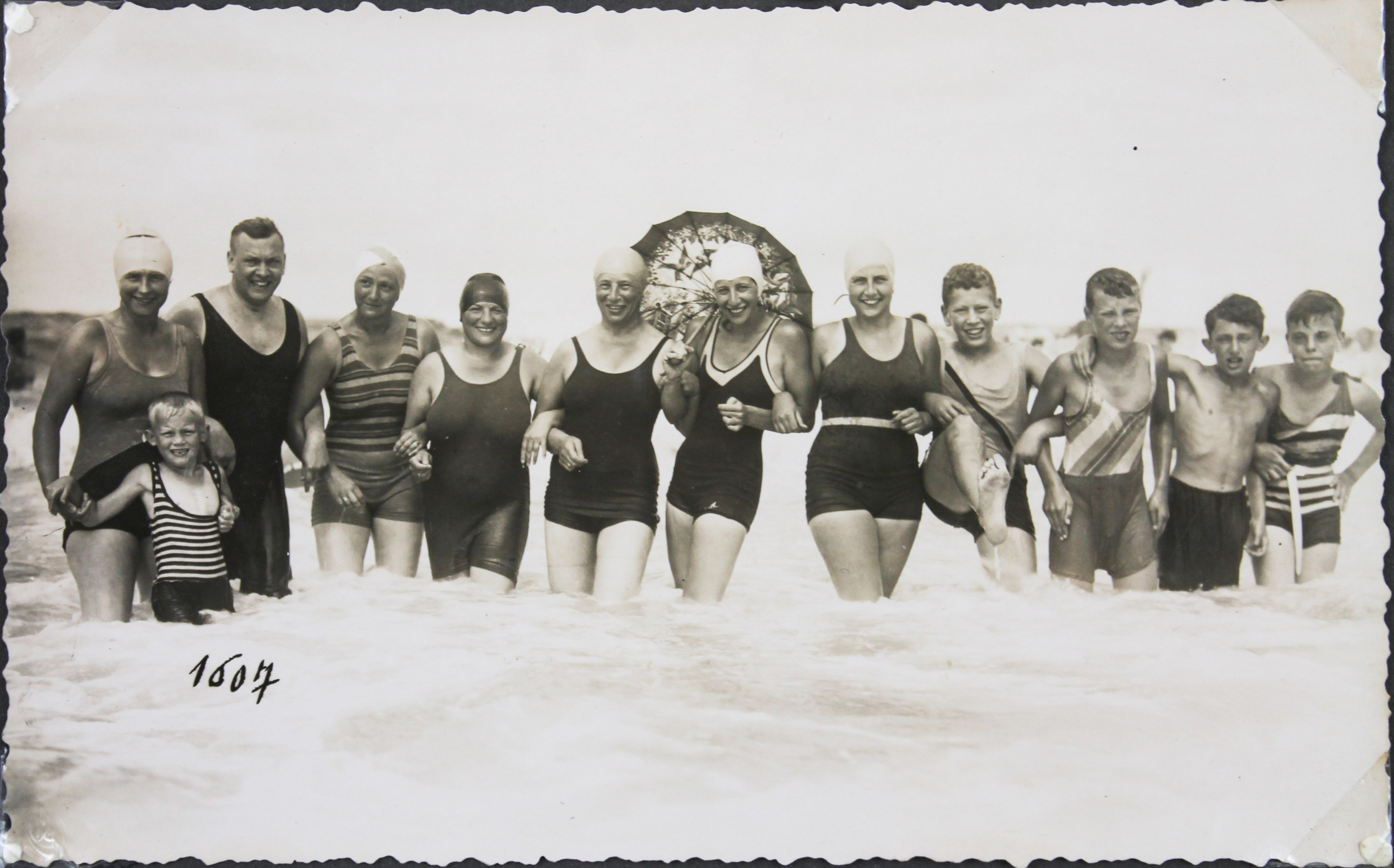
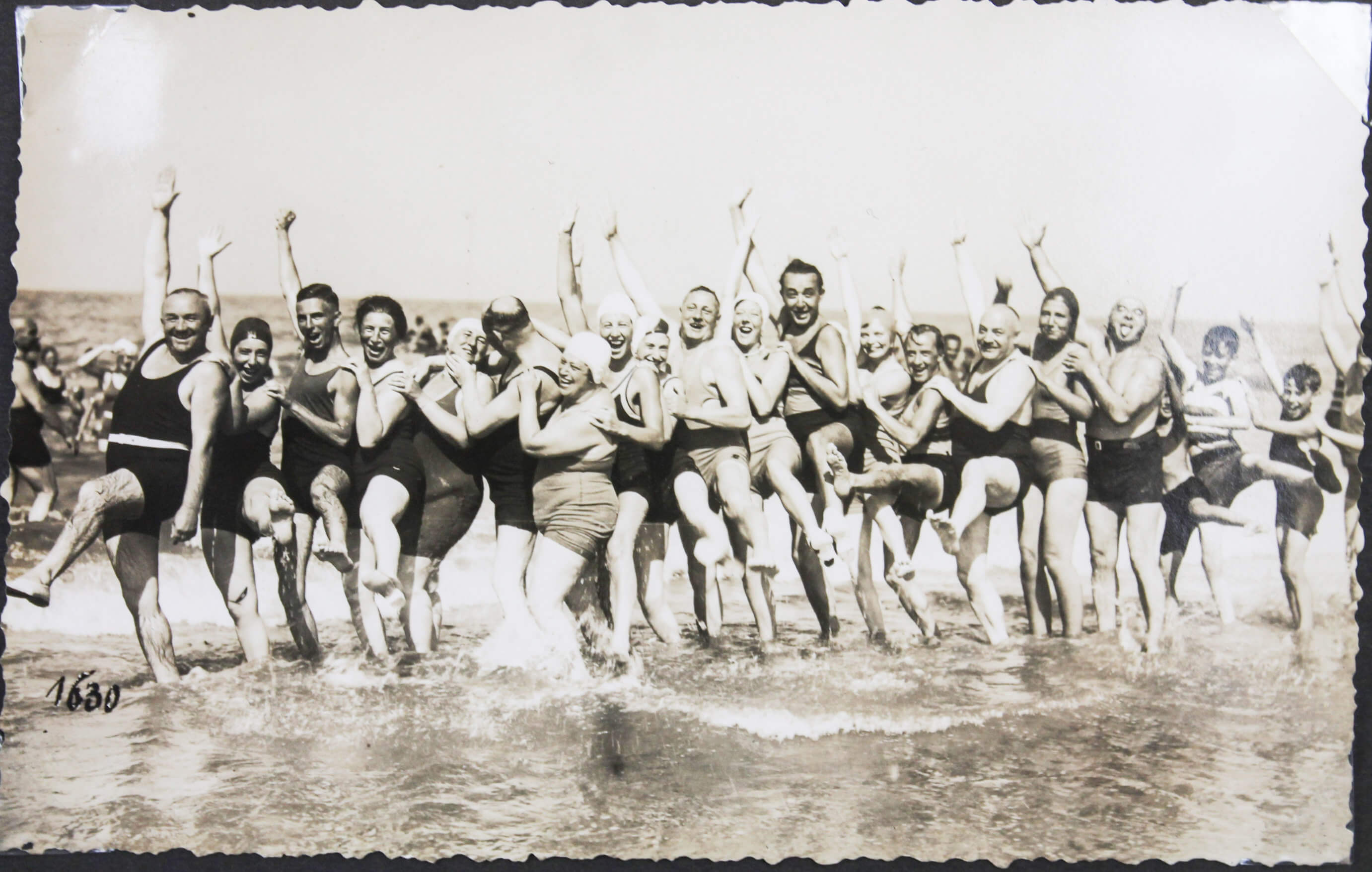
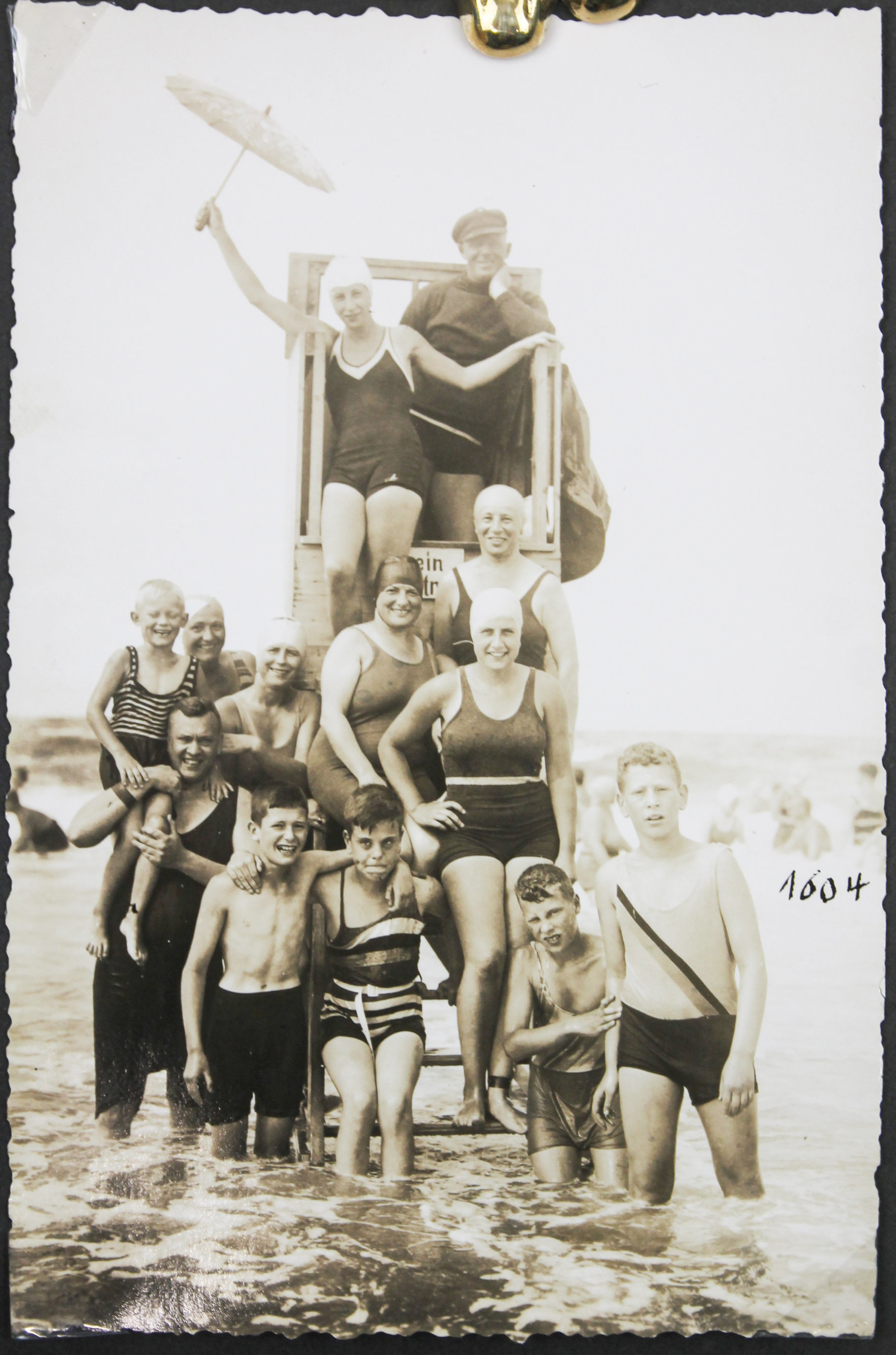
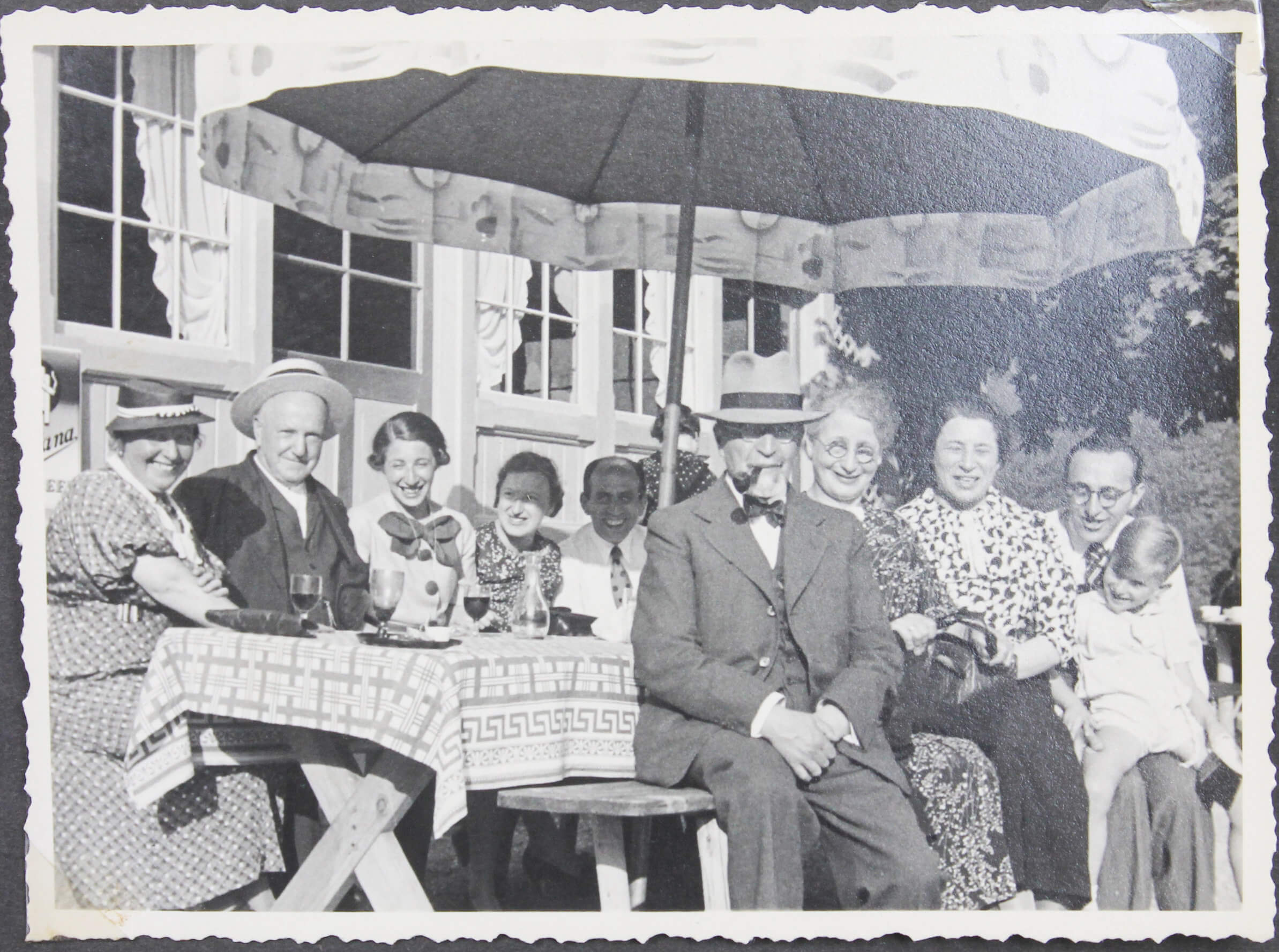
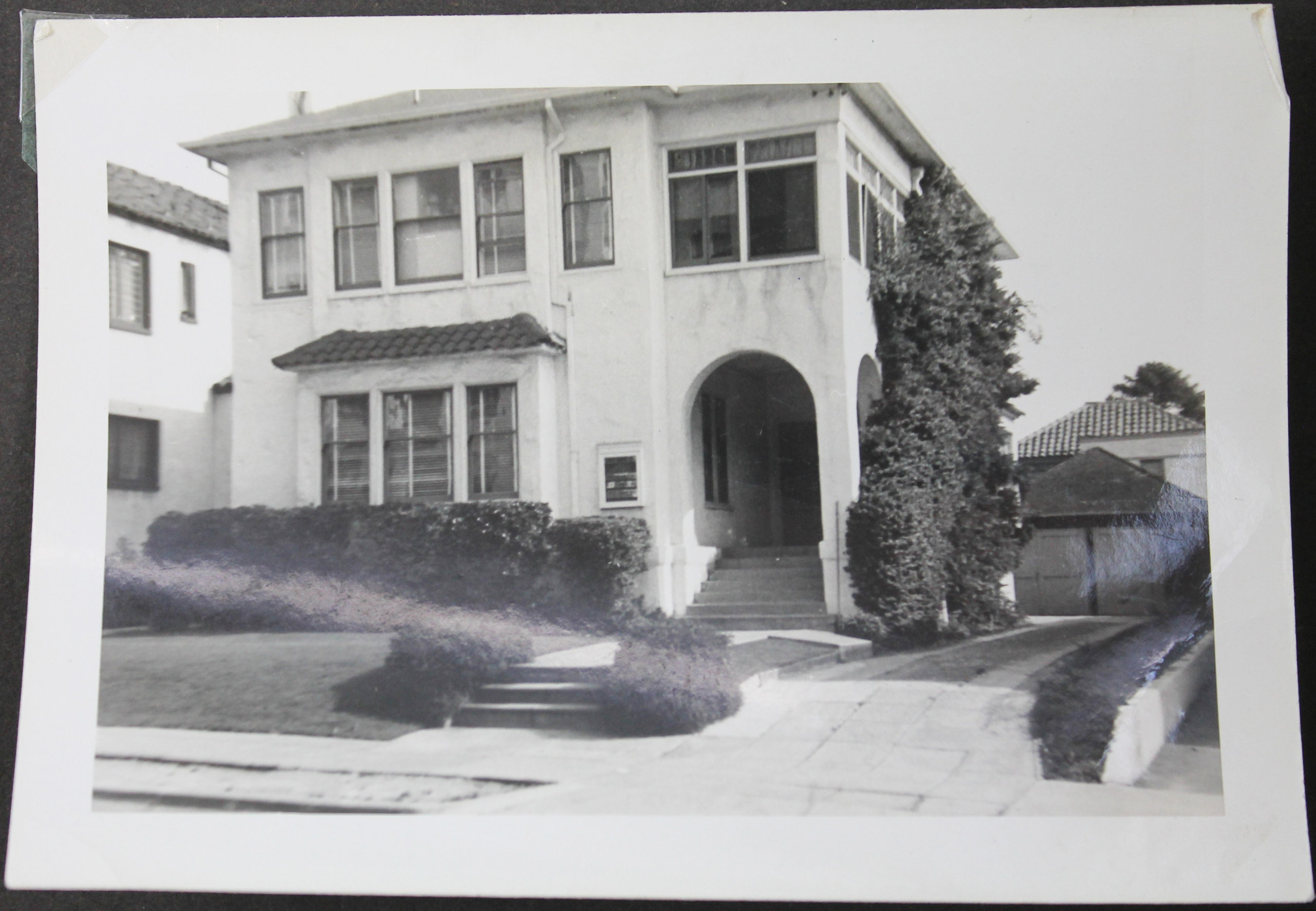
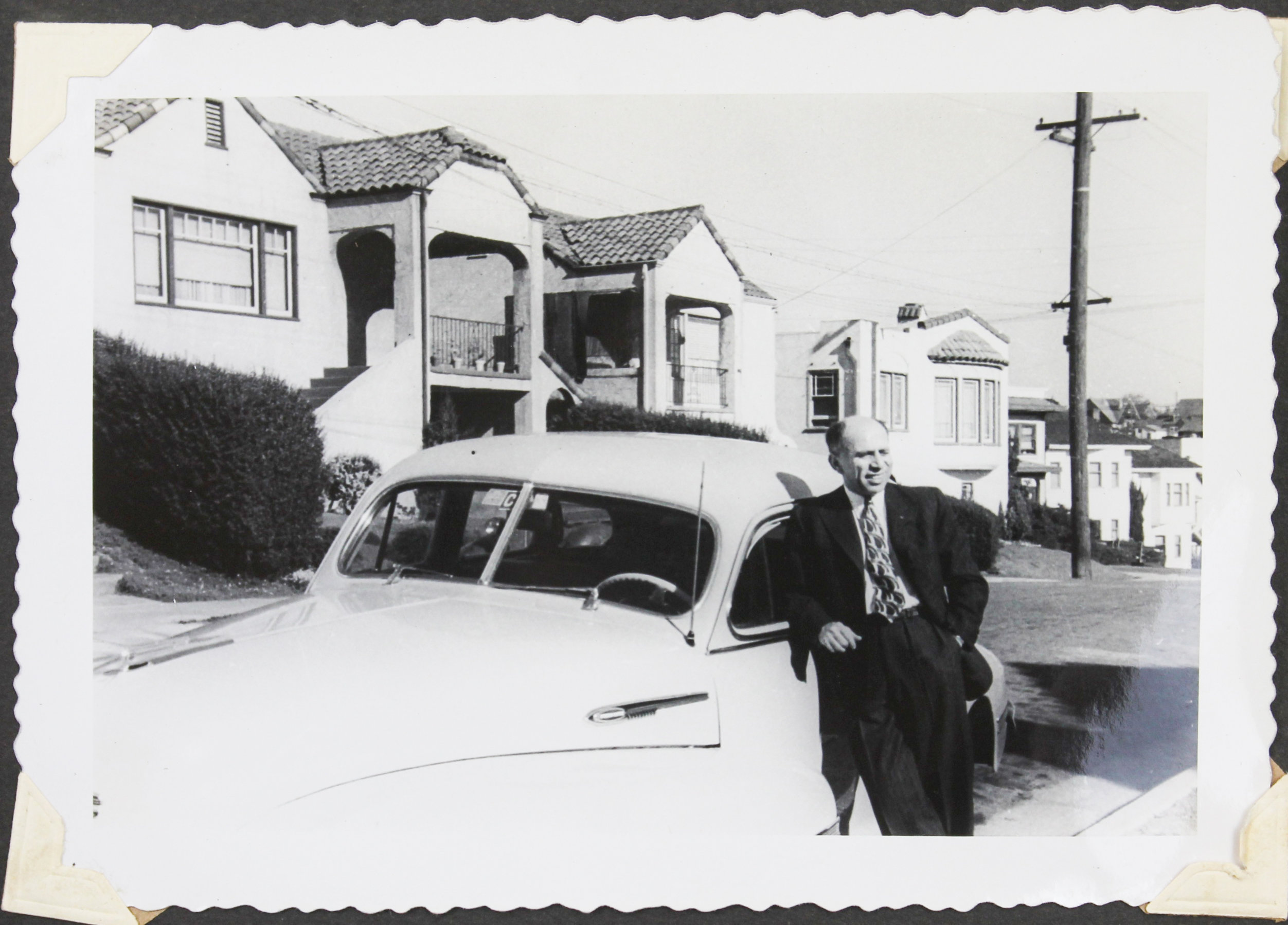
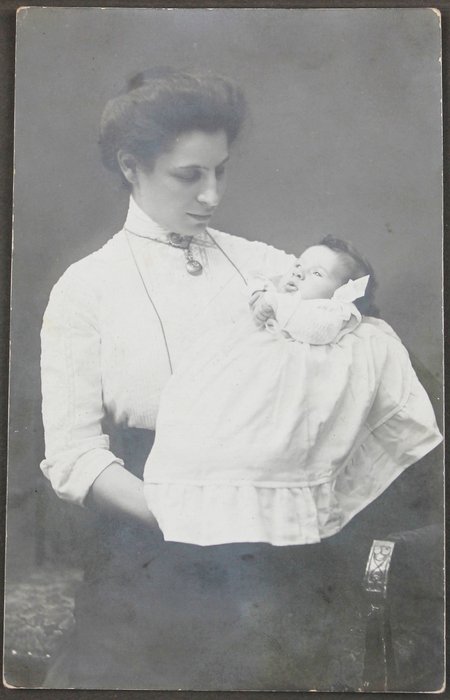
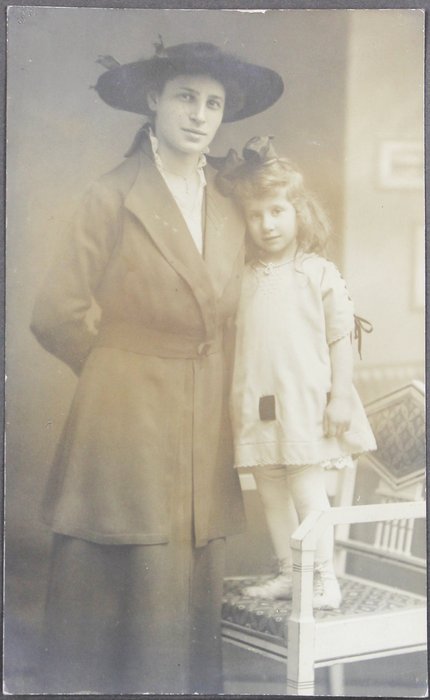
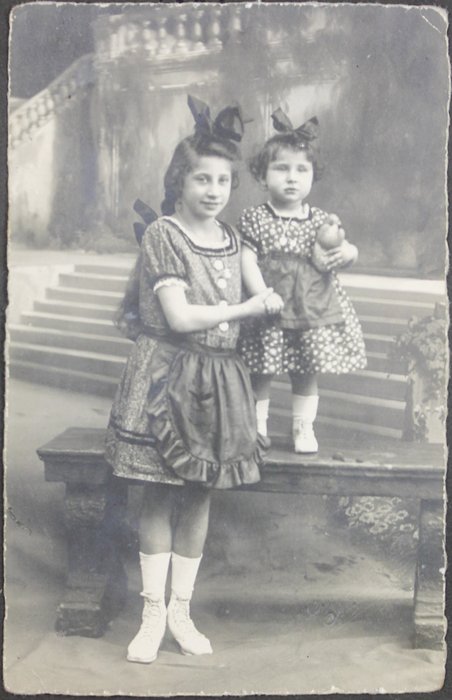
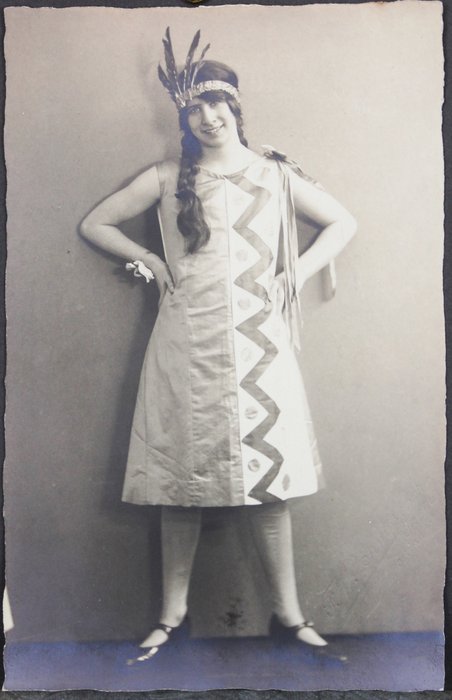
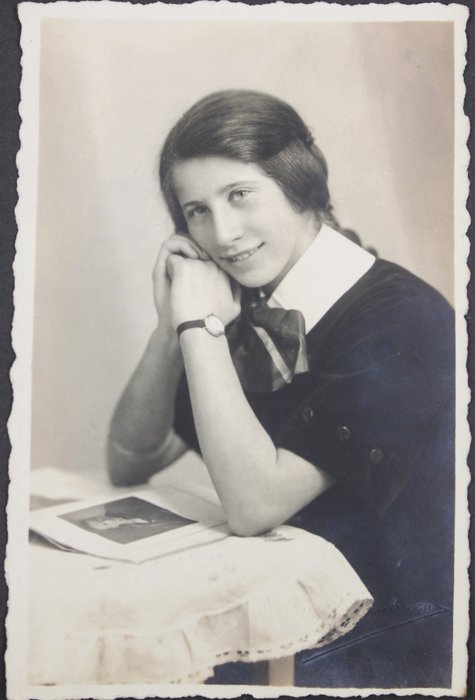
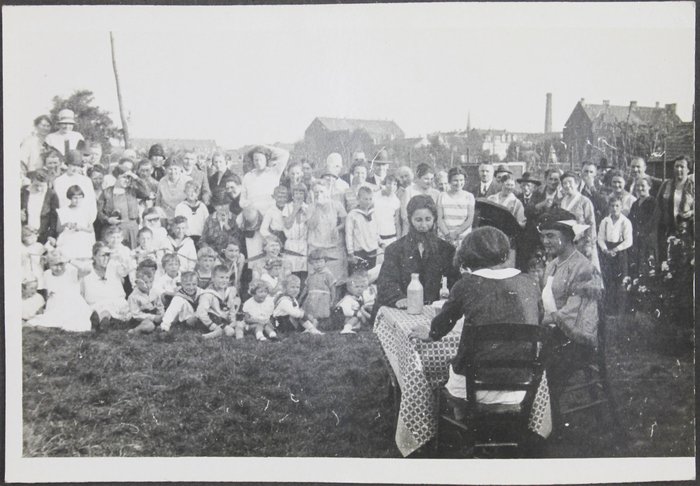
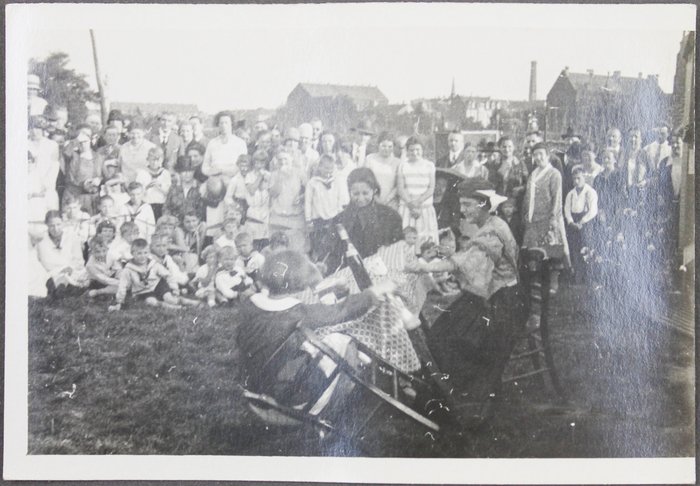
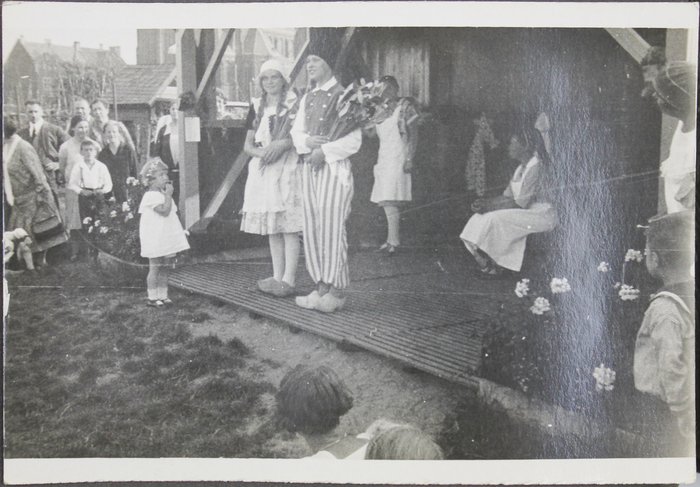
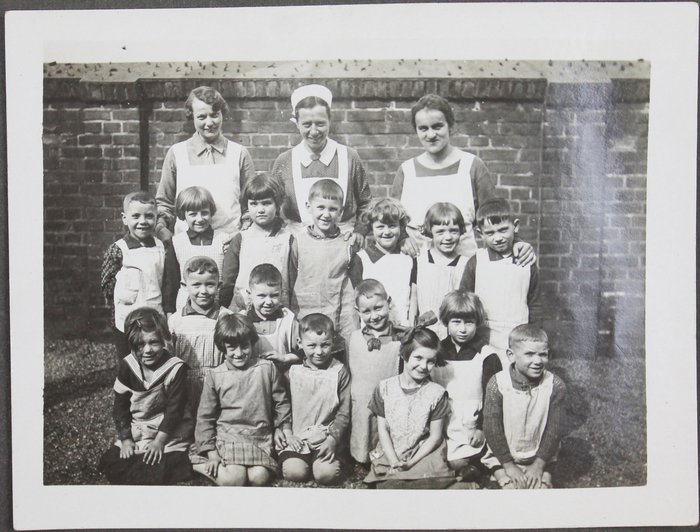
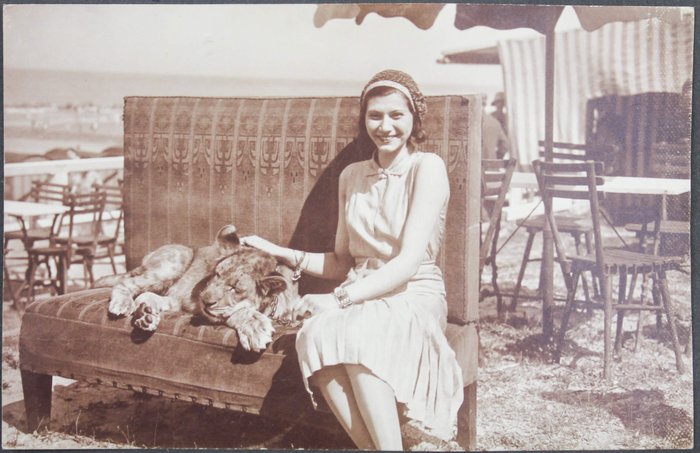
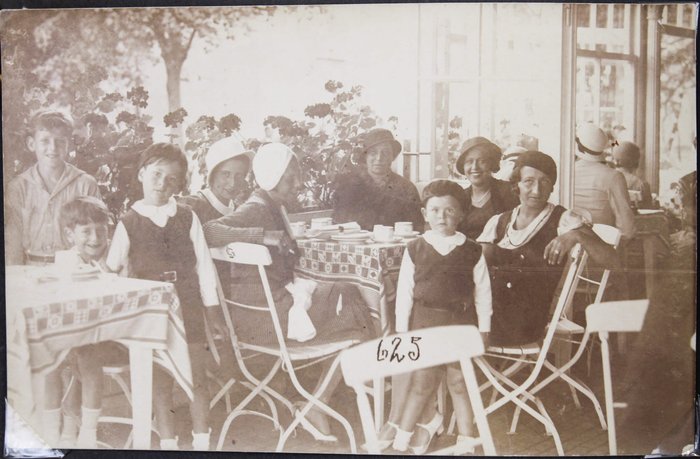
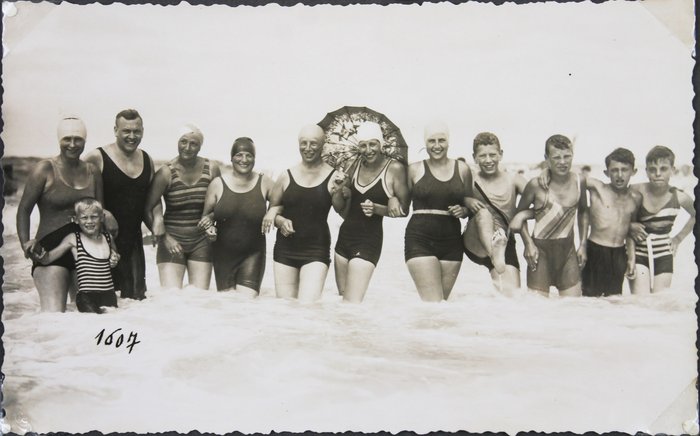
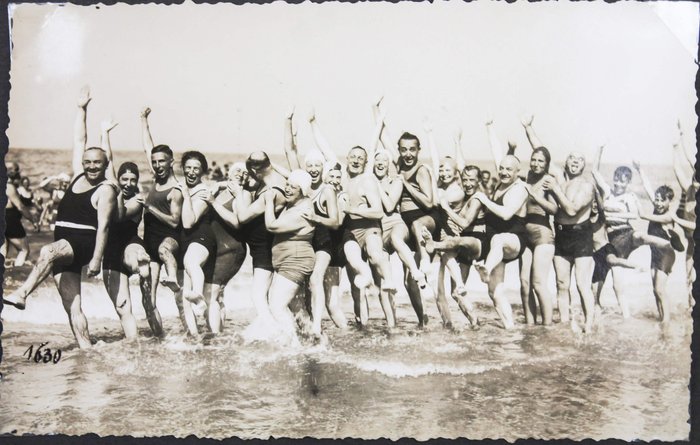
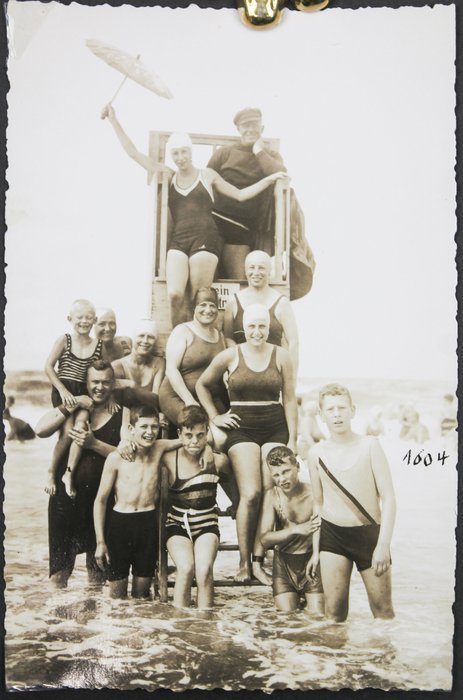
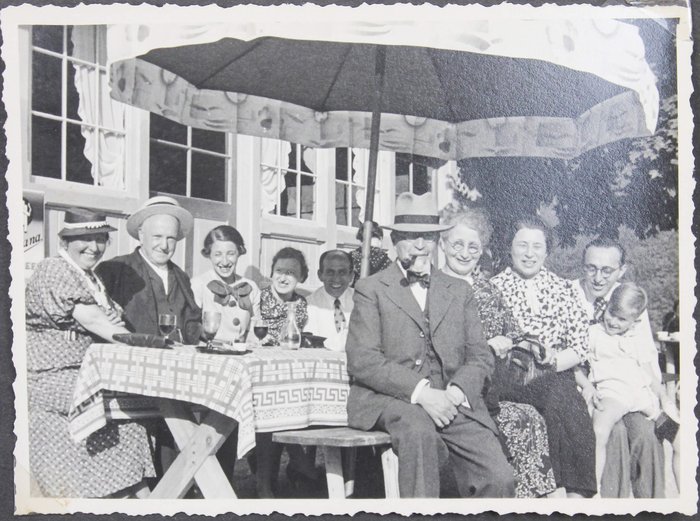
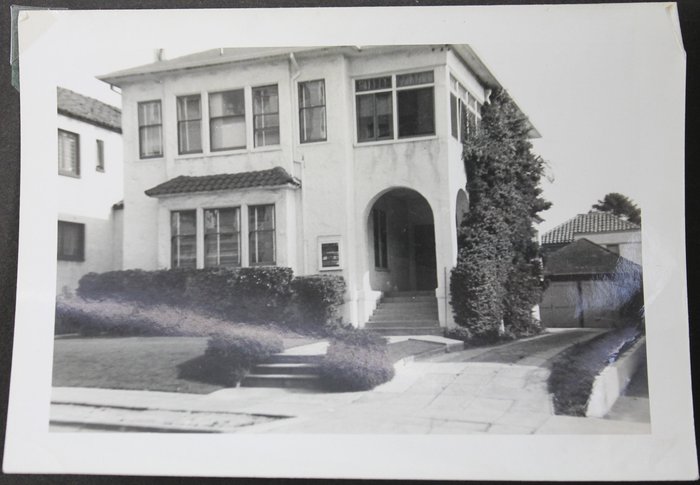
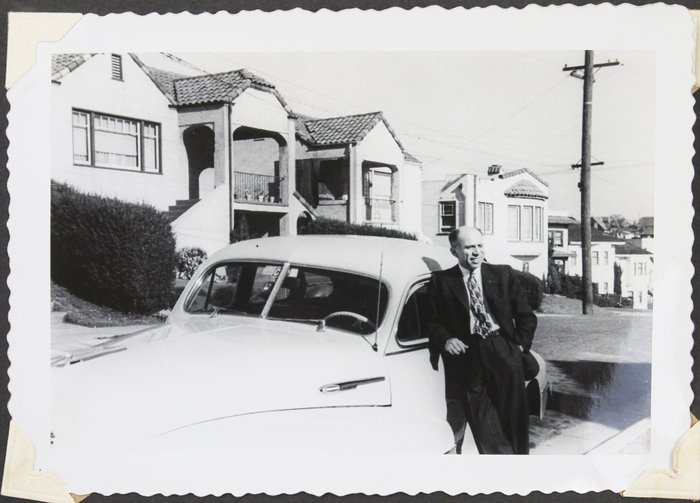
The album contains about 109 original gelatin silver photographs and real photo postcards (including ca. 65 mounted and ca. 44 loose), collected and taken by Margaret Heilbronn between 1912 and the 1940s. Many of the photographs capture Margaret in both studio and outdoor settings, from infancy through her late teens, occasionally posing with her mother. Several images bear inscriptions from early German photographic studios, including Benque & Kindermann, F. W. Knipscher Foto, B341, Ostwall 152, and Hugo Schaunbach. Especially interesting is a series of lively vernacular photos from pre-Nazi Germany depicting a large festival, likely a Shockheaded Peter installation for kindergarten children, with young spectators watching, actors in costume addressing the crowd, and children at play. Other important images include portraits of the Presidency of the Youth Federation, showing the group posed in front of a painted theatrical backdrop at City Hall, dressed in cabaret costumes, singing and performing in the Crocodile Bar. Additional photos document daily life for German youth, including swimming and posing in swimsuits. Later images, taken after Margaret’s emigration to the United States, show the exterior of their house on Summit Street, “Doc’s desk,” festive tables, and other domestic scenes. The album is further supplemented by approximately 40 loose gelatin silver photographs and postcards, featuring Margaret, Alexander, joint portraits, Moritz, and four images of Krefeld in 1945, capturing the city’s postwar ruins.
The archive comprises at least eight typewritten documents (including three original envelopes) and two handwritten letters, two German newspaper clippings, two transcripts of registration, two civilian inquiry forms, two German passports, one American passport, one memorial book, one receipt, one landing card, one business card, one driver’s license, one birth certificate, one military pass, one official letter, one conduct certificate, and one military Führungs-Attest. The documents span from the 1860s to the 1960s, providing a rare historical perspective on Jewish life in the Weimar Republic, Nazi Germany, and among émigrés in the United States.
Some of the most interesting documents from the family’s time in Nazi Germany include:
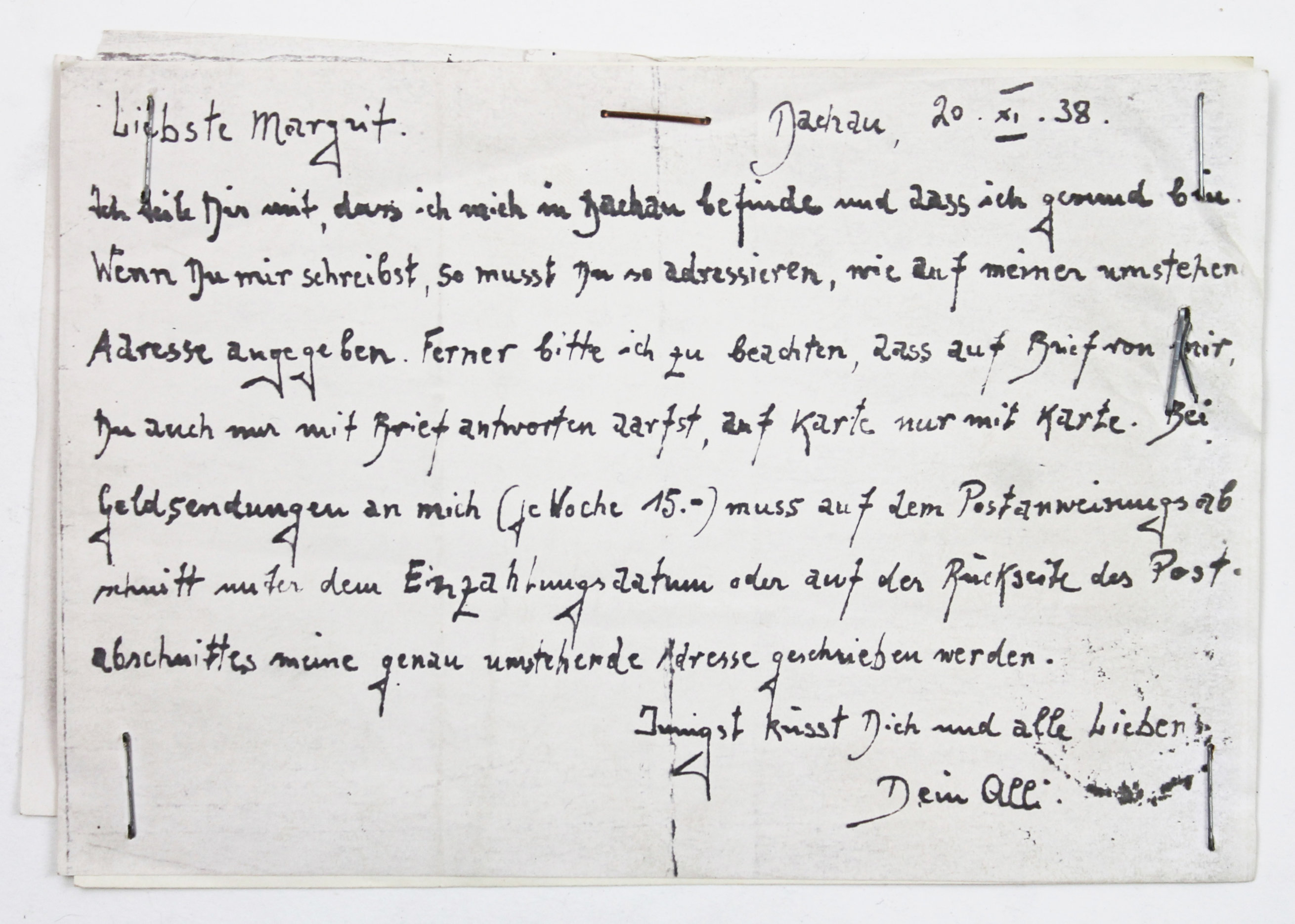
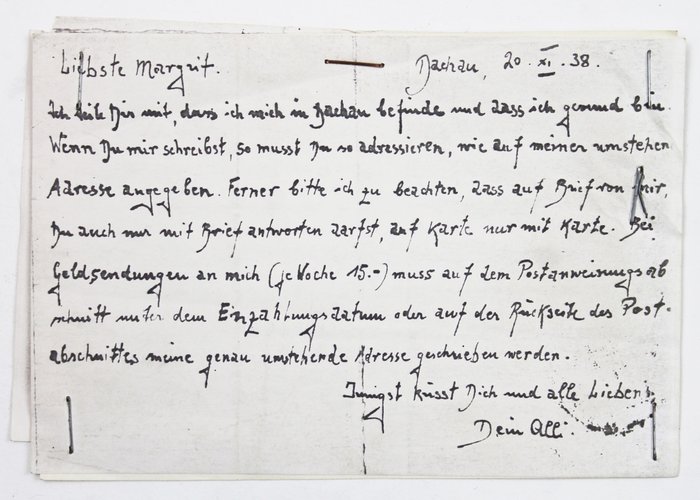
1) Heilbronn, Alexander. Dachau (concentration camp): 11 Nov 1938. 3 pp. of text. 32mo (ca. 9,6x14,1 cm or 3 ¾ x 5 ½ in). Black ink and typewritten text on white paper. Fine.
Text in German.
A letter from Alexander Heilbronn to his wife Margaret dated November 20, 1938, sent as a concentration camp postcard from Dachau (one of the first concentration camps built by Nazi Germany and the longest-running one, opening on 22 March 1933). It confirms his arrest during Kristallnacht (November 9–10, 1938) and his detention alongside thousands of other Jewish men, pressured into emigration. The message follows the camp’s required phrasing to indicate good health (English translation): “Dearest Margrit, I am telling you that I am in Dachay and that I am healthy. When you write to me, you must address it as shown on the back. Furthermore, I ask you to note that I may only respond to letters with a letter, and to cards only with a card.” The verso contains printed Dachau camp regulations (3K): prisoners could send or receive only two letters or cards per month; all correspondence had to be written in ink, legible, and no longer than 15 lines. His address is listed as Block 21, Stube (Room 4).
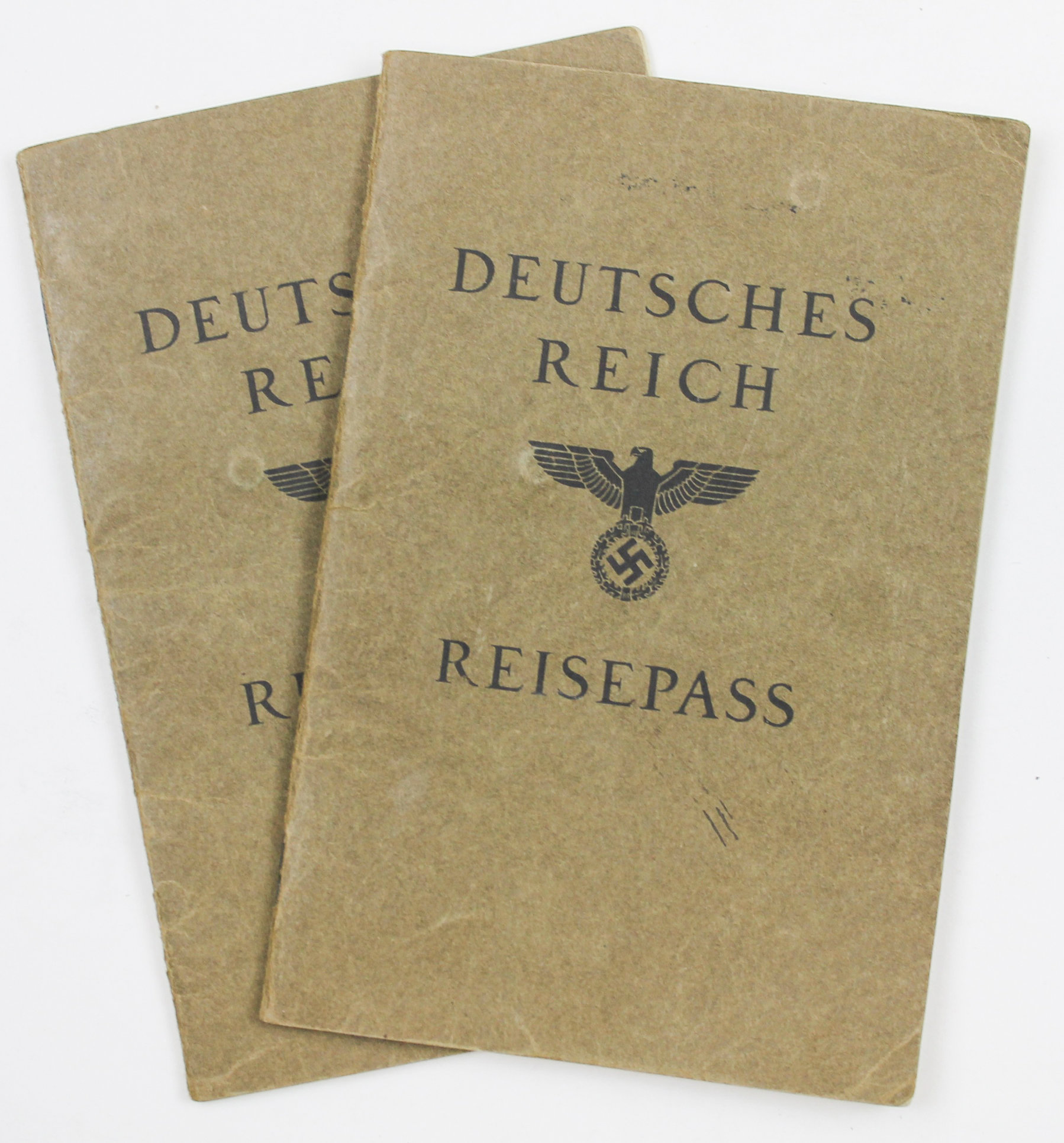
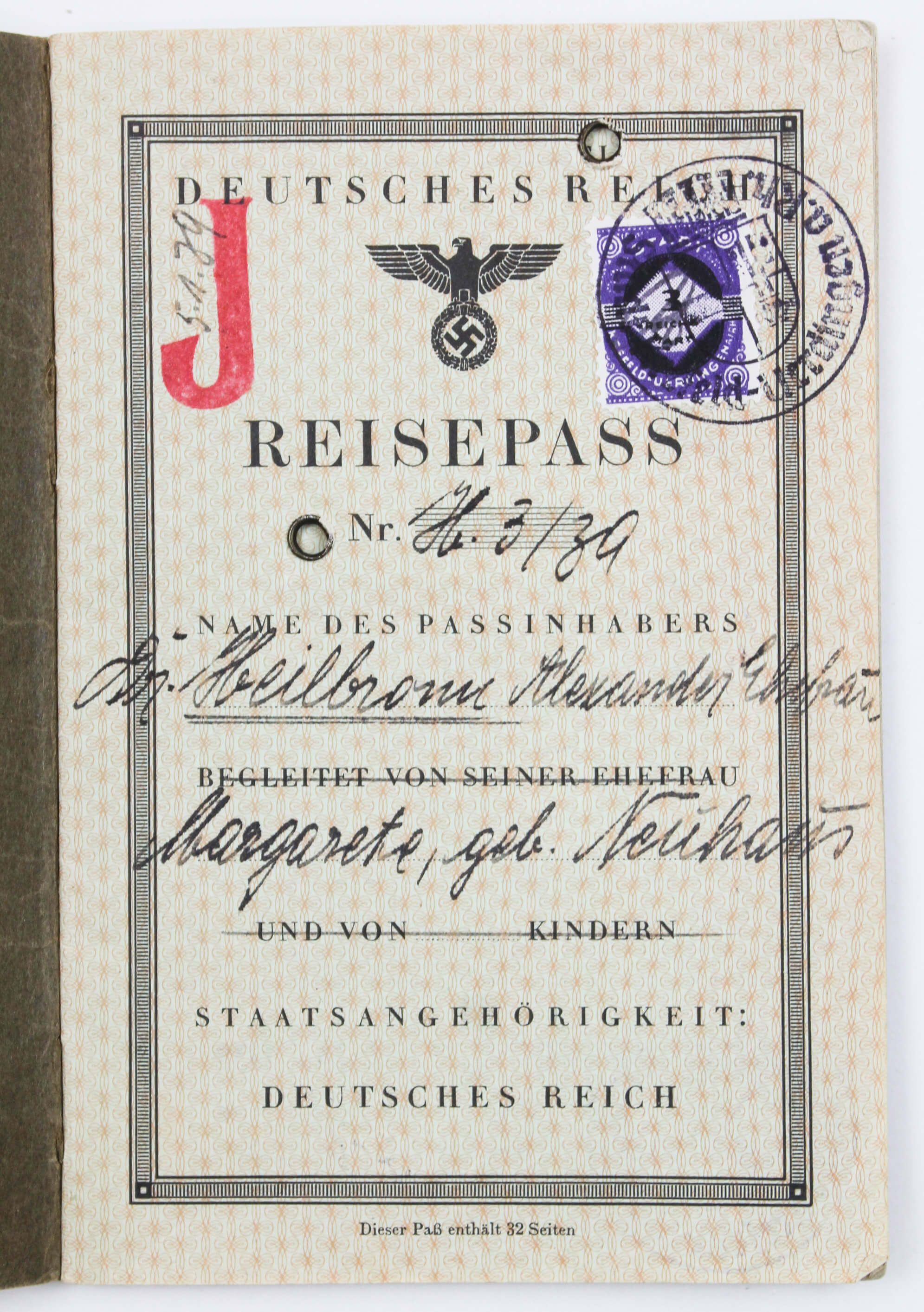
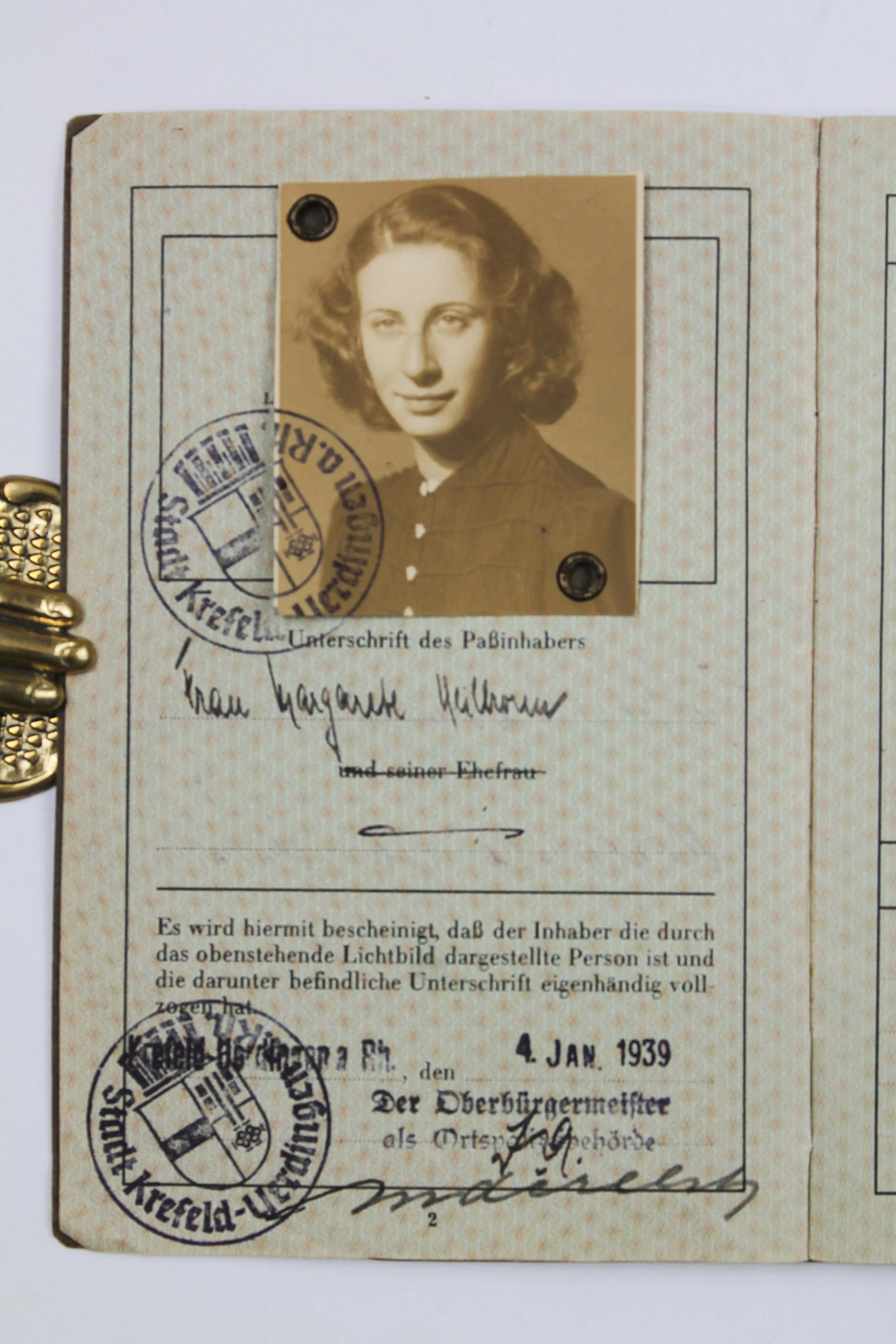
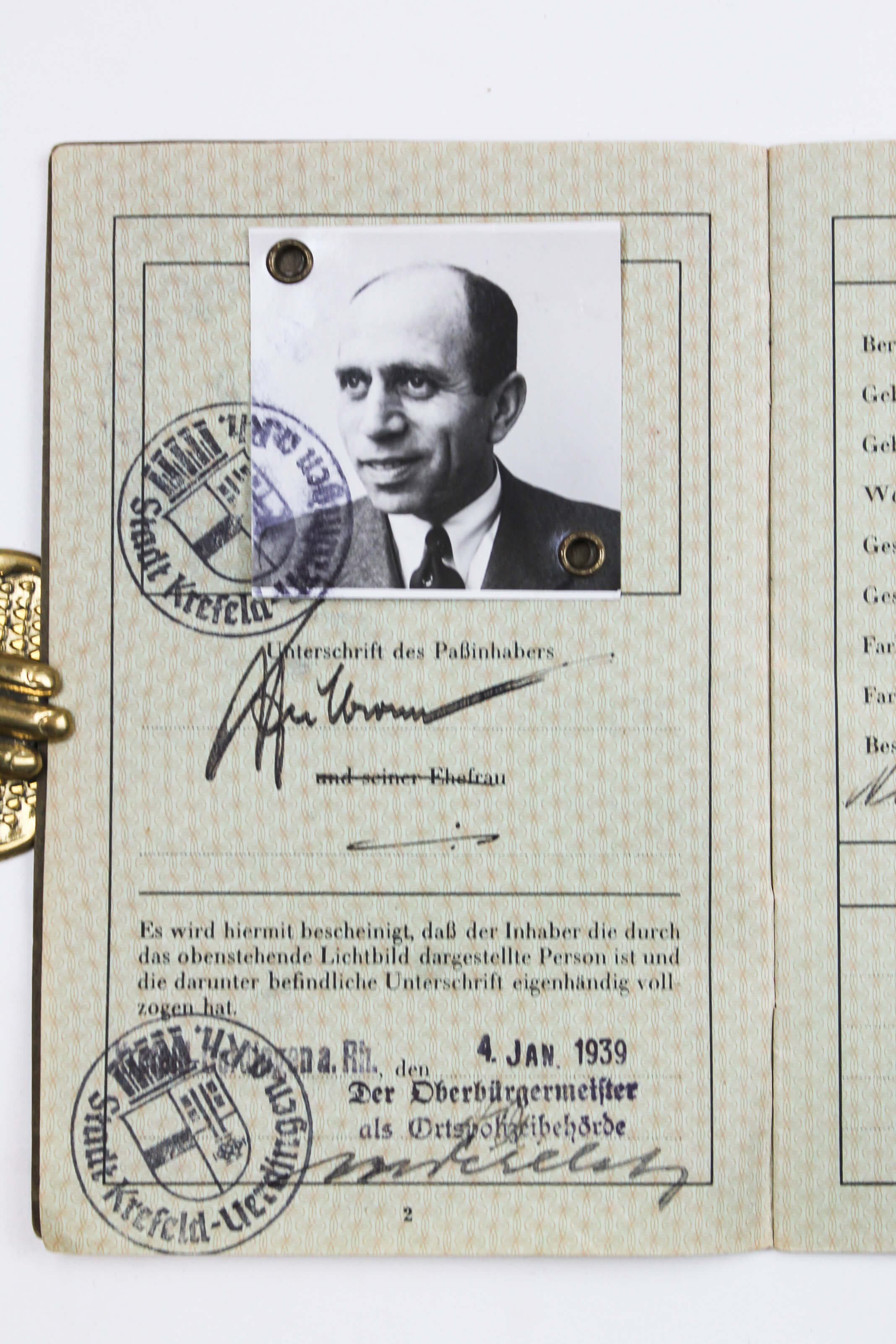
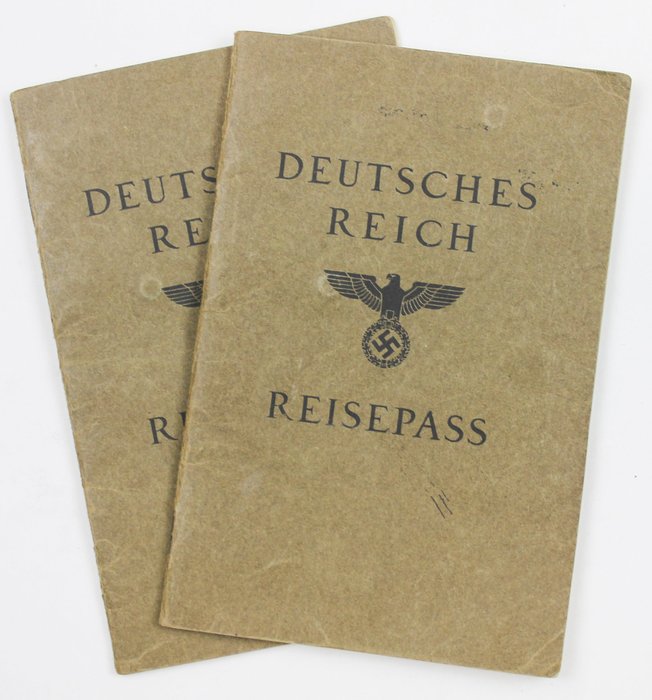
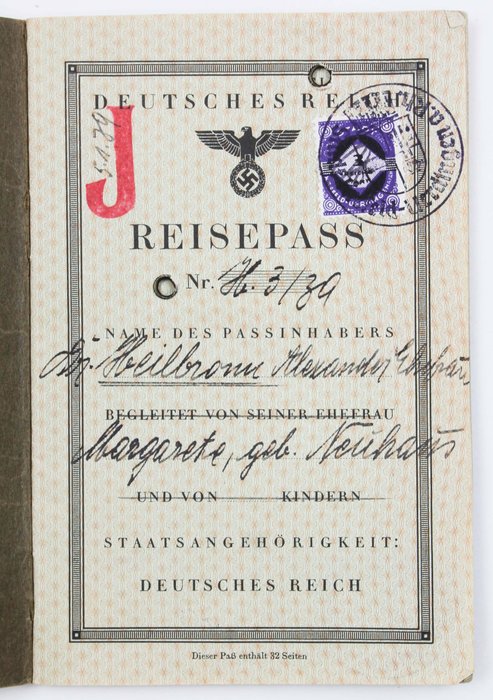
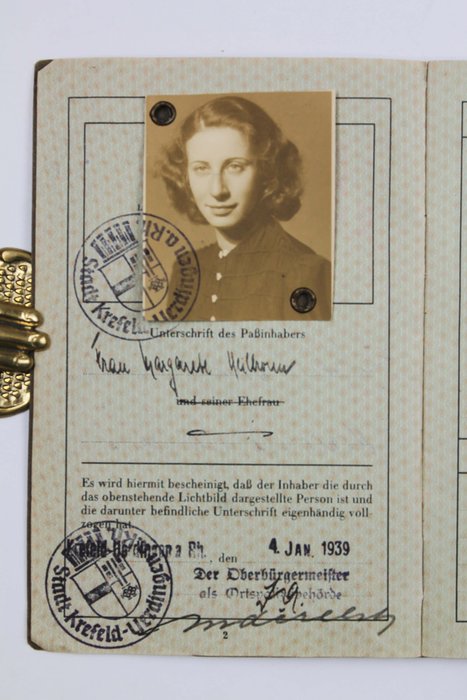
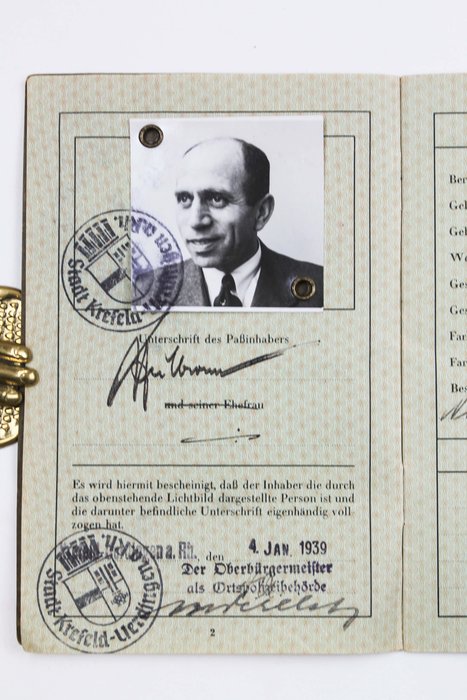
2) Deutsches Reich Reisepass [i.e. German Reich Passport]. Krefeld: 1939. Each 32 pp: one black-and-white photo, stamps. Each passport ca. 16,5x10,8 cm or 6 ½ x 4 ¼ in. Fine condition
Two German passports issued to Alexander Heilbronn and Margaret in January 1939, after the former was released from Dachau. The covers display the Nazi Party eagle and swastika emblem, while the interior pages bear the large red “J” for Jude, the designation imposed on Jewish passport holders beginning in late 1938. Each passport contains a photograph and brief personal details, as well as an entry from the Deutsche Bank Krefeld branch, restricting the bearer to only 9.93 Reichsmarks in foreign currency (a regulation designed to strip Jewish emigrants of their assets prior to departure). Also present are a Direct Transit visa issued by the British Vice-Consul in Cologne in January 1939 and multiple official stamps, including those of the Immigration Officer in London, the Nijmegen checkpoint, and the Arnhem Police Alien Service.
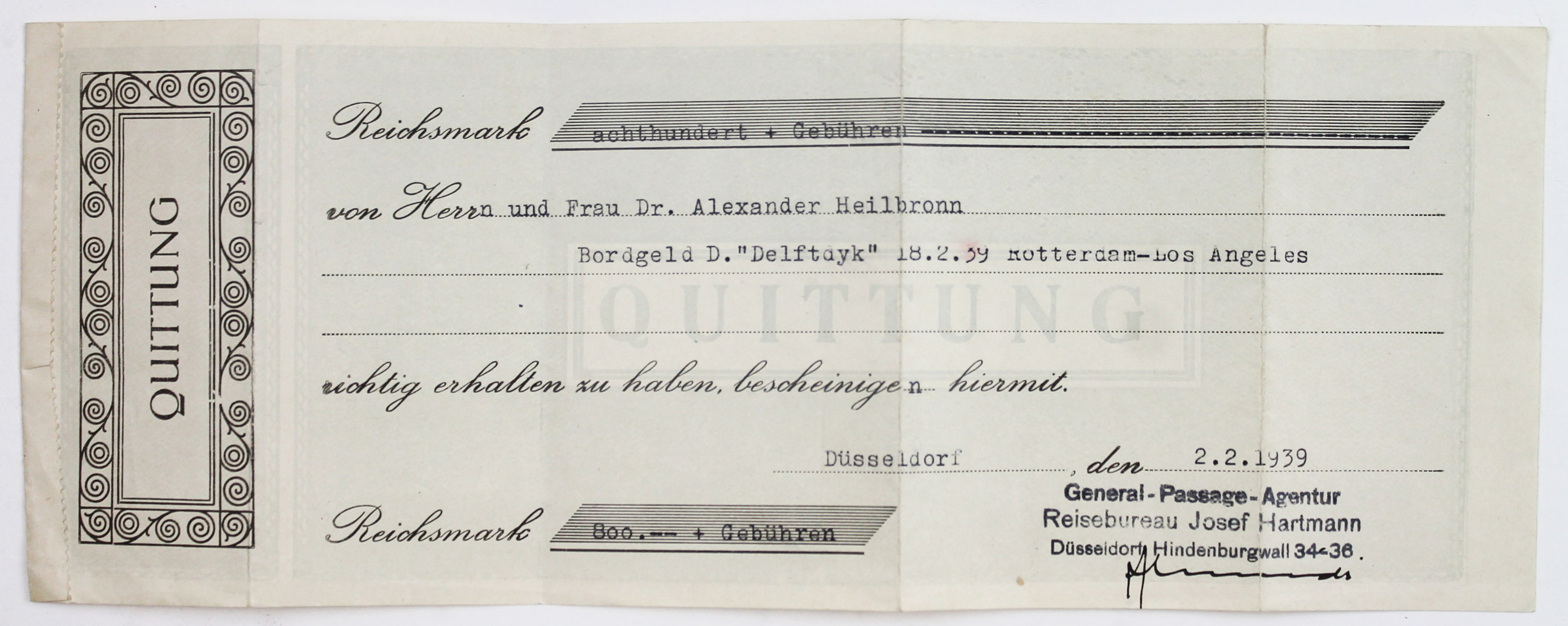
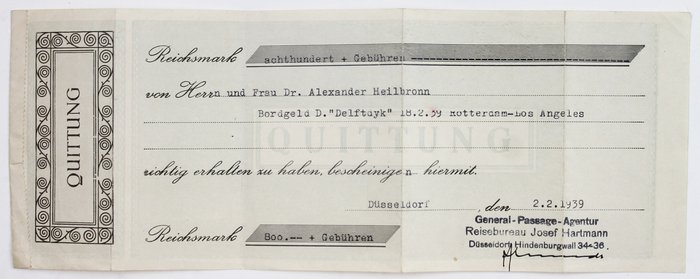
3) Quittung [i.e. Receipt]. Düsseldorf: 2 February 1939. 1 p. of typewritten text. 10,4x27,3 cm or 4 x 10 ¾ in. Fold marks, but otherwise in a very good condition.
Text in German.
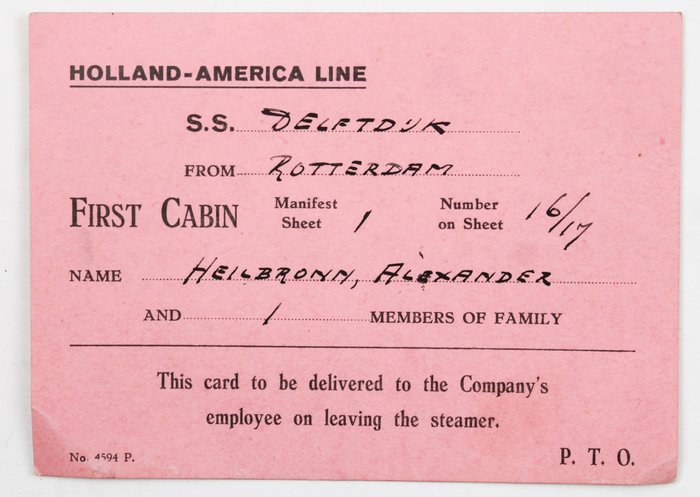
A receipt dated 2 February 1939, documenting payment for the Heilbronns’ passage from Nazi Germany to the United States. Issued by the Josef Harmann Travel Bureau in Düsseldorf, the document outlines their route from Rotterdam to Los Angeles, with departure scheduled for February 18, 1939 aboard the Holland-American liner Delftdyk.
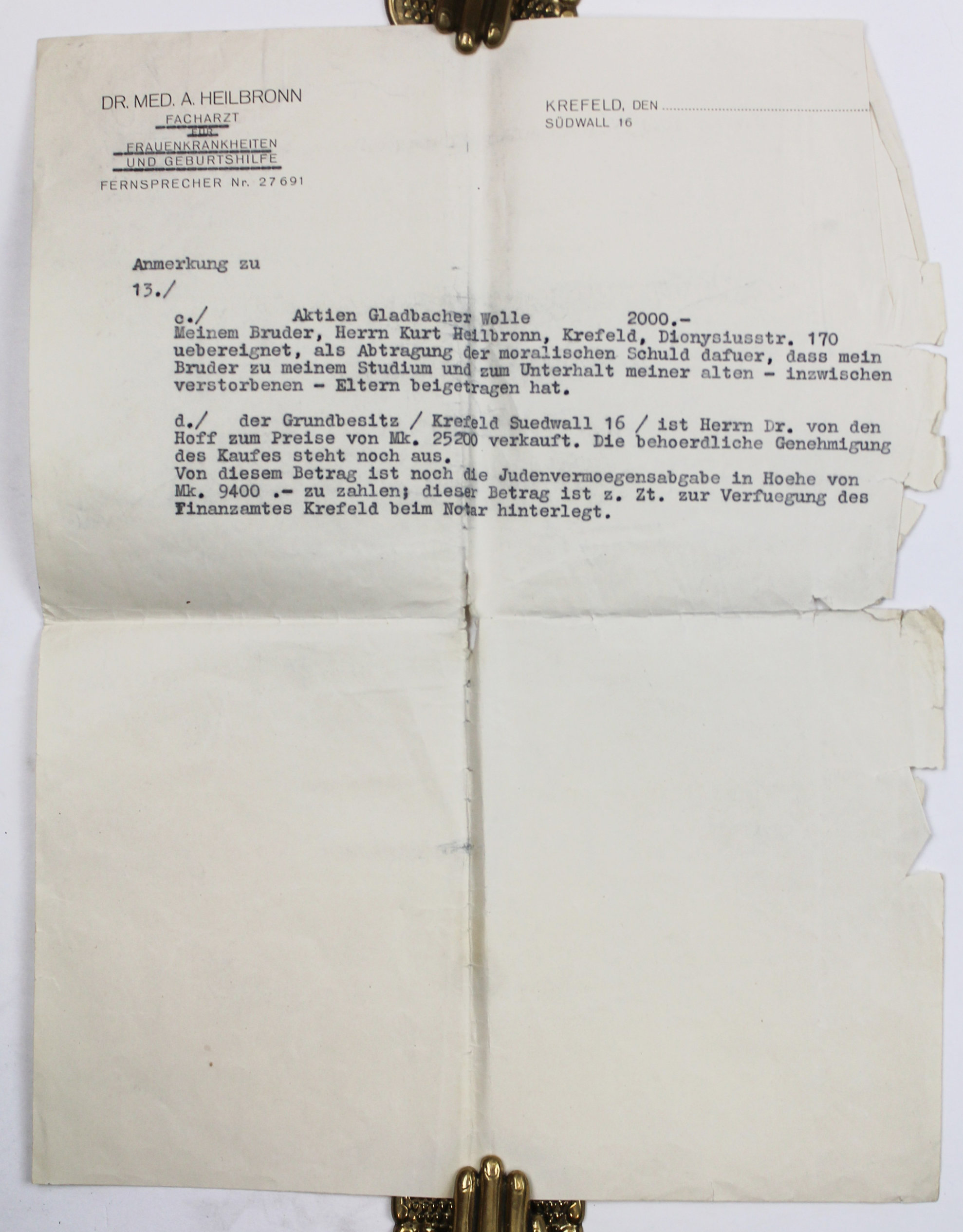
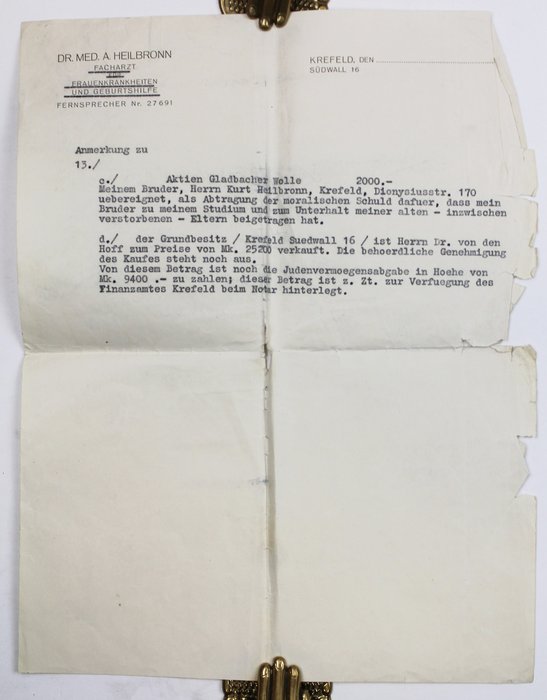
4) Krefeld: [1938]. 1 p. of text. Small Folio (ca. 28,8 x 22,4 cm or 11 ½ x 8 ¾ in). Typewritten text on white paper. Fold marks, tears and loss of small fragments at the right margin, but otherwise very good.
Text in German.
Typed formal declaration detailing the assets and forced financial obligations of Dr. Alexander Heilbronn in connection with his emigration to the United States. The document records the transfer of 2,000 RM in “Gladbach Wool” textile shares to his brother Kurt as repayment for family support and medical studies, and the sale of the Süedwall 16 property to Dr. von den Hoff for 25,200 RM—of which 9,400 RM was confiscated under the Jewish Wealth Levy.
5) [Krefeld:] 22 December 1938. 2 pp. of text. Small Folio (ca. 29,5x20,9 cm or 8 ¼ x 11 ¾ in). Carbon copy of a typewritten text. Signed in manuscript by Herrn Heilbronn. Fold marks, but otherwise very good.
Text in German.
Typed carbon copy of a formal emigration questionnaire, likely part of the clearance documentation required for Jewish citizens seeking to leave Nazi Germany. Completed by Dr. Alexander Heilbronn prior to his departure for the United States, it records his identity and Krefeld address, declares assets of 29,000 RM, bank accounts at Deutsche Bank, and notes his parents-in-law’s assets totaling 75,000 RM.
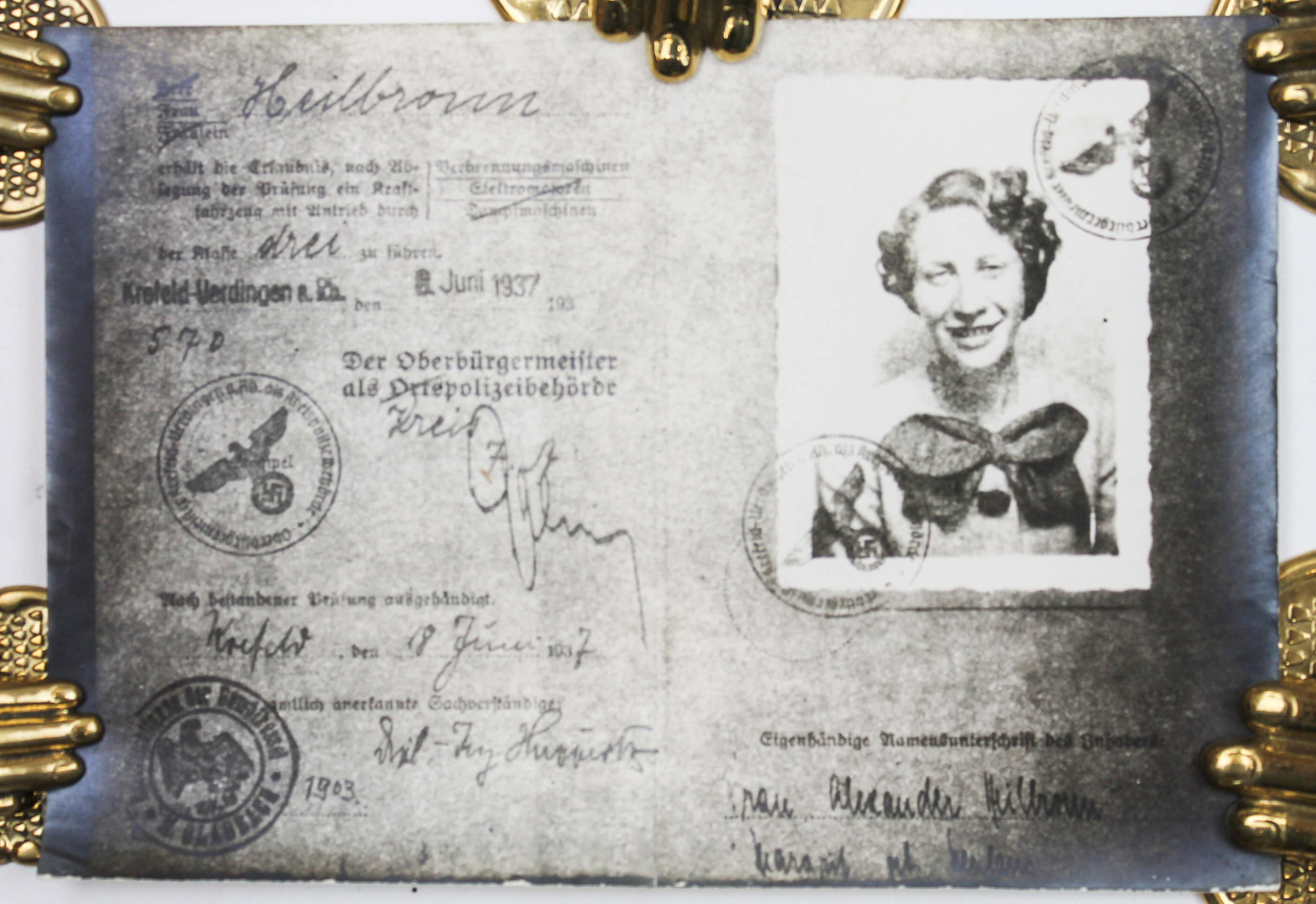
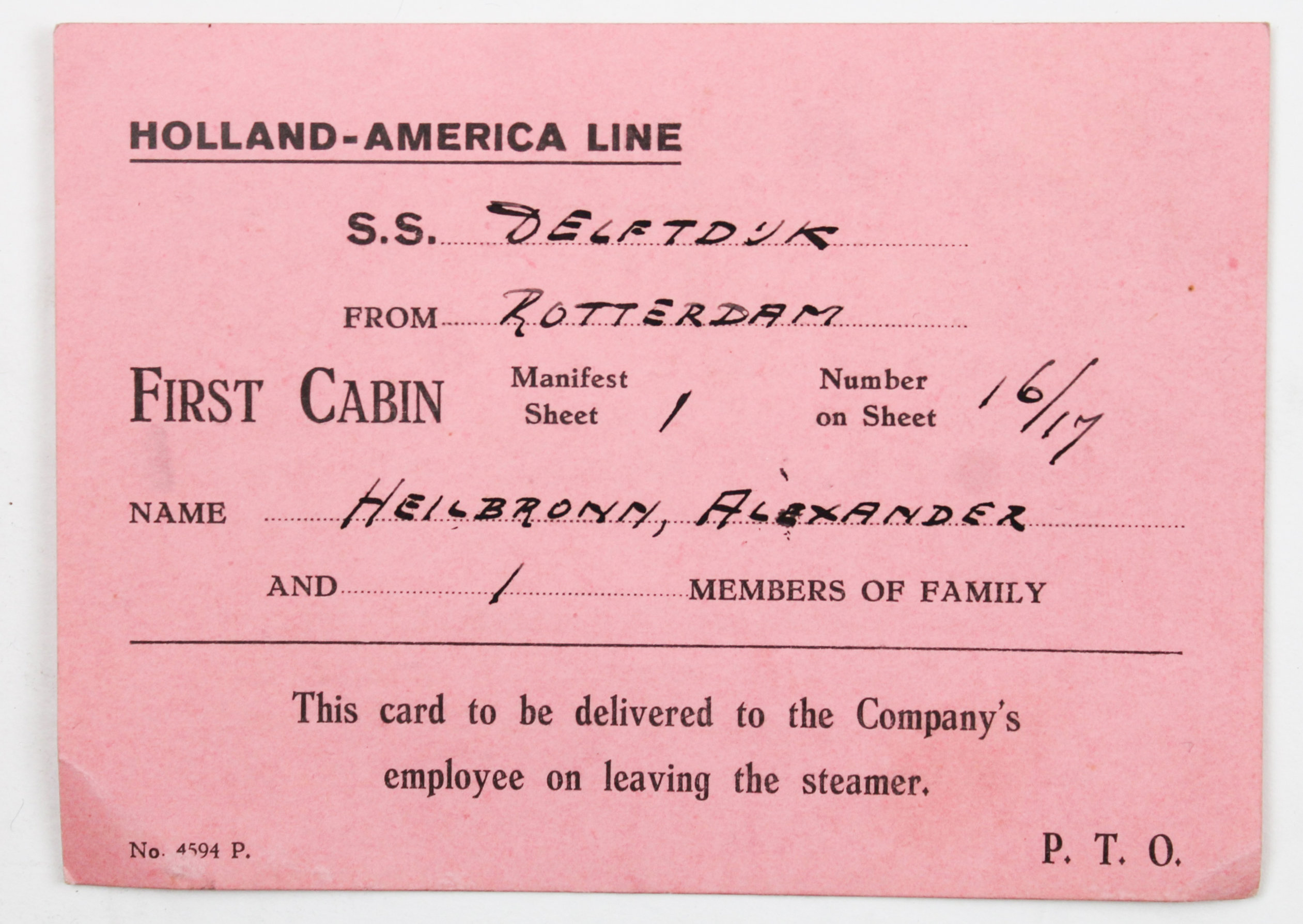
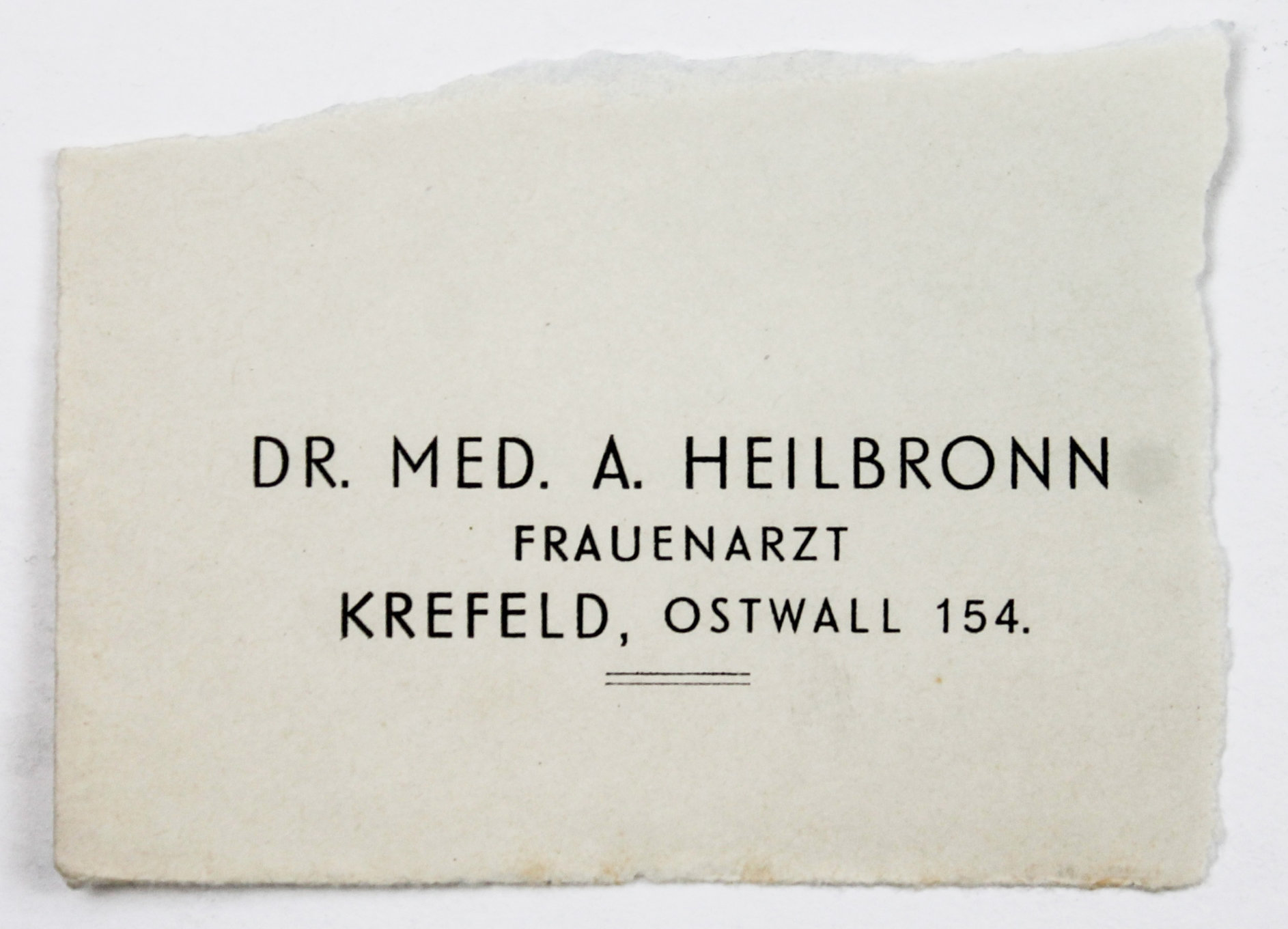
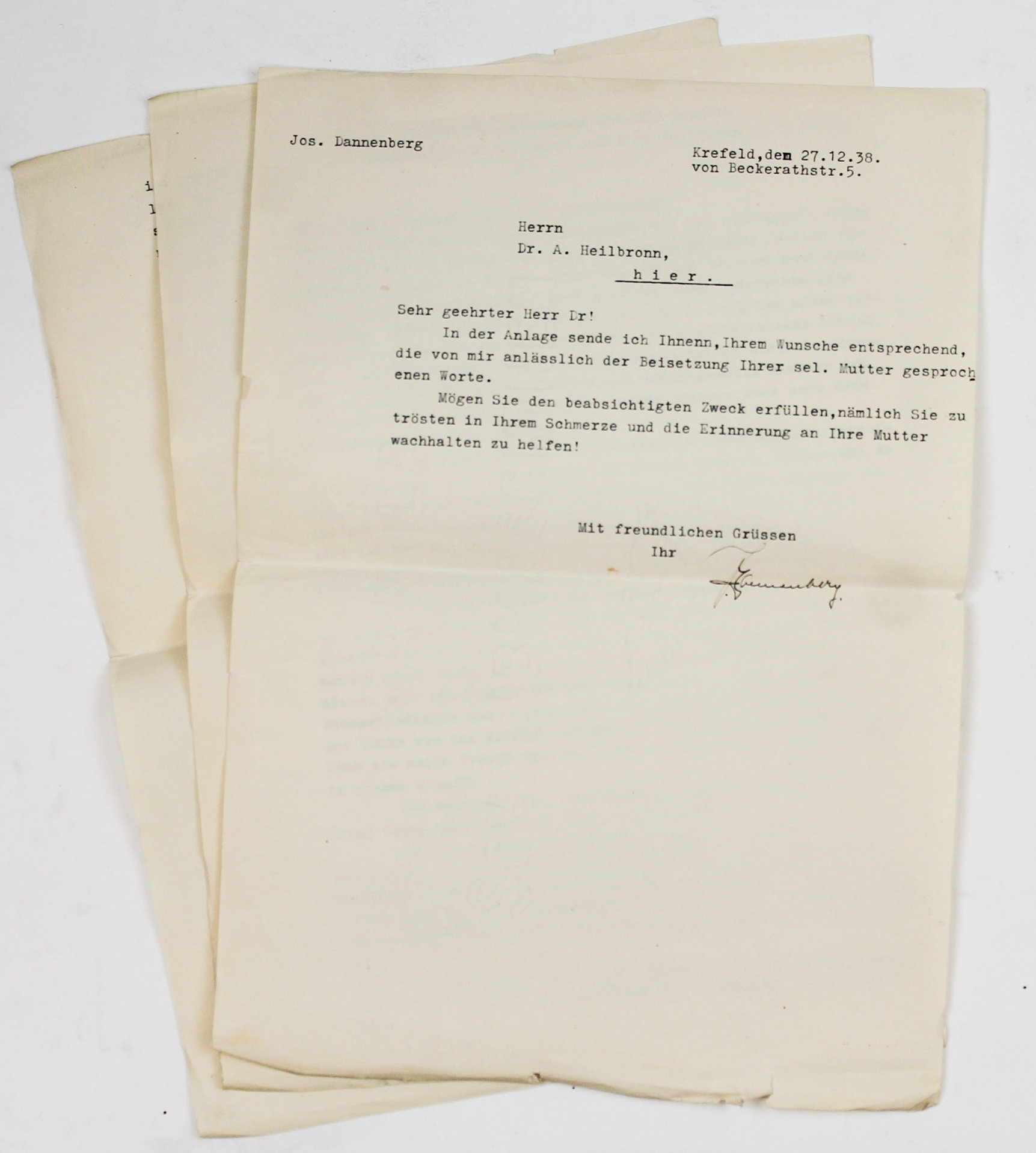
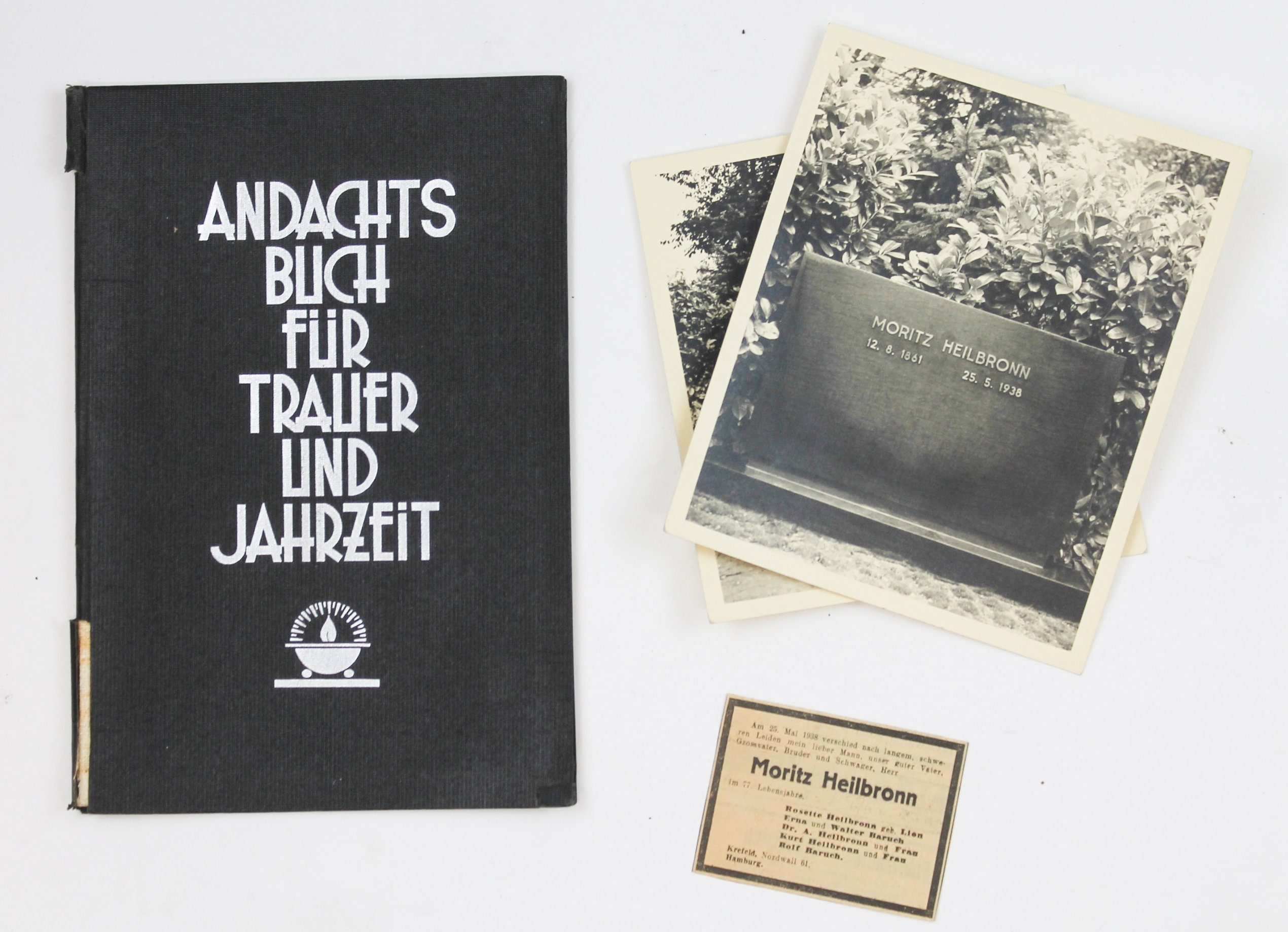
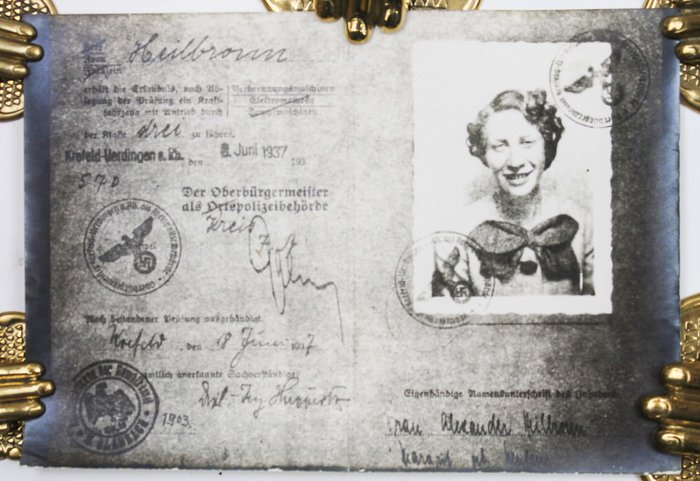
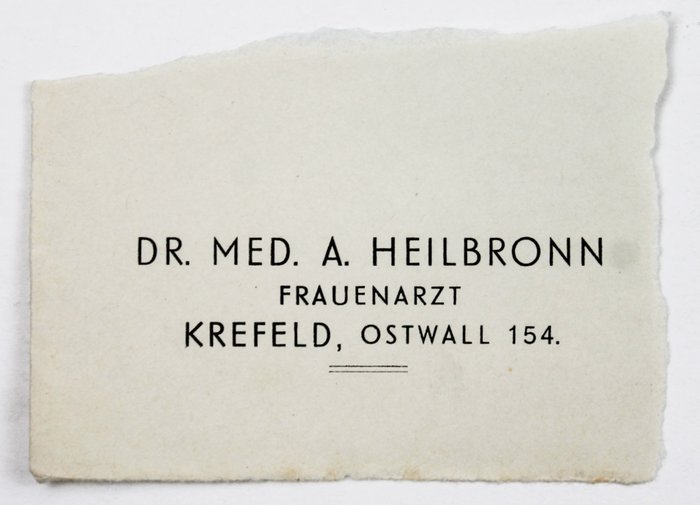
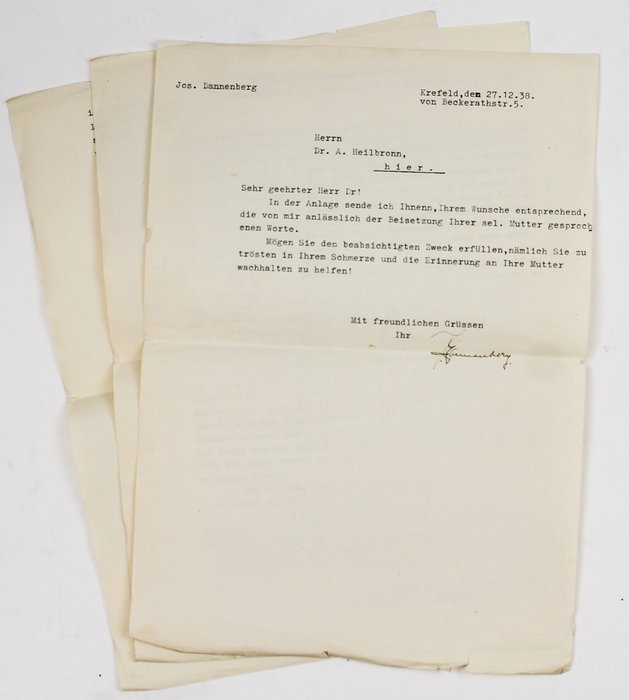
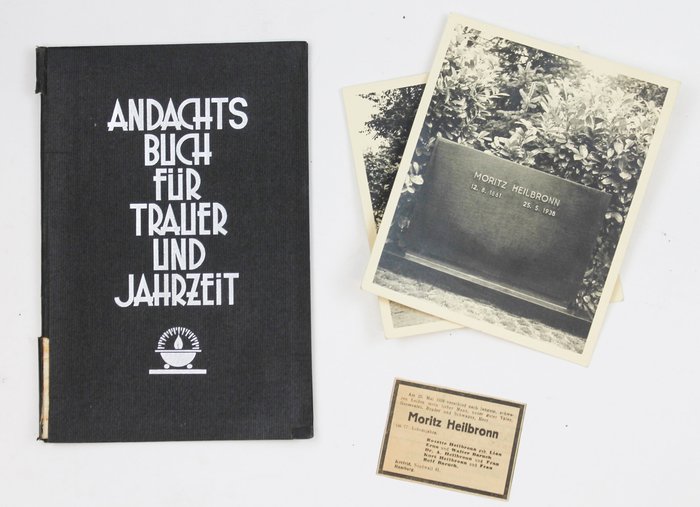
Other documents from this period include: Jewish memorial devotional and Yahrzeit book published in Berlin in 1938 and dedicated to the memory of Moritz Heilbronn. Issued in Nazi Germany in the same year as Kristallnacht, it was edited by Rabbi Manfred Swarsensky, a prominent communal leader who was later imprisoned in Sachsenhausen. The book is accompanied by three photographs of Moritz’s grave and includes his German obituary; 1937 driver’s license issued to Margaret Heilbronn in Krefeld. The document bears the Nazi eagle and swastika stamps and includes her photograph; Alexander Heilbronn’s business card, listing him as a gynecologist/obstetrician with an office at Ostwall 154, Krefeld; typed letter dated February 13, 1939, from Dr. Alexander Heilbronn to the electricity company Sanitas in Berlin, requesting that payment for undelivered equipment be transferred to the Jewish Community of Krefeld, as he is leaving Germany that day; Legal inheritance contract from Krefeld District Court, dated 1938, recording an agreement between Rosette Heilbronn and her children Kurt, Alexander, and Erna; three-page typewritten letter from Jos. Dannenberg to Dr. A. Heilbronn (Dec 27, 1938), enclosing the transcript of Frau Heilbronn’s funeral eulogy, “Words of Remembrance and Consolation” (Dec 8, 1938); and first-class landing card for the Delftdyk.
Some of the most interesting documents from the Heilbronns’ years in the United States encompass:
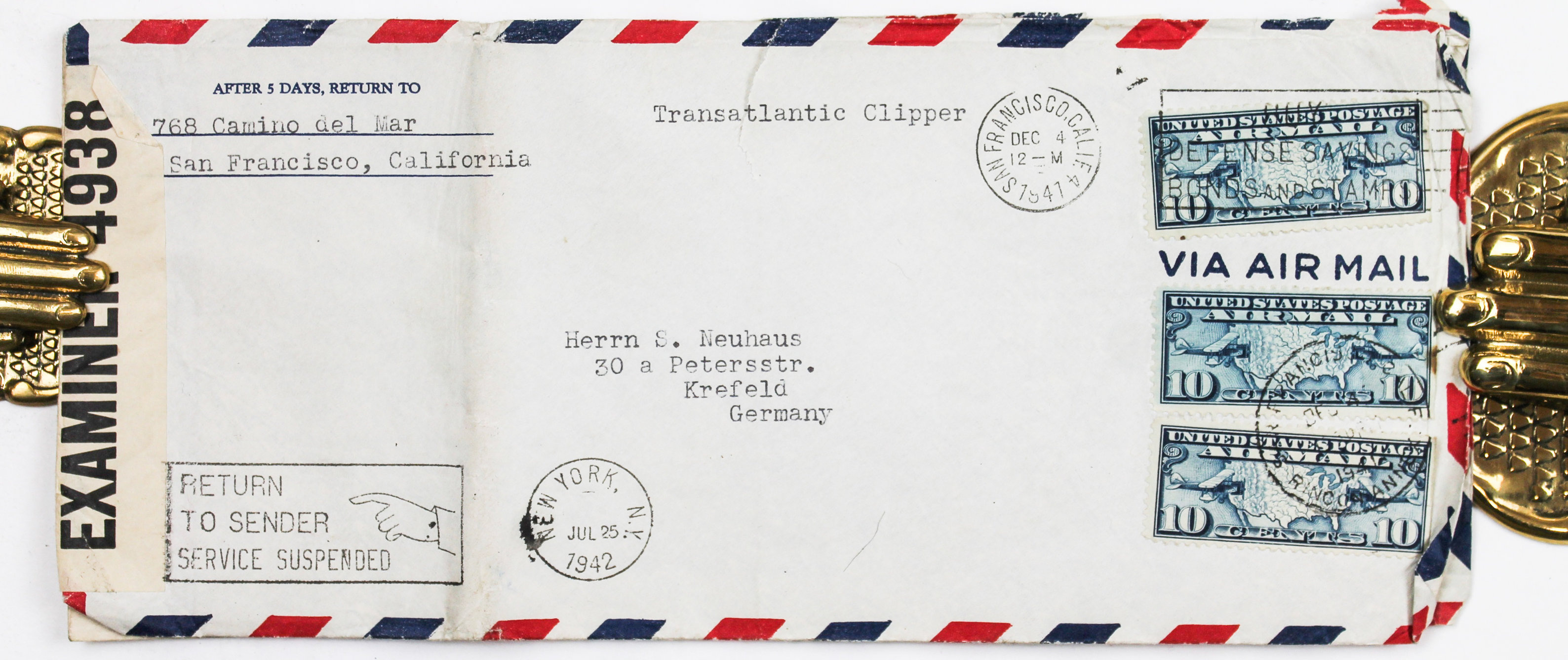
1) Malie & Alli. San Francisco: 26 November 1941. 1 p. Quarto (ca. 29,5x20,7 cm or 11 ¾ x 8 in). Carbon copy of a typewritten text. Signed in manuscript by “Malie und Alli.”; with original envelope (ca. 10,5x24 cm or 4 x 9 ½ in). Envelope addressed and stamped (including “Return to Sender. Service Suspended”). Letter with fold marks, envelope rubbed, tears from opening, but otherwise very good.
Text in German.
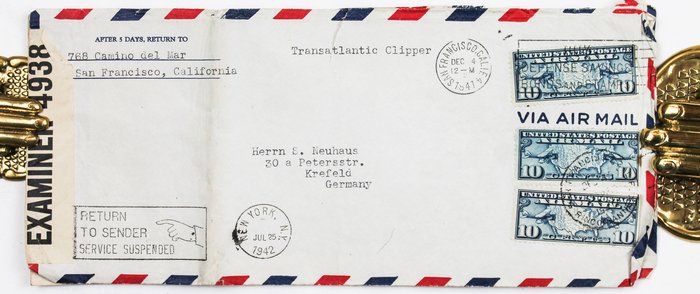
A typewritten letter dated November 26, 1941, sent from San Francisco to Herrn S. Neuhaus, Petersstrasse 30a, Krefeld (a known Jewish house where families were later consolidated prior to deportation). Likely written by Margaret’s cousin “Alli”, the letter expresses hope that her parents might still secure the necessary documents to emigrate. It discusses whether to deposit funds with the Joint (JDC) or a travel agency, noting that agencies were faster but risked heavy losses if passage was canceled. The writers mention efforts by friends and relatives, including one “Loewenberg” in Havana, to obtain Cuban visas, and report that acquaintances (Mr. Hertz) had recently received theirs. Sent via “Transatlantic Clipper,” the letter was ultimately stamped “Return to Sender – Service Suspended” in July 1942, after the United States entered World War II and transatlantic transport ceased—rendering such visa hopes futile.
2) San Francisco: 4 December 1941. Envelope: ca. 10,5x24 cm or 4 x 9 ½ in. Addressed, stamped (including “Return to Sender. Service Suspended), and with three 10-cent United States Postage Defense Saving Bonds and Stamps. Envelope rubbed, fold marks, tears from opening, but otherwise very good.
Half-closed envelope with enclosed German letter from the Heilbronns to Herrn S. Neuhaus in Krefeld. Sent via “Transatlantic Clipper,” the correspondence was later stamped “Return to Sender – Service Suspended.”
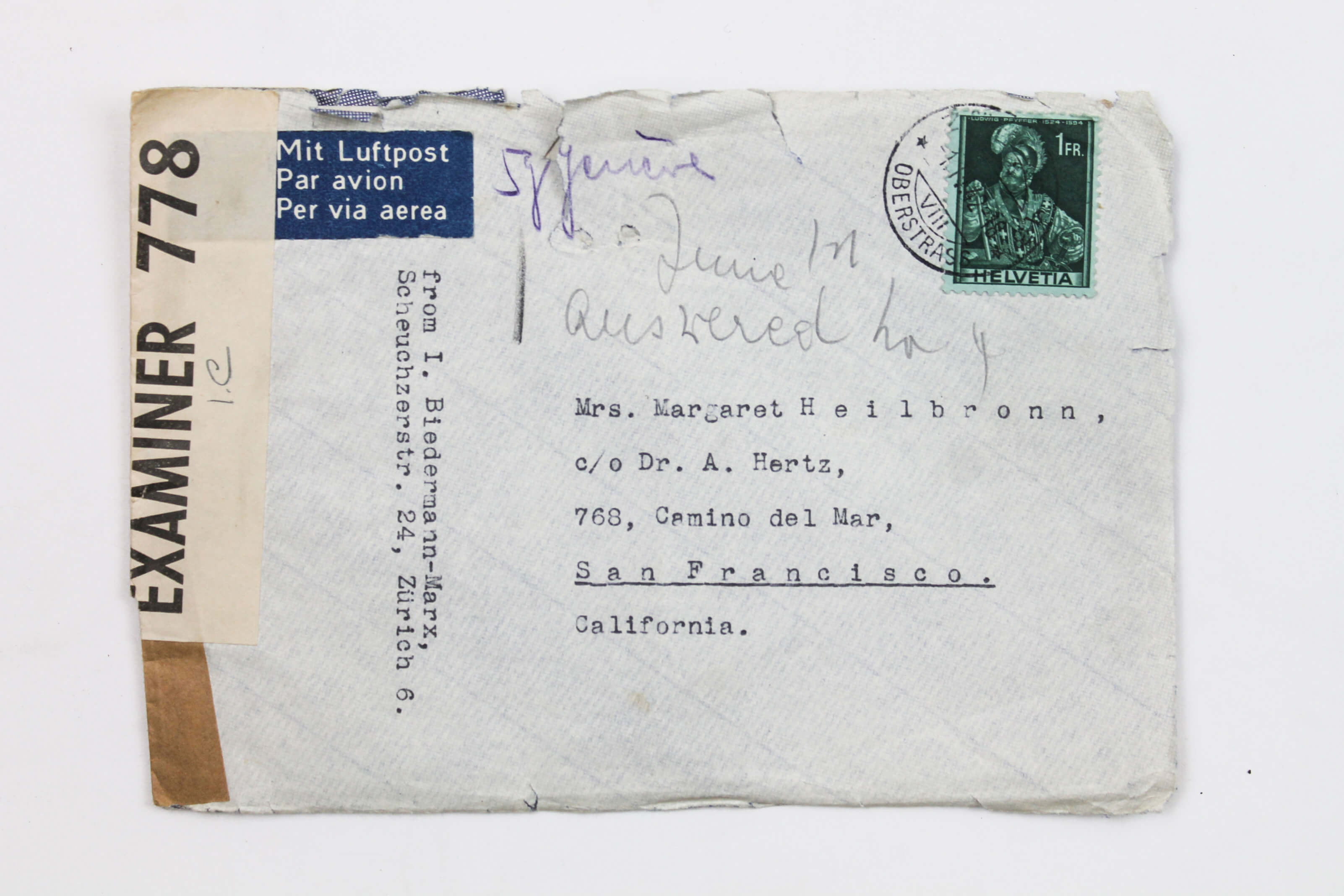
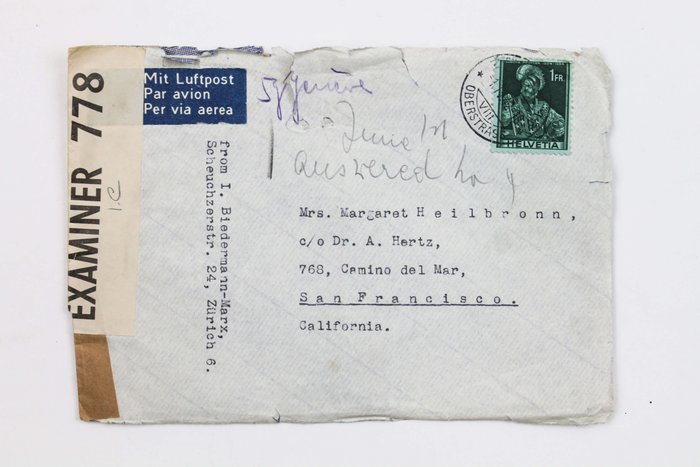
3) Biedermann-Marx, I. Zurich: 31 March 1942. 2 pp. of text. Quarto (ca. 29,5x20,5 cm or 11 ½ x 8 in). Carbon copy of typewritten text. Signed in manuscript by “Helle & Max;” with original envelope (ca. 11,3x16,4 cm or 4 ½ x 6 ½ in). Enveloped addressed and stamped. Letters with tears, envelope rubbed with loss of the fragments, but otherwise very good.
Text in German.
Two-page typewritten letter dated March 31, 1942, sent from Zurich by I. Biedermann-Marx to Mrs. Margaret Heilbronn, 768 Camino Del Mar, San Francisco. The letter recounts efforts to trace missing relatives through the Red Cross and reports deportations, noting that family members were permitted to take only field beds and mattresses as “precious goods.” It describes severe shortages, starving children arriving from France, export restrictions in Lisbon limiting food shipments, and difficulties sustaining the family corset business in Switzerland. Dr. A. Hertz is listed as a contact; no news had been received from Erna. The letter closes with cautious optimism for an Allied victory and is signed “Helle & Max.”
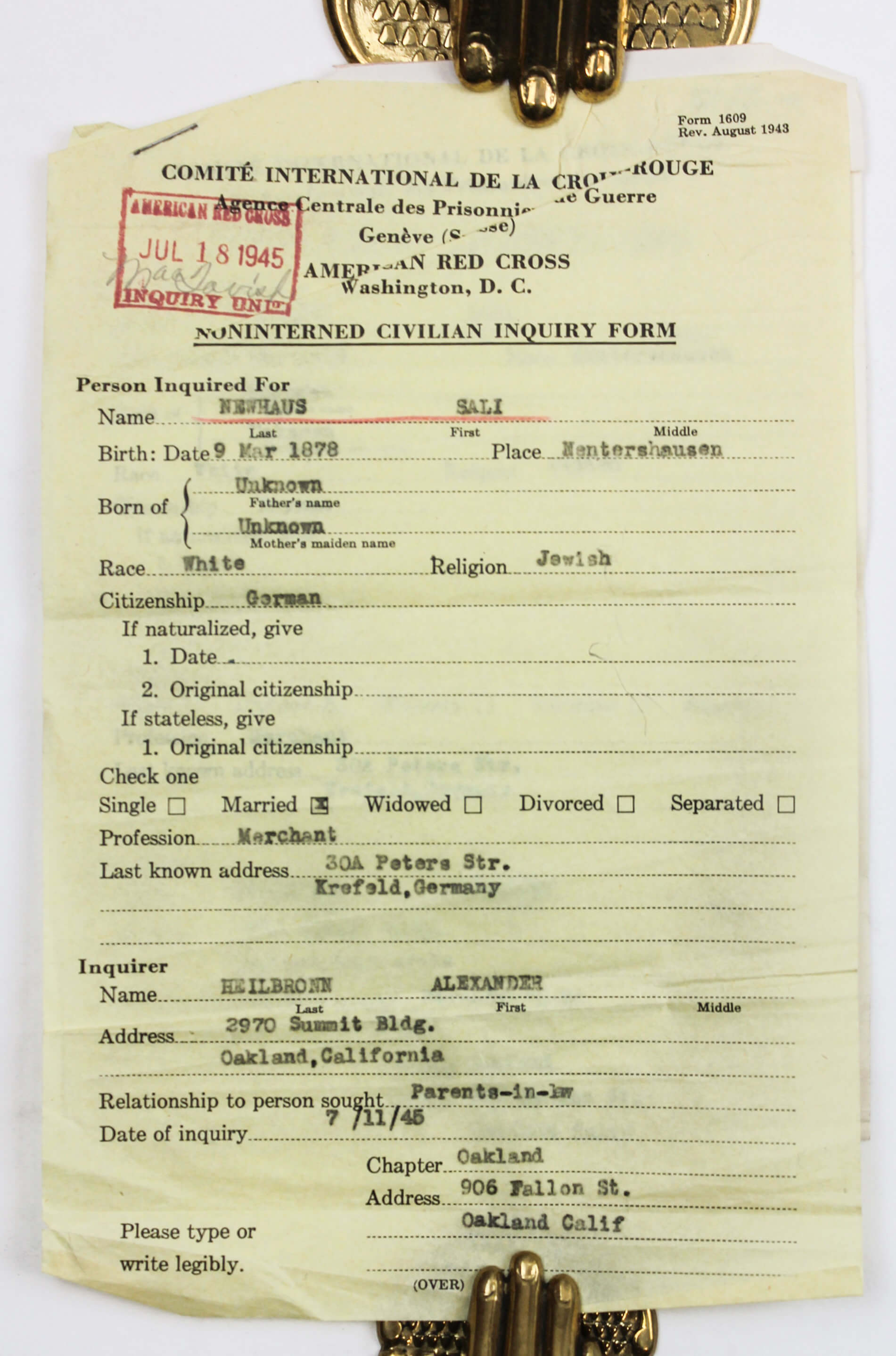
4) Heilbronn, A. Two “Noninterned Civilian Inquiry Forms.” Oakland: 18 July 1945. 4 pp. (including two pages of carbon copies stapled). Octavo (each ca. 21,3x13,8 cm or 8 ½ x 5 ½ in). Typewritten text on yellow carbon copies and white papers. With the stamp of the American Red Cross. Fold marks, but otherwise very good.
Text in English.
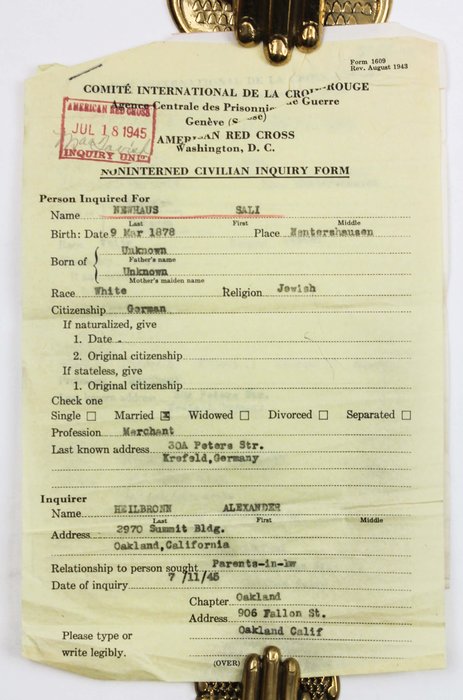
Two “Non-Interned Civilian Inquiry” forms issued by the International Committee of the Red Cross and processed by the American Red Cross, completed and stamped on July 18, 1945. Filed only two months after the end of World War II, the tracing requests were submitted by Alexander Heilbronn in an effort to locate his sister, Erna Baruch Heilbronn (b. 1892), and his father-in-law, Sali Neuhaus (1878–1941), who had gone missing during the Holocaust. Subsequent research confirms that both were victims of the Holocaust, including Sali, who perished in Riga.
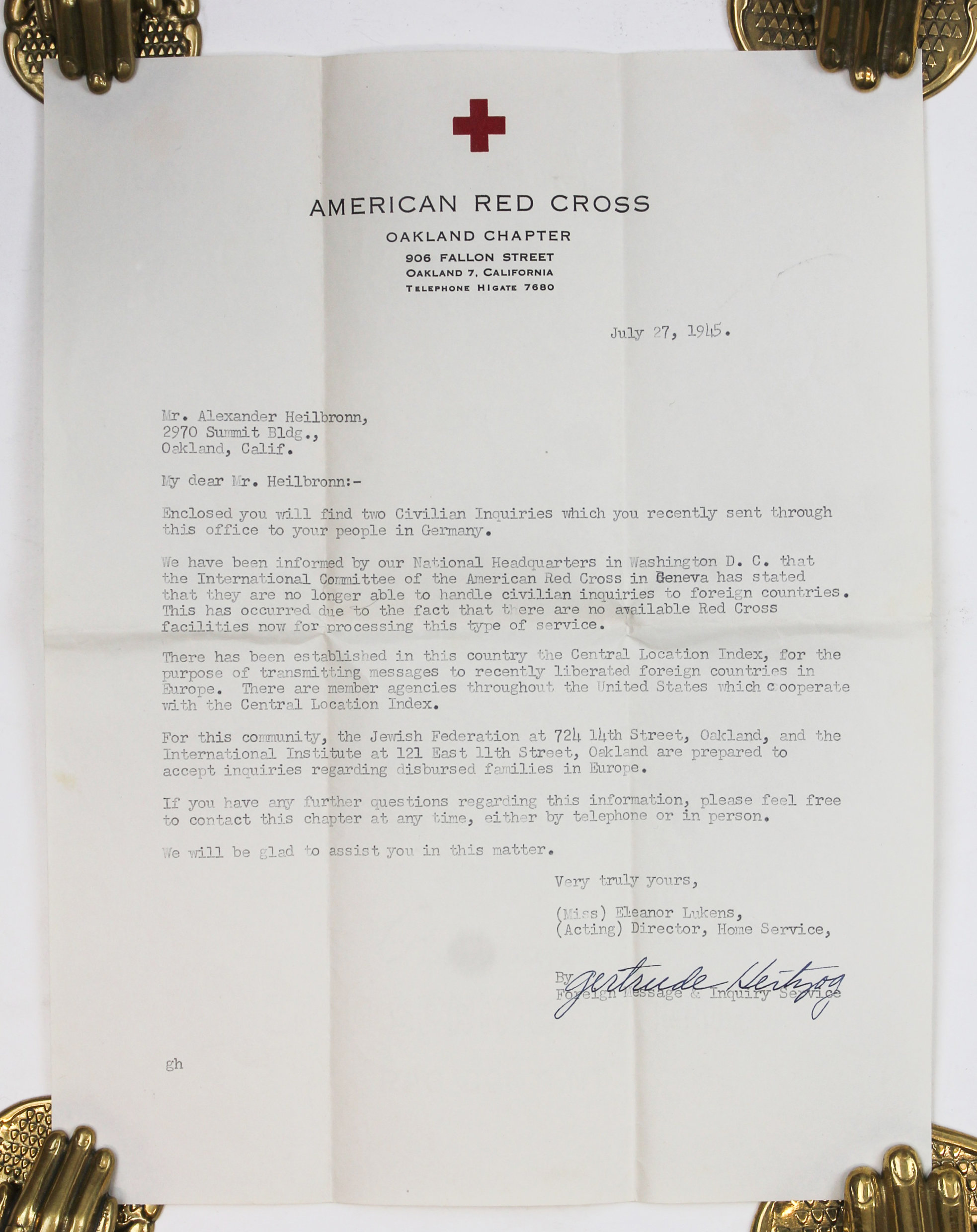
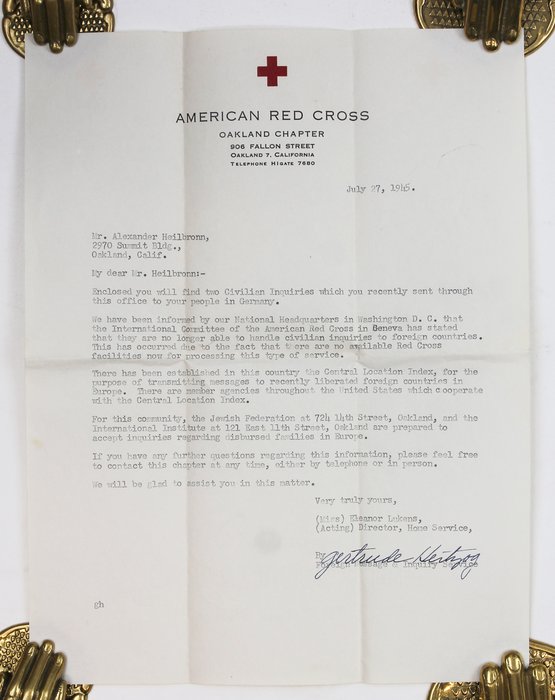
5) Lukens, Eleanor (Director, Home Service, American Red Cross, Oakland Chapter); Hertzog, Gertrude (Foreign Message & Inquiry Service, American Red Cross, Oakland Chapter). Oakland: 27 July 1945. 1 p. of text. Small Folio (ca. 27,7x21,3 cm or 11 x 8 ½ in). Typewritten text on official printed letterhead of the American Red Cross, Oakland Chapter. Fold marks, but otherwise near fine. Signed in manuscript by Gertrude Hertzog.
Text in English.
A formal typewritten letter from the American Red Cross, Oakland Chapter, dated July 27, 1945, addressed to Dr. Alexander Heilbronn at his Oakland office. The letter responds to his efforts to locate family in Germany, informing him that further inquiries cannot be processed because the International Tracing Service in Geneva has been suspended. Signed by Gertrud Hertzog.
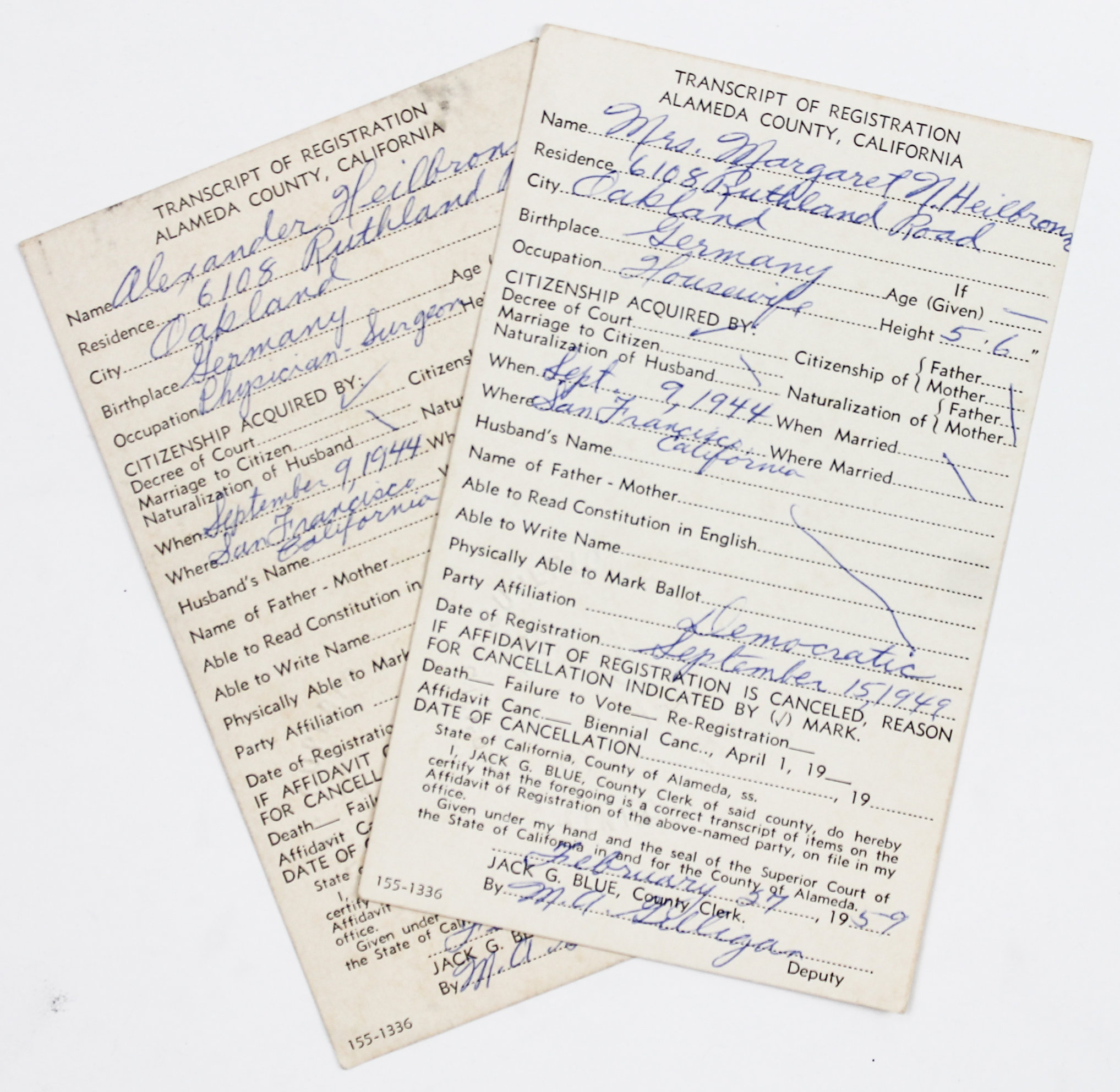
6) Two Transcripts of Registration. Alameda County (California): 27 February 1959. Each 1 p. 12mo (ca. 14x8,8 cm or 5 ½ x 3 ½ in). Blue ink on yellowish cardboards. Fine condition.
Text in English.
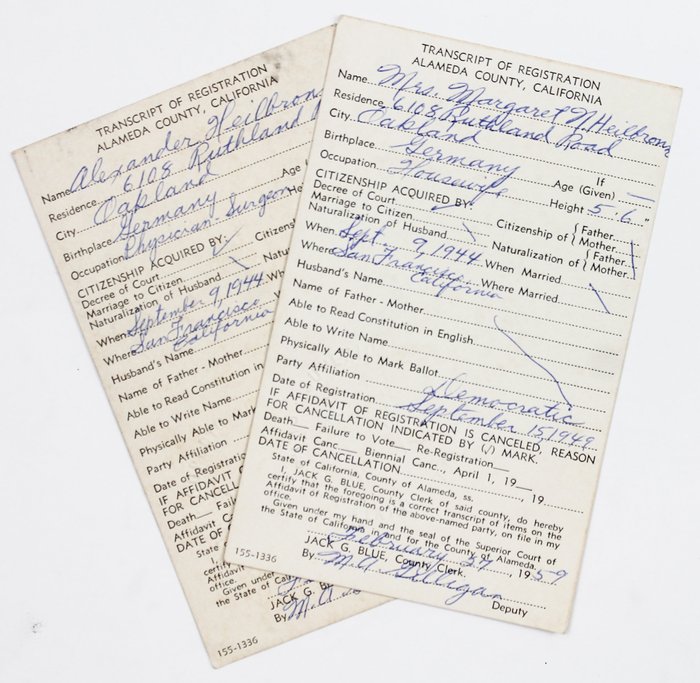
Two voter registration transcripts issued in February 1959 and signed in manuscript by Deputy M. A. Gilligan. The forms, completed by hand, list Alexander Heilbronn as a physician and Margaret as a housewife. Both are recorded as affiliated with the Democratic Party and note their naturalization in 1944 in San Francisco.
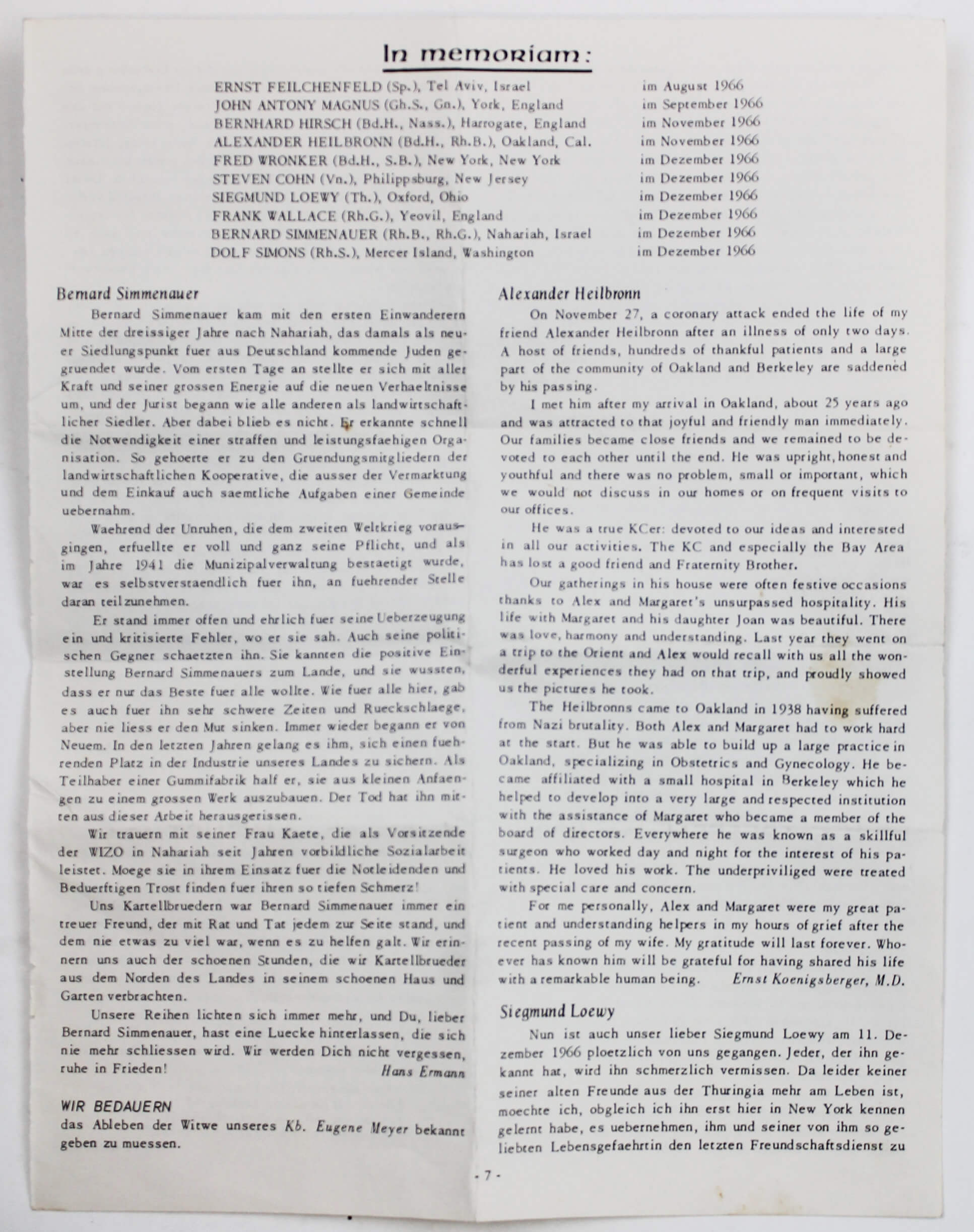
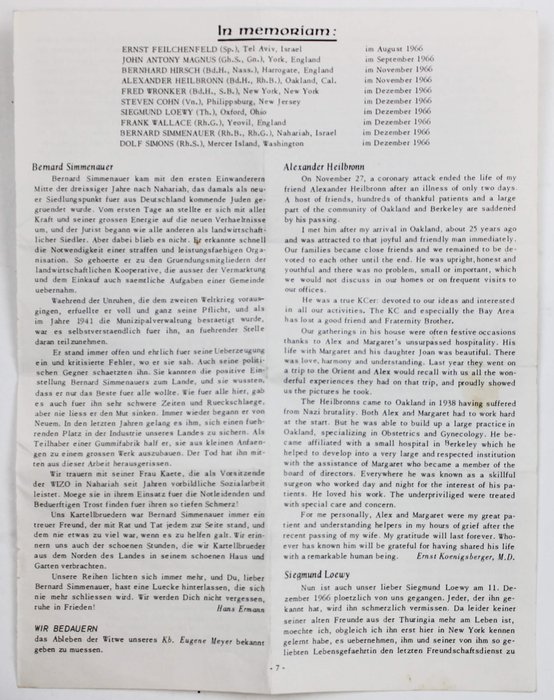
7) In Memoriam. [1966]. 2 pp. [7-8]. Ca. 27,9x21,5 cm or 8 ½ x 11 in. Fold marks, minor stain, but otherwise very good.
Text in English.
A page from a bulletin published in late 1966 containing obituary tributes for members of the Kartell-Convent (K.C.), a union of German Jewish student fraternities, who had emigrated worldwide. The page includes a tribute to Alexander Heilbronn, written by his friend and fellow physician, Ernst Koenigsberger.
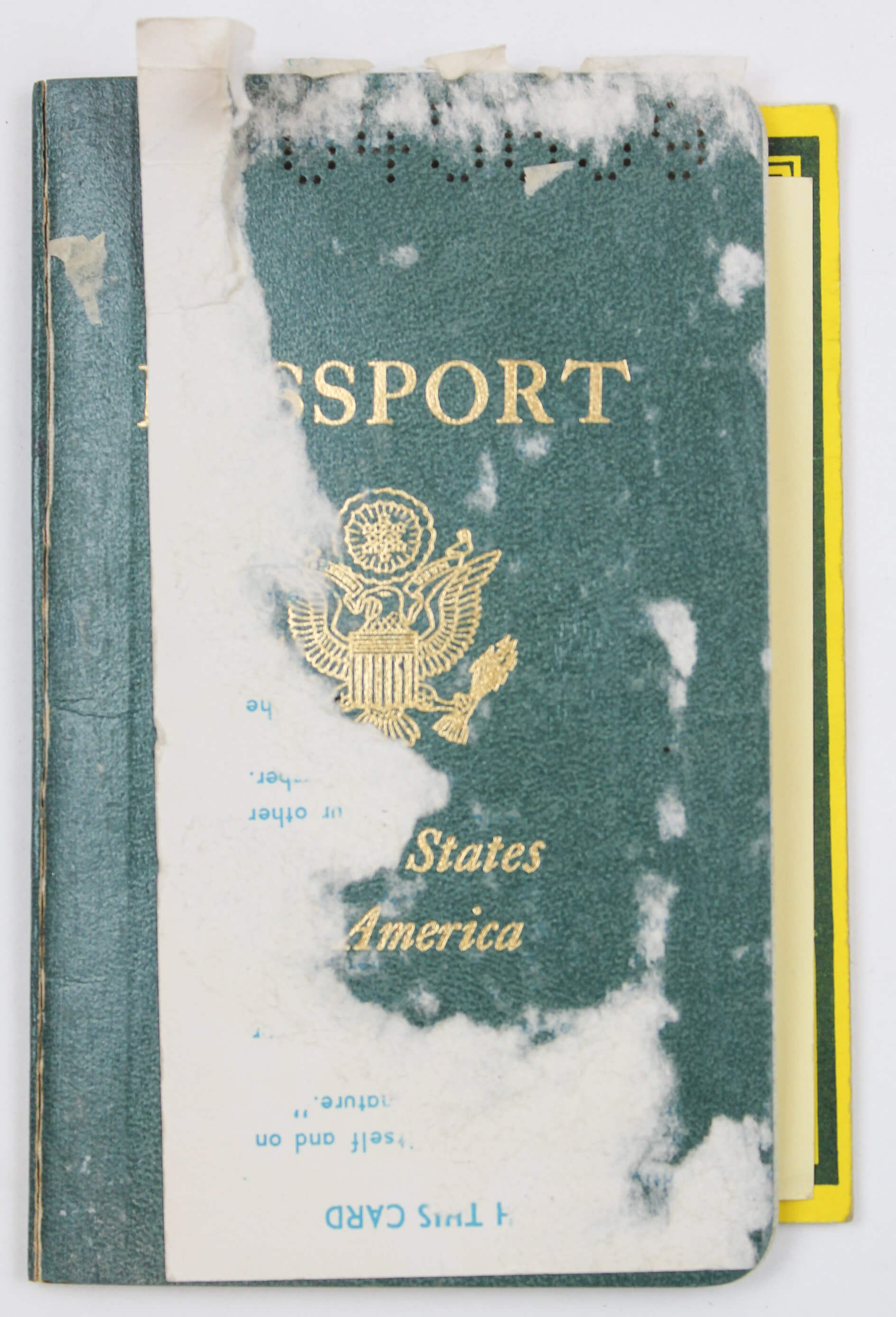
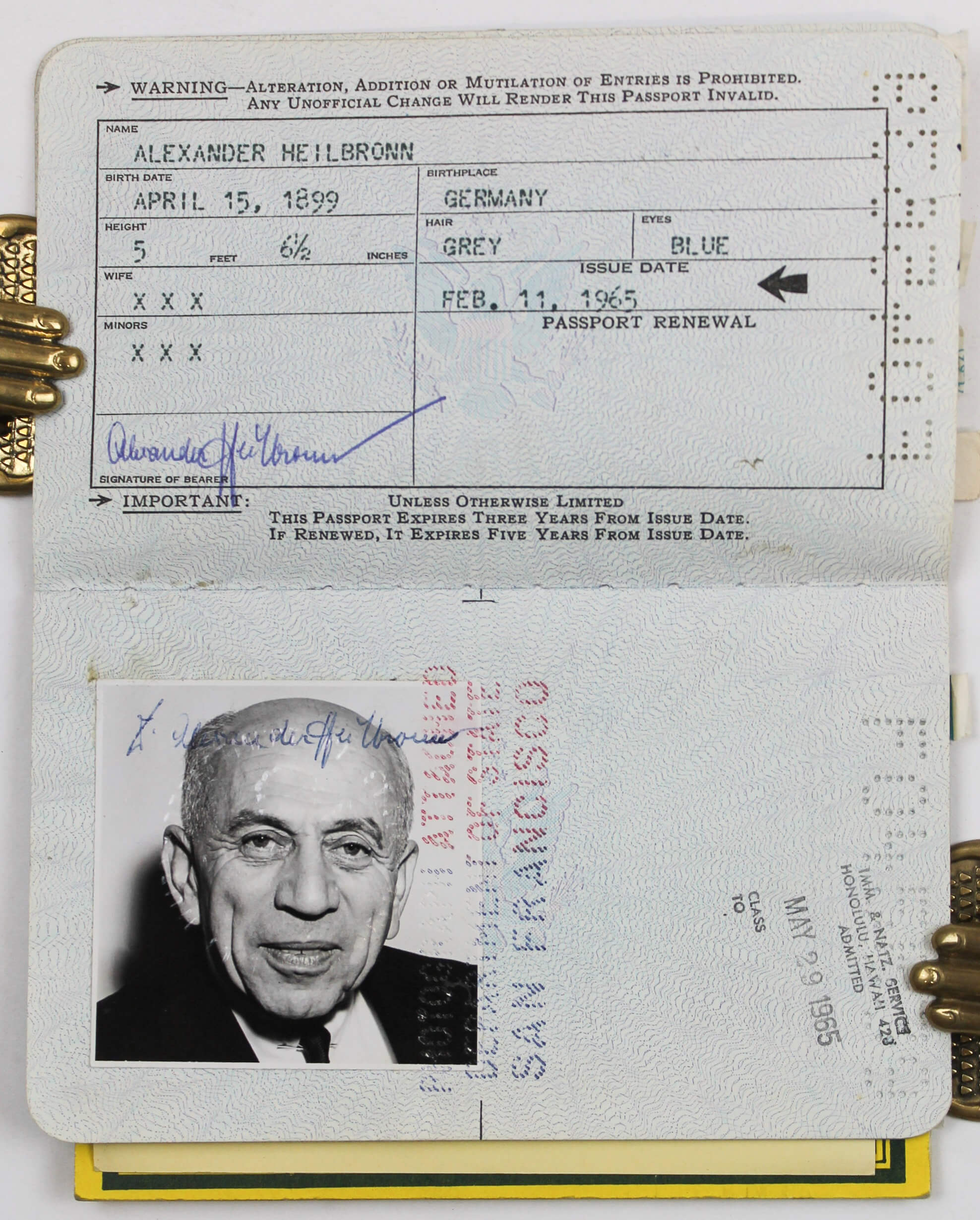
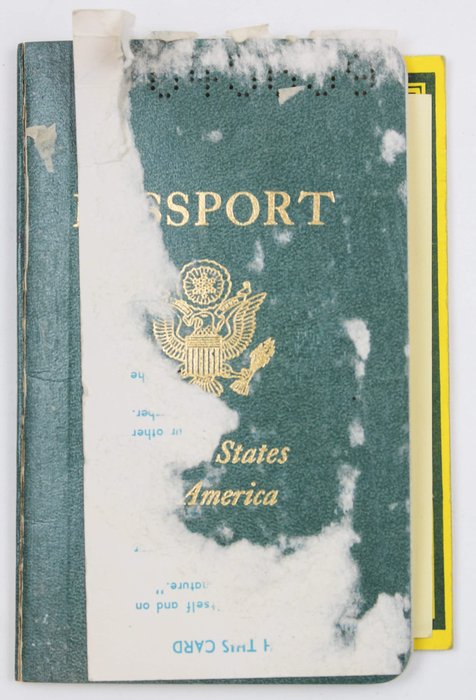
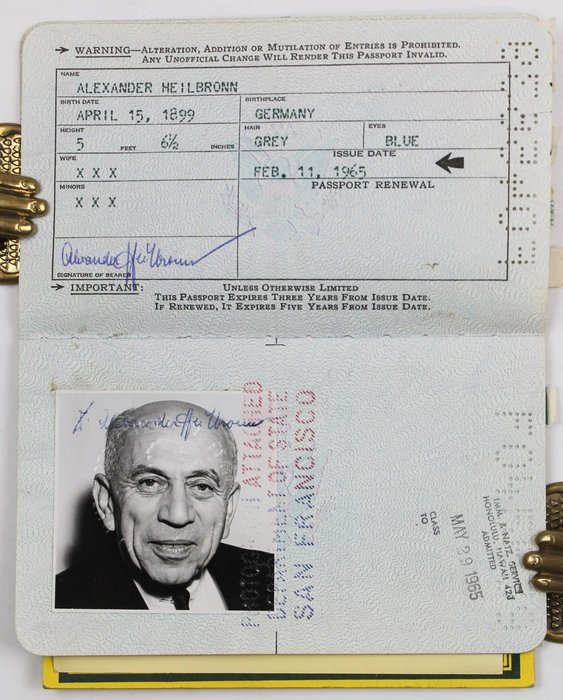
8) Passport of the United States of America. [California]: 1965. 20 pp.: one black-and-white photo, stamps, and visas. ca. 15,5x9,4 cm or 6 x 3 ¾ in.; with a mounted International Certificates of Vaccination: 11 pp. ca. 14,4x10,1 cm or 5 ½ x 4 in; and a tipped in “Notice to Physicians Attending Announce Aux Medecins Consultants.” Tokyo: 1965. 2 pp. ca. 13,1x9,7 cm or 5 x 4 in. Passport with traces of paper glued to the front cover, but otherwise very good.
A United States passport issued in 1965 to Alexander Heilbronn, then residing in Oakland. The passport contains visas for Japan, Hong Kong, Bangkok, the Republic of China (Taiwan), and the Philippines, along with entry stamps admitting him to Japan and Malaysia in May 1965 and a “Departed” stamp from Taipei International Airport dated May 16, 1965. Tipped in are International Certificates of Vaccination for smallpox (1965), yellow fever, cholera, and typhoid, all dated 1965. Also included is a notice from the Tokyo Airport Quarantine Station stating that the holder had recently arrived from a cholera-infected area.
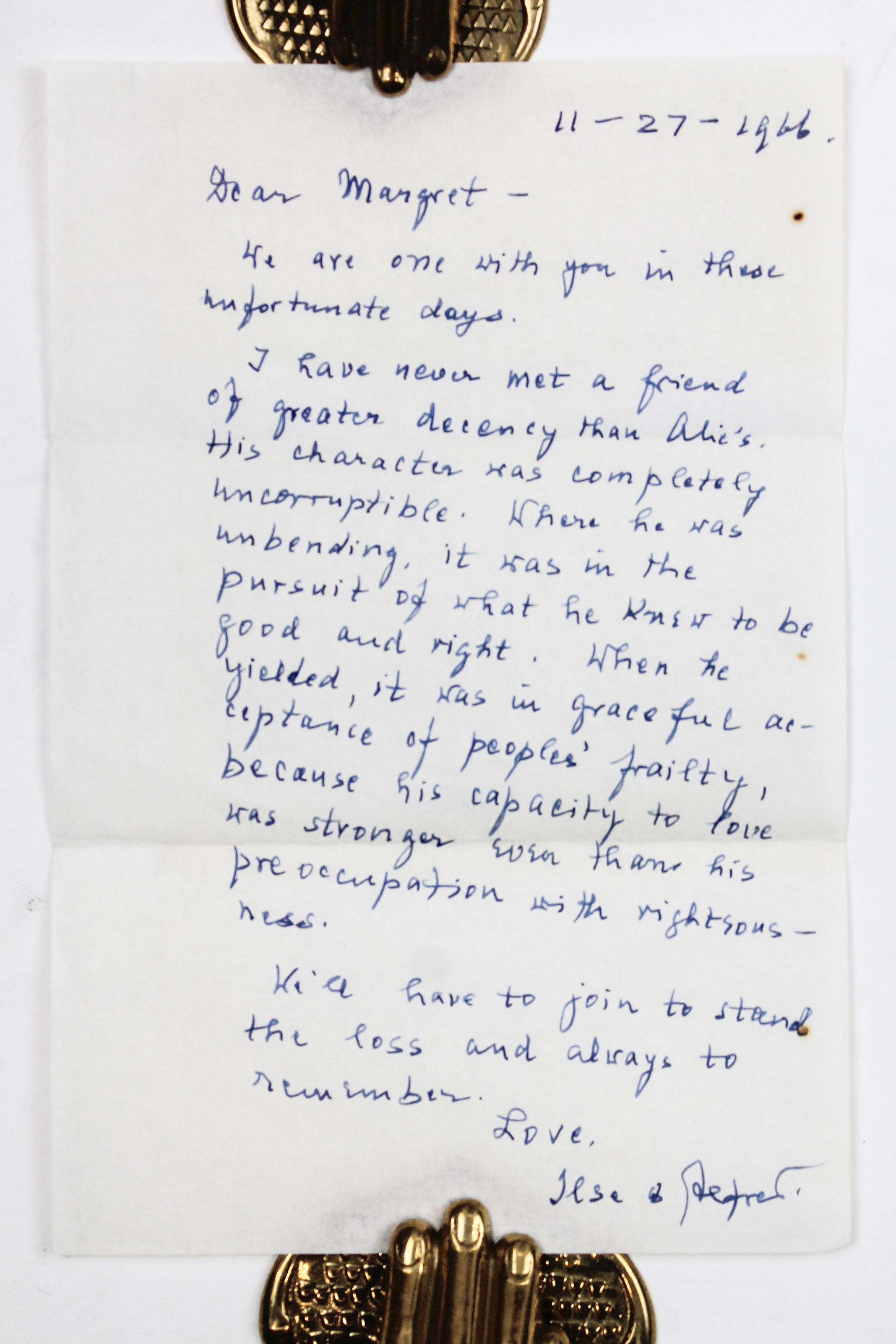
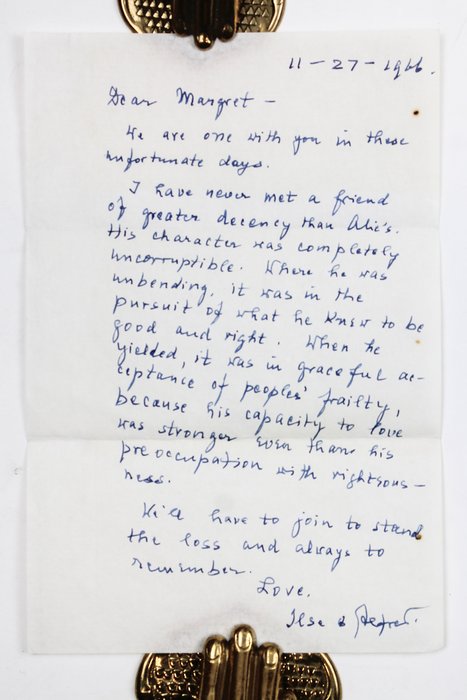
9) Ilse & [Alfred]. 27 November 1966. 1 p. of text. Octavo (ca. 22,7x15,1 cm or 9 x 6 in). Blue ink on white paper. Fold marks, but otherwise very good.
Text in English.
Handwritten condolence letter in English addressed to Margaret following the death of her husband, dated November 27, 1966, signed “Ilse & [Alfred].”
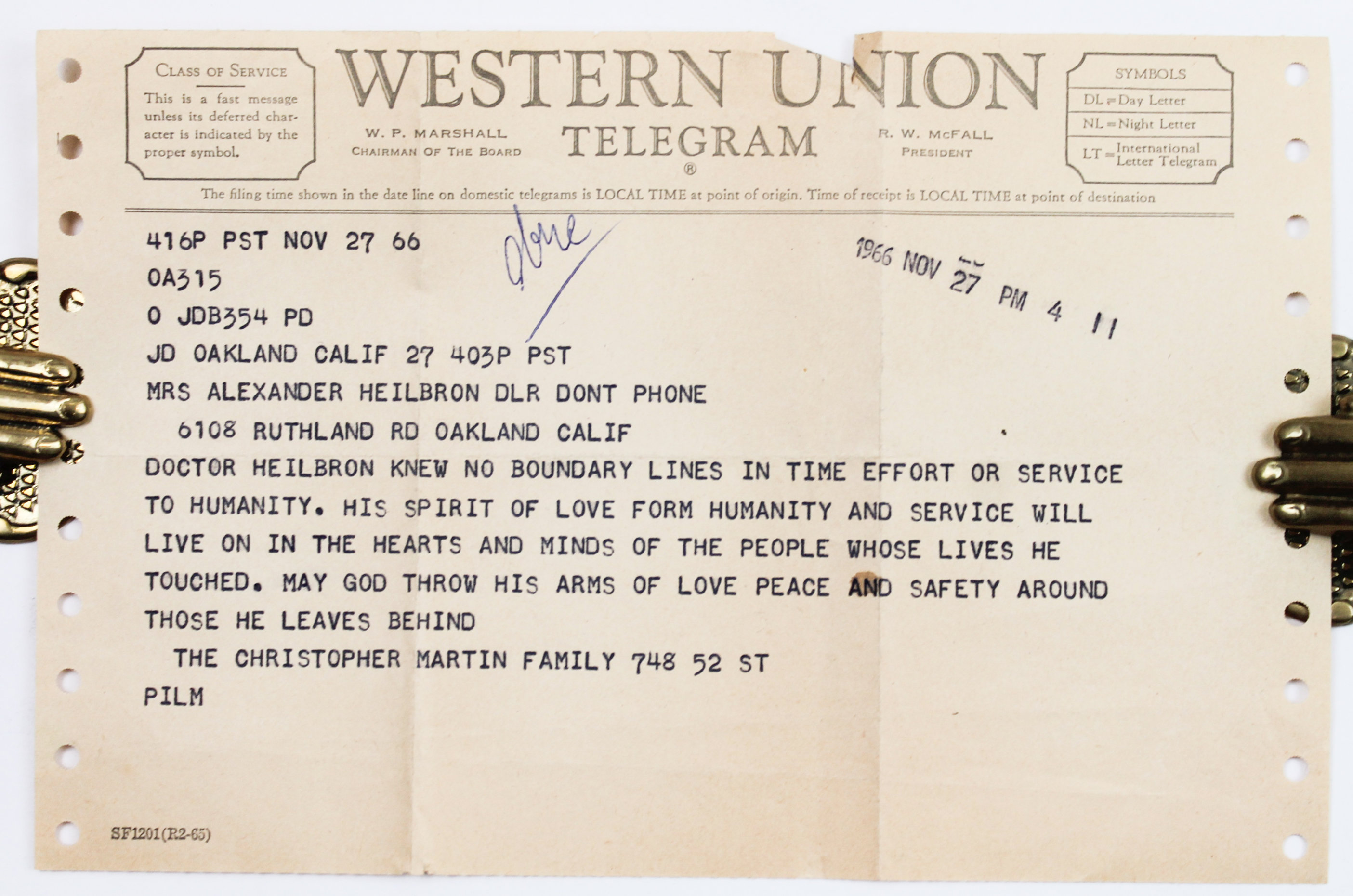
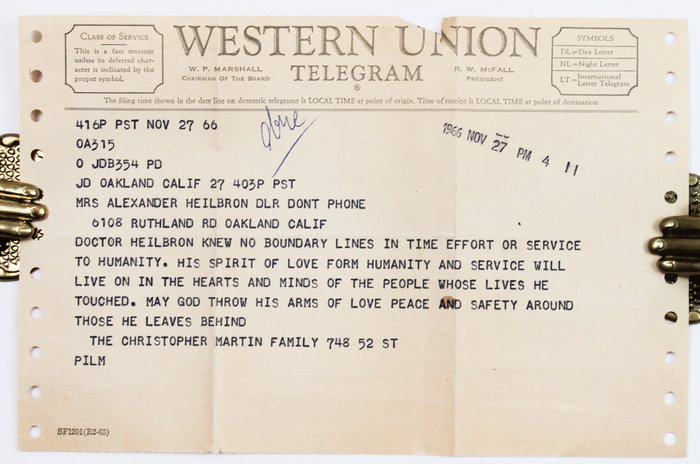
10) The Christopher Martin Family. 27 November 1966. 1 p. Octavo (ca. 13,9x21,4 cm or 5 ½ x 8 ½ in). Typewritten text on yellowish paper. Fold marks, tear at the upper margin, but otherwise very good.
Text in English.
Western Union telegram dated November 27, 1966, sending condolences to Margaret on the passing of her husband, sent by the Christopher Martin family.
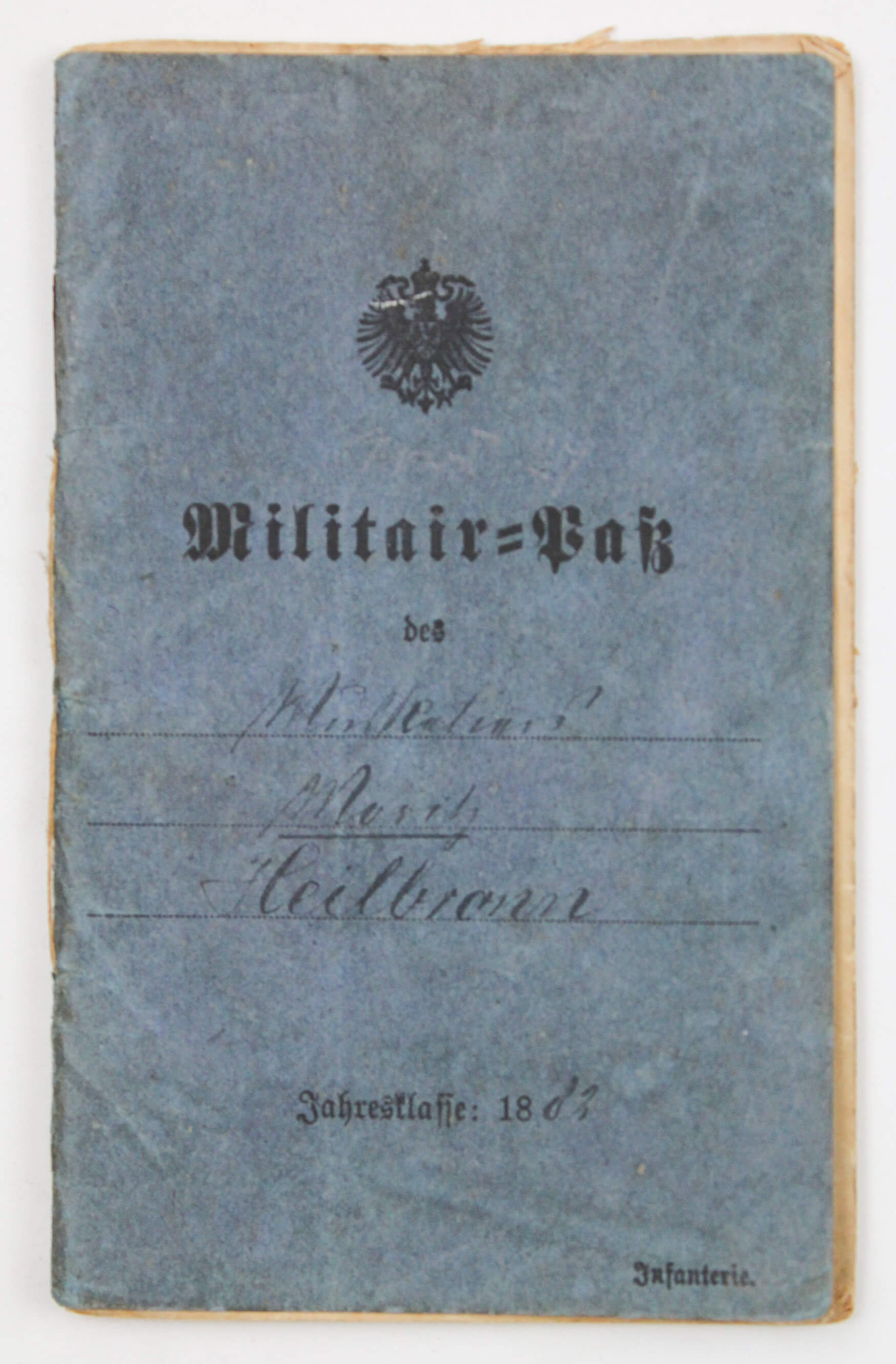
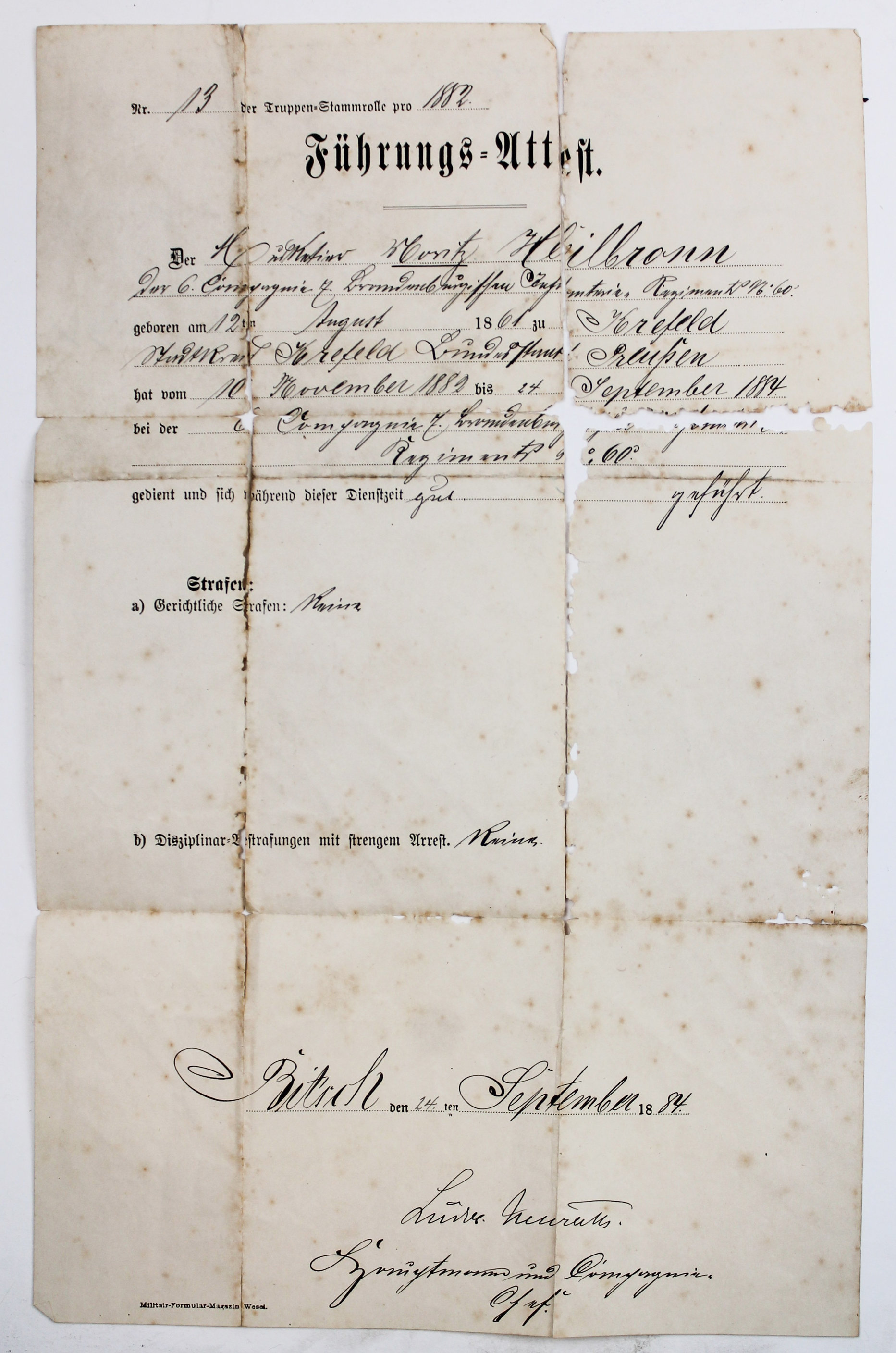
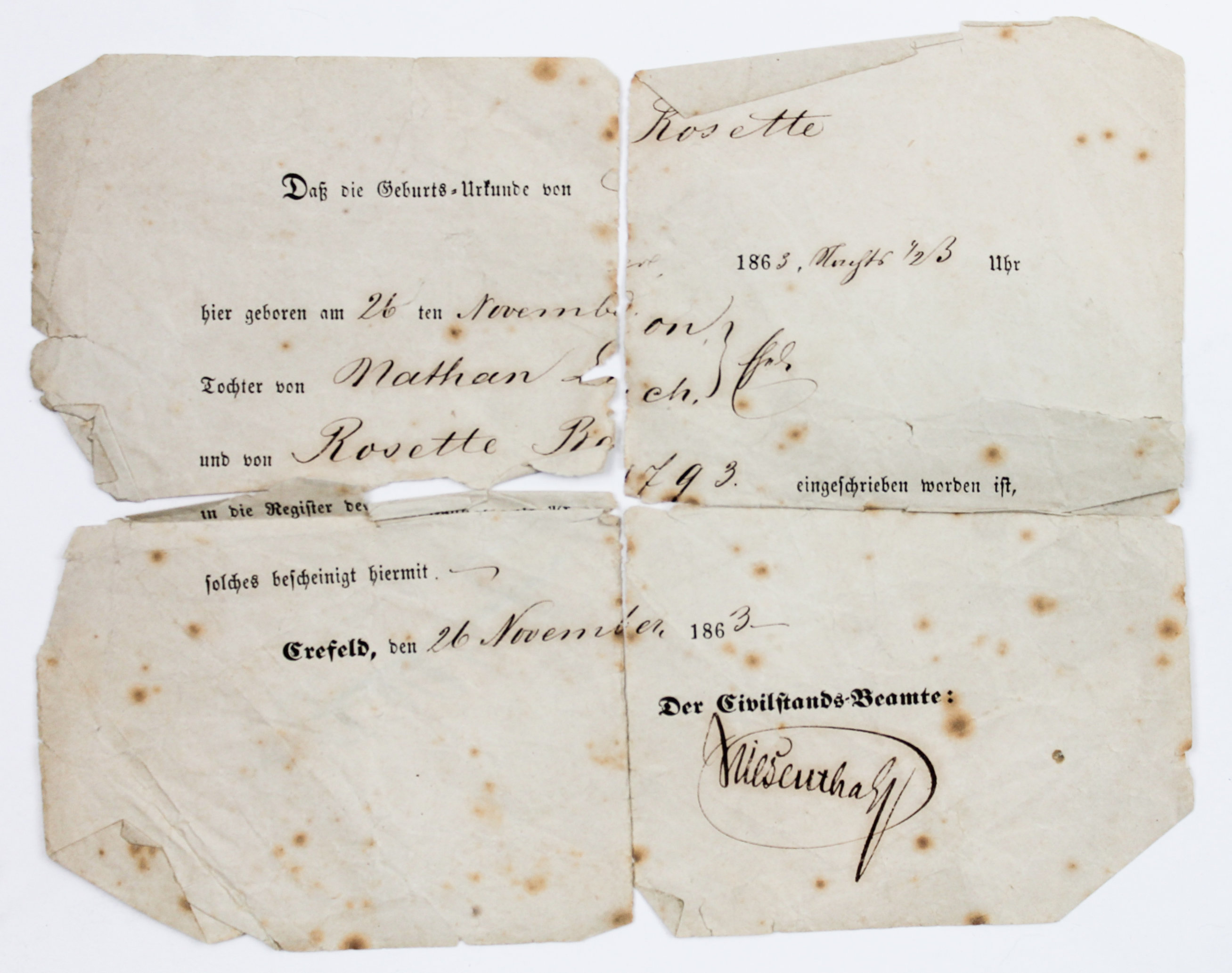
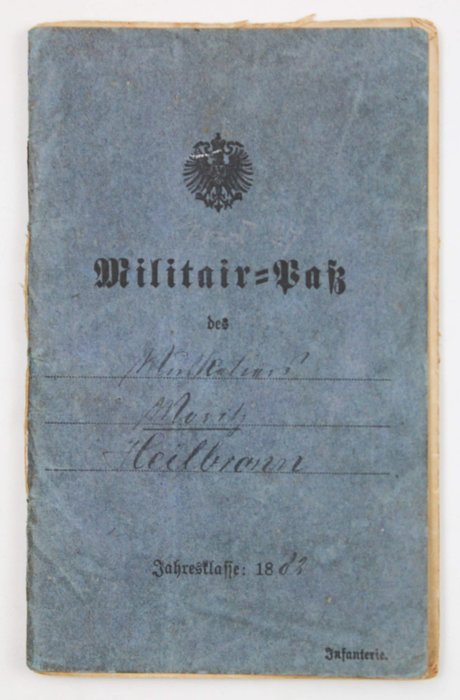
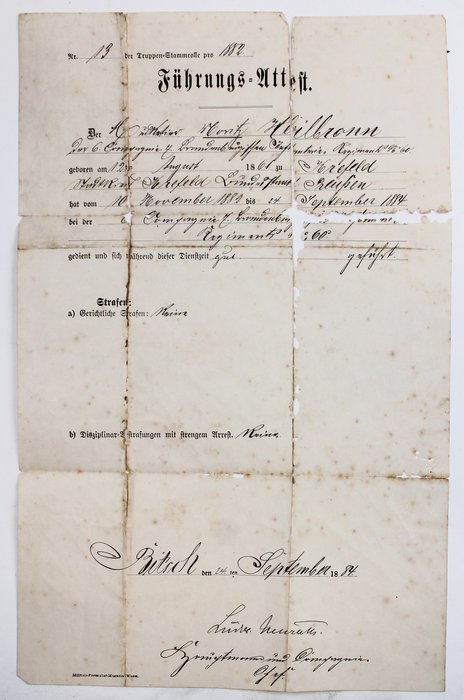
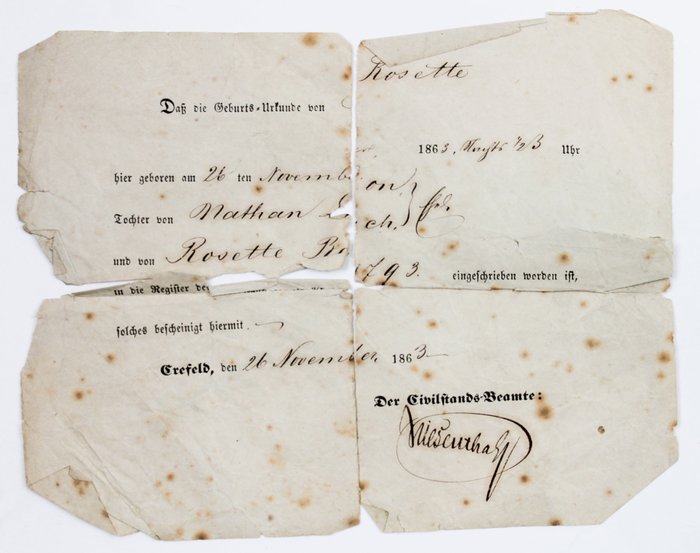
Documents from the Weimar Republic include: Military pass issued by the Kingdom of Prussia to Moritz Heilbronn upon his entry into military service. The document records his personal details (occupation butcher, born in 1861, religion listed as israelitisch) and features several stamps from the Prussian Army (text in German); birth certificate for Rosette Lion, born November 26, 1863, wife of Moritz Heilbronn. Signed the same day by an official of the Krefeld Civil Registry (text in German); Führungs-Attest (conduct certificate) issued in 1884 by the Prussian Army for Moritz Heilbronn, serving as an official discharge and character reference (text in German).
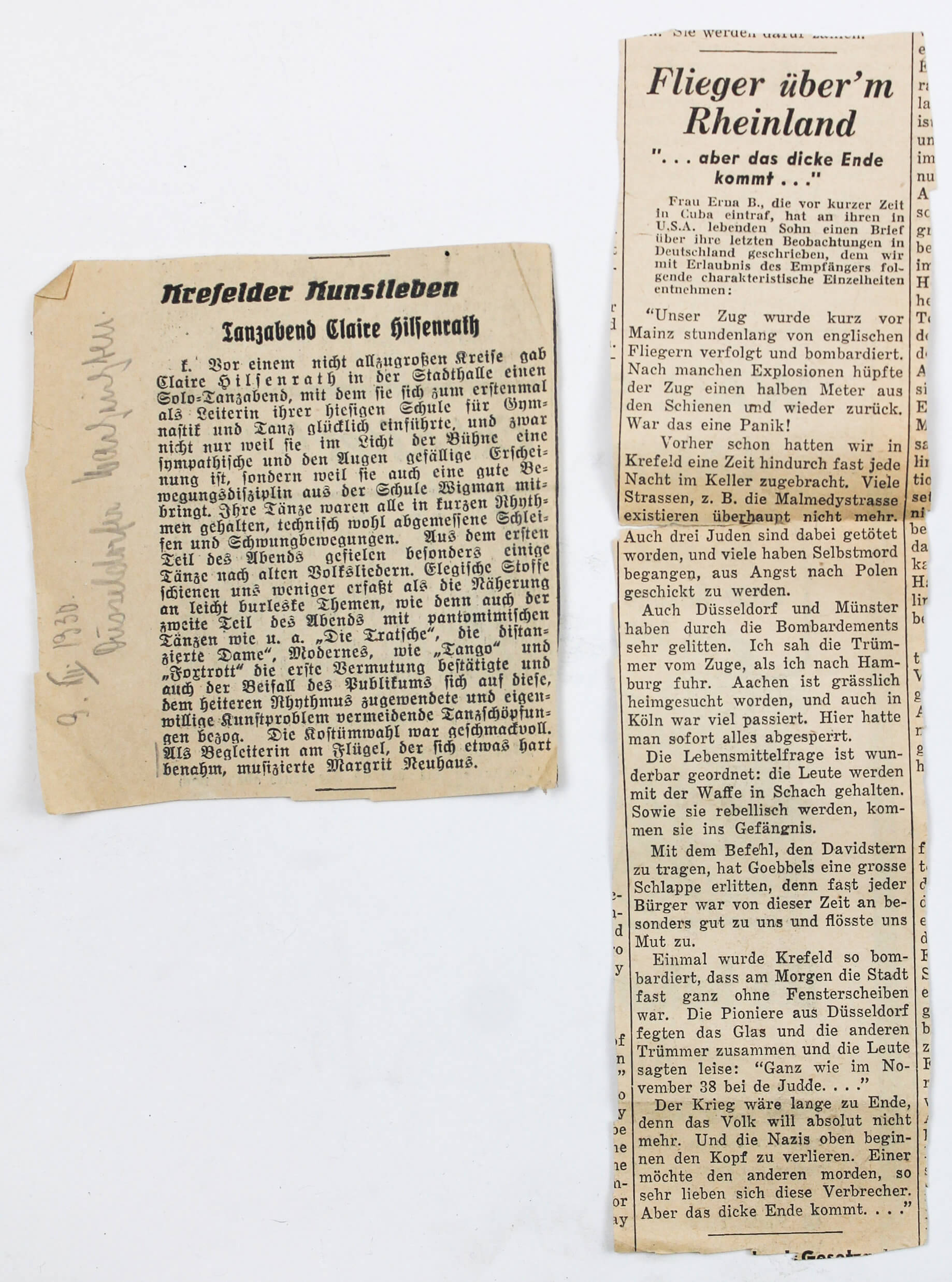
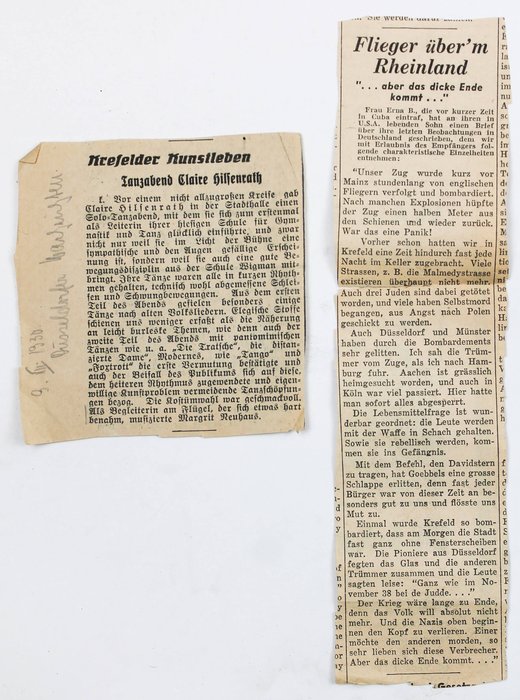
The archive also includes two German newspaper clippings: the first, from Düsseldorf News dated December 9, 1930, reports on Claire Hilsenrath’s solo dance recital at City Hall, accompanied on grand piano by Margaret Neuhaus. The second is a letter from “Erna B.,” recently arrived in Cuba, written to her son in the USA (likely 1941–1942), providing a harrowing firsthand account of wartime Germany. It is likely that Alexander initially believed the author to be his sister Erna; however, according to our research, this letter was not from her, as she was killed in the Holocaust in Riga in 1945.
Overall, historically important extensive archive of original gelatin silver photographs, real photo postcards, handwritten and typewritten correspondence, receipts, and official records, documenting the persecution of a middle-class Jewish family in Nazi Germany, their urgent efforts to emigrate to the United States, and their subsequent life in exile.