
#MA7
1877-1879
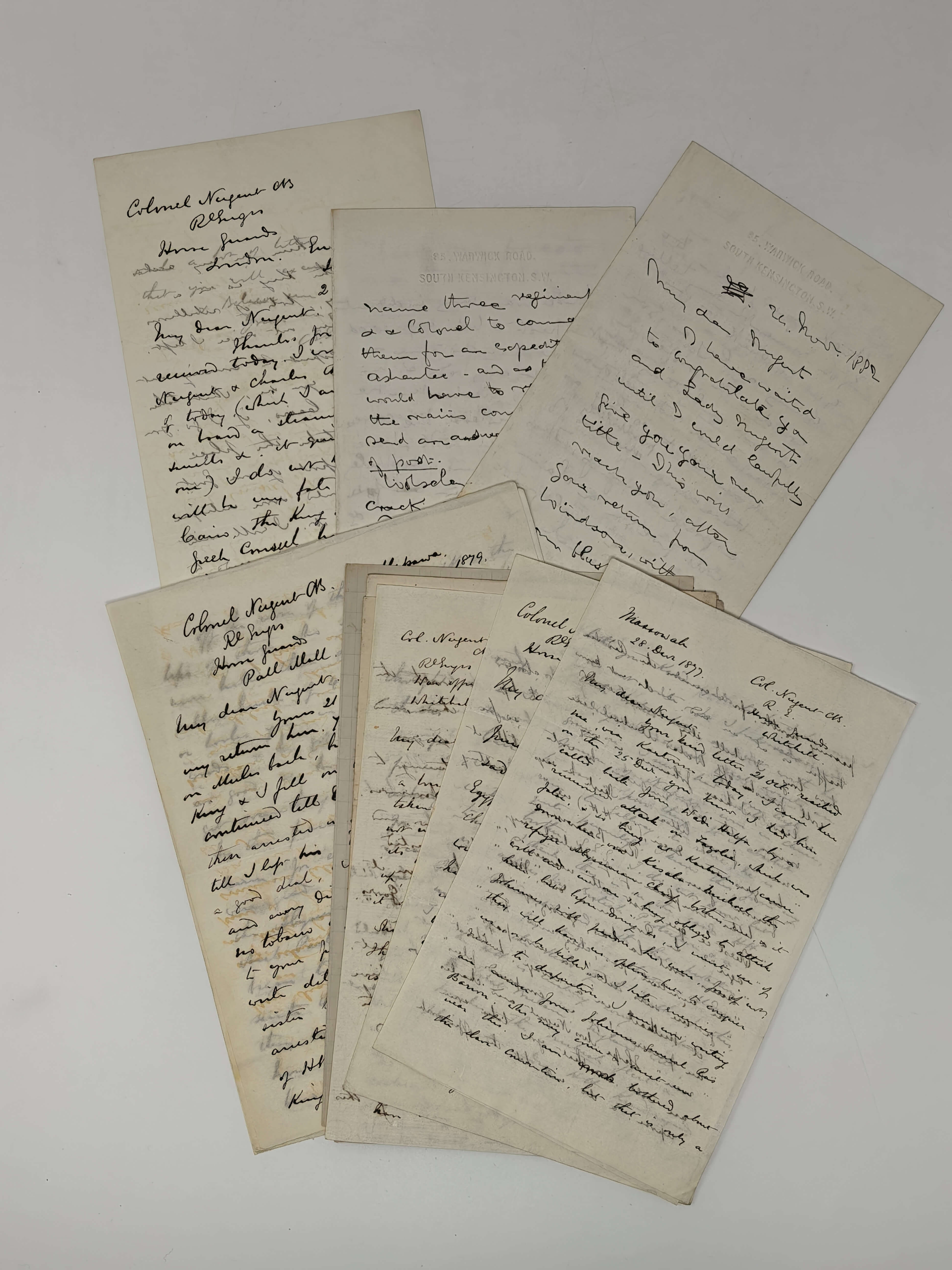
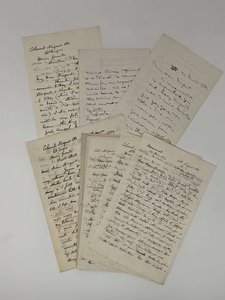
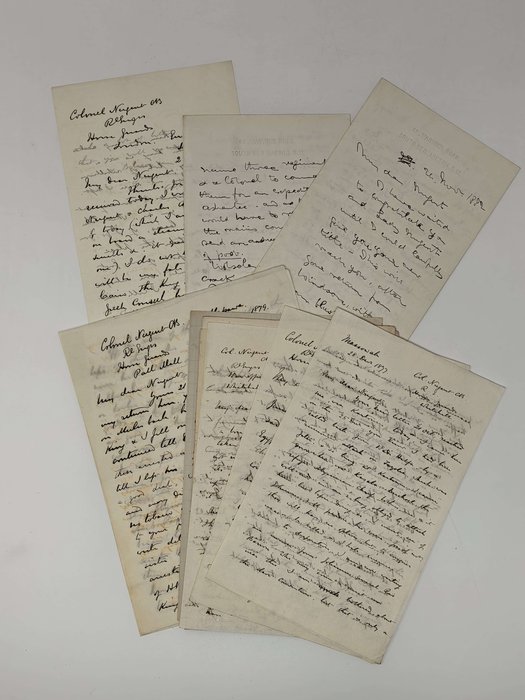
Octavo to Small Octavo, from ca. 20,5x16 cm (8 x 6 ¼ in) to ca. 20x12,5 cm (7 ¾ x 4 ¾ in). Brown ink on laid, wove or squared paper. 3,5, 3, 4, 4, 4, 3, 6, 4, 2,5 = in 34 pp. of text. All signed by Gordon. Gordon’s manuscripts: two Octavo leaves, both ca. 20,5x13 cm (8x5 in); brown ink on squared paper; in both 3 pp. of text. One manuscript signed by Gordon and dated “28 Oct. 1878.” Wrottesley’s ALS: 24 November 1882. 12mo (ca. 17,5x11 cm or 7 x 4 ¼ in). Two wove paper bifoliums; text in brown ink; blind-stamped addresses “85, Warwick Road, South Kensington S.W.” on top of the first leaf of each bifolium. Fold marks, paper of several letters slightly age-toned, occasional minor tears on extremities, but overall a very good collection.
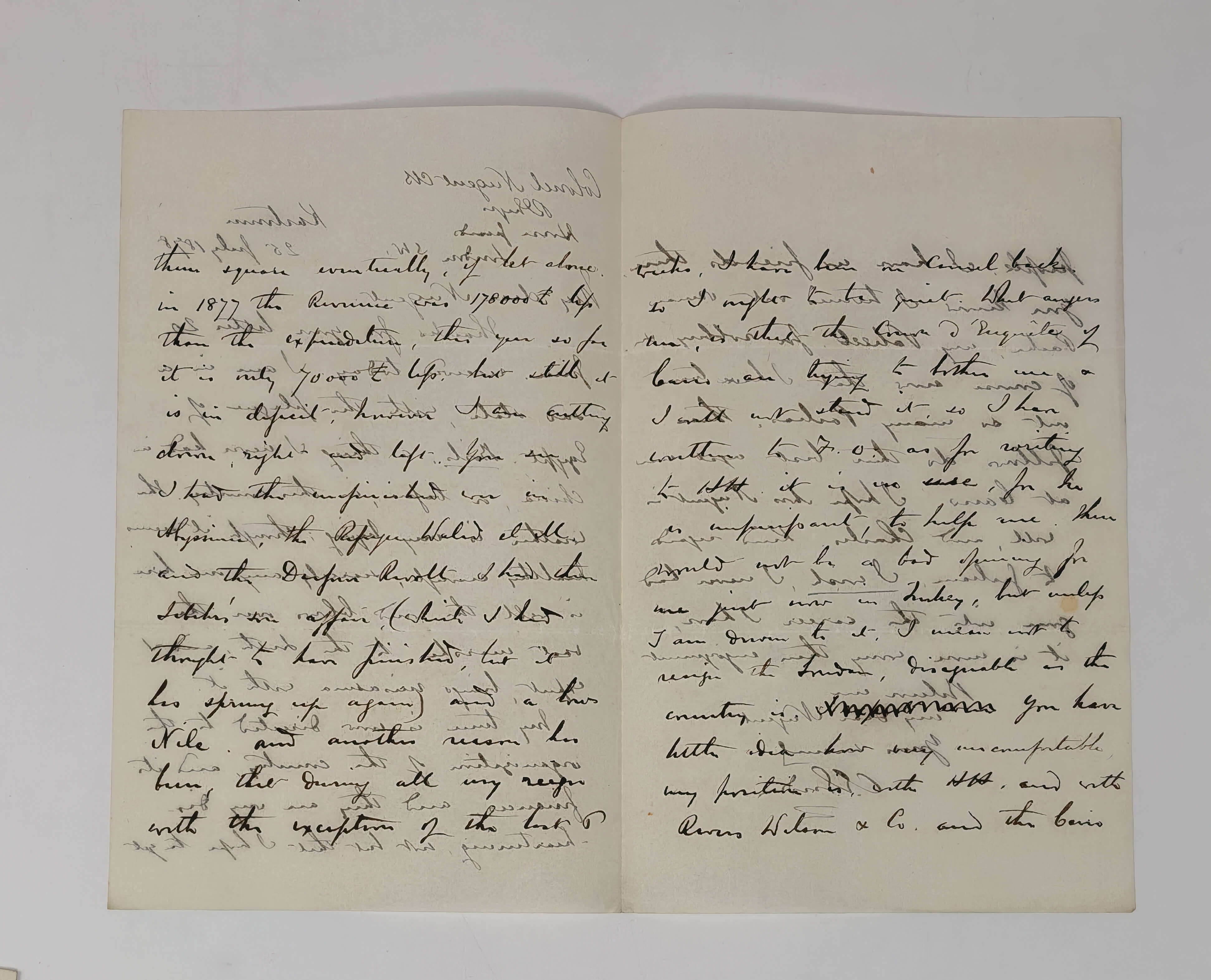
Historically significant archive of nine original content-rich letters, written by the famous Governor-General of the Sudan, Charles Gordon, during his first term in office (May 1877-December 1879), addressed to his friend Colonel Sir Charles Nugent (1827-1899) and former subordinate, Lt. Charles Watson (1844-1916).
“In 1873 the khedive Ismail Pasha of Egypt, who regularly employed Europeans, appointed Gordon governor of the province of Equatoria in the Sudan. In Equatoria, from April 1874 to December 1876, Gordon mapped the upper Nile River and established a line of stations along the river as far south as present-day Uganda. After a brief stay in England, he resumed service under the khedive as governor-general of the Sudan. Gordon established his ascendancy over this vast area, crushing rebellions and suppressing the slave trade. Ill health forced him to resign and return to England in 1880” (Encyclopedia Britannica).
The earliest letter written by Gordon in Massawa (then a part of the Egyptian Sudan) focuses on Sudan’s relations with the Ethiopian Empire in the aftermath of the Egyptian-Ethiopian War (1874-1876). Gordon talks about “Johannes” (Yohannes IV, Emperor of Ethiopia in 1871-89), “Walad Michael” (likely, Mikael of Wollo, 1850-1918, a high-ranking Ethiopian nobleman), Emperor’s “General Ras Bariou” and the Egyptian Khedive’s (“H.H.”) rumoured intentions to apply “for British Protection & a Resident, and with that protection will try to gain Mecca & Medina & be the Head of the Faith.” In another letter from Massawa, written in December 1879, Gordon describes his recent embassy to Yohannes IV to prevent a possible war between Egypt and Ethiopia. Characterizing the Emperor in distinctively negative terms, Gordon complains of being kept “a semi prisoner <…> and every disagreeable you can imagine. No tobacco or drink <…> The King will listen to no one, he cuts off the nose of those who […?] & the lips of those who smoke, <…>. A nasty sullen […?] of 47, he never smiles or looks you in the face.”
Five letters written from Khartoum in 1878 refer to Gordon’s attempts to manage Sudan’s finances and the region treasury’s ongoing deficit, Gordon’s conflict with Charles River Wilson (1831-1916, then a member of the commission to access the finances of Egypt); a telegram to Gordon from the khedive’s new Prime Minister, Nubar Pasha; blockage of the upper Nile River with the “sudd” vegetation; Gordon suffering from “the plague of Egypt, Boils, a thing I never had in China or before in this country,” his thoughts of resignation; the ongoing rebellion by the slave traders in the Darfur region; money owed to Charles Appleby for the construction of the Sudan Railway, &c. One of the letters, addressed to Gordon’s former subordinate, Lt. Charles Wilson (participated in the survey of the Equatoria Province in 1874, took part in the Anglo-Egyptian War of 1882, served in the Egyptian Army and as Governor-General of the Red Sea Littoral of the Anglo-Egyptian Sudan, was member of the Royal Geographical Society since 1875), is supplemented with two original Gordon’s manuscripts accounting the revenue, expenses and debt of Sudan in 1878.
Very interesting is the letter written from “Edowa, Darfur, en route to Shaka” in April 1879, during Gordon’s military expedition against the slave traders of Shaka (the region of South Kordofan in modern-day Sudan). He talks about catching “two caravans with 46 slaves,” his intention of “driving all the Gallabats out of the country” and a plan to restrict all travel or residence in Darfur without passports, military moves of his long-time friend and subordinate Romolo Gessi (1831-1881), an intrusion of a slave woman to Gordon’s tent at night, his suffering from a scorpion bite, &c. The last letter, written “en route to Suez,” on Christmas 1879, contemplates Gordon’s forthcoming resignation (he would leave Egypt shortly after).
Overall an important collection of rare original letters by the Gordon of Khartoum, providing a first-hand account of different aspects of his service as the Governor General of the Egyptian Sudan (1877-1879).
The addressee of eight Gordon’s letters, Sir Charles Butler Peter Nugent Hodges (1827-1899), was commissioned as 2nd Lieutenant, RE, in 1845. He served in the Baltic during the Crimean War in 1854 and 1855, and in the Anglo-Egyptian War (1882) as Commanding Royal Engineer (twice mentioned in dispatches, KCB, Medal and 2nd Class Order of the Medjidie). The 1882 letter written to by Nugent by his friend, Retired Royal Engineers Major-General George Wrottesley (1827-1909) congratulates him on the promotion and discusses General Garnet Wolseley’s (1833-1913) plans to appoint “himself to the command of the Ashantee expedition” (Wolseley commanded the 1873-43 military expedition against the Ashantis; in 1882 he suppressed the Urabi Revolt in Egypt; in 1884 he commanded the Nile Expedition for the relief of Charles Gordon in Khartoum).
Excerpts from the letters:
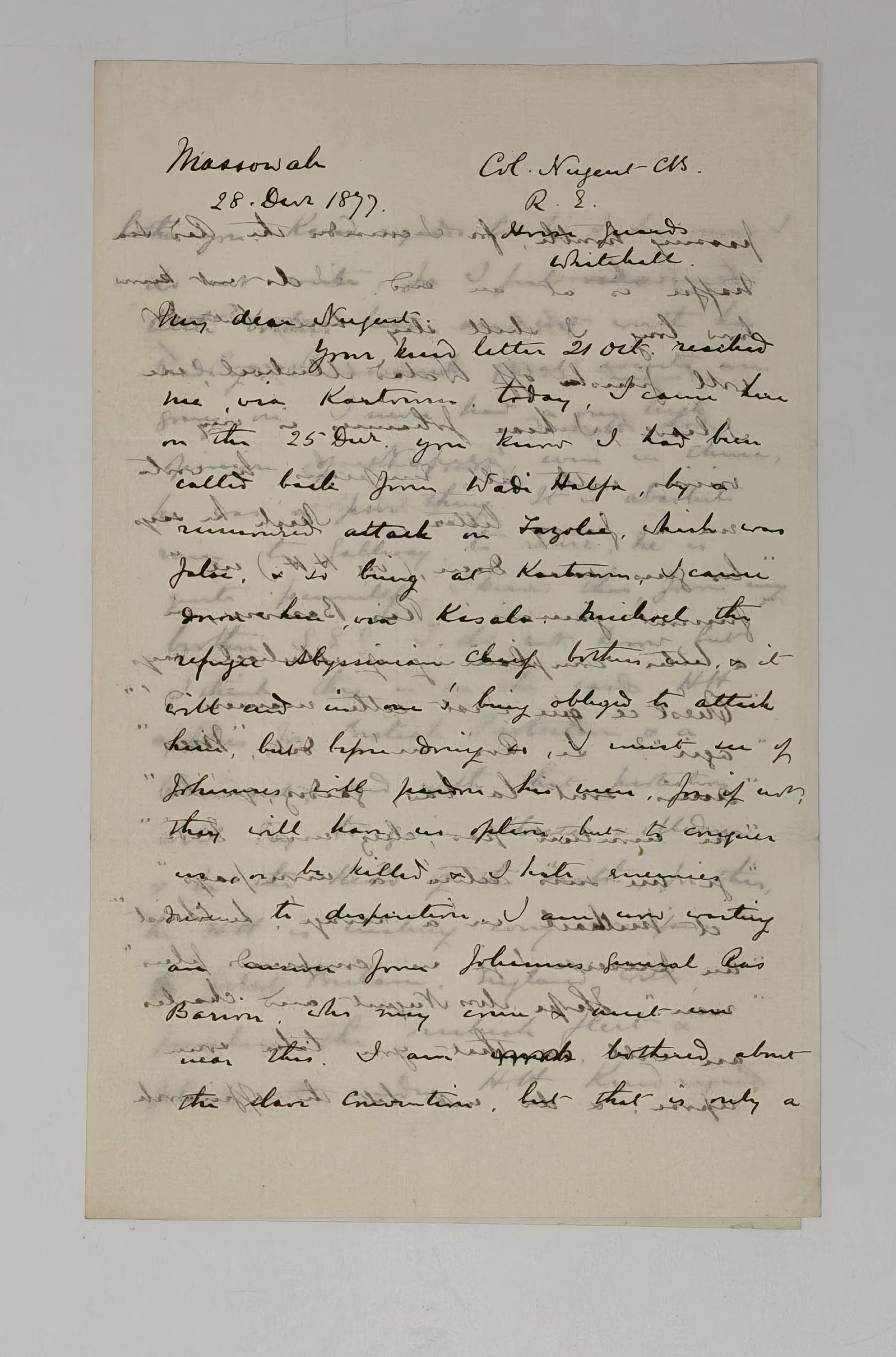
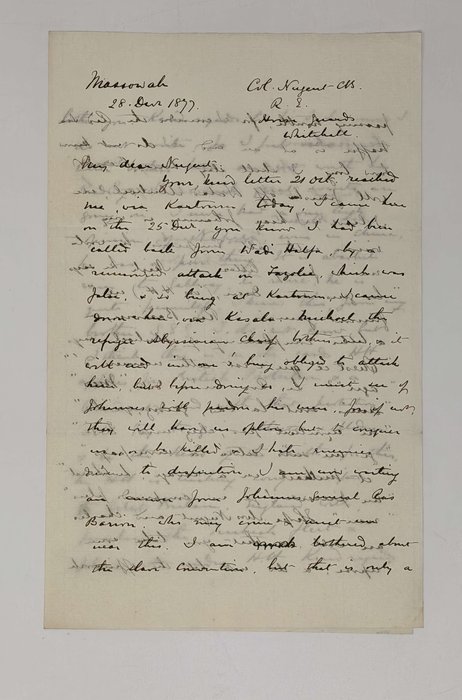
“Massowah, 28 Dec. 1877
My dear Nugent, <…> I came here on the 25 Dec. You know I had been called back from Wadi Halfa by a rumoured attack on Fazolie [Fazogli] which was false, & so being at Kartoum, I came upon here via Kesala [Kassala]. Michael [Walad el Michael] the refugee Abyssinian chief bothers me & it will end in one’s being obliged to attack him, but before doing so I must see if Johannes will pardon his men for if not they will have no option but to conquer us or be killed & I hate enemies driven to desperation.
I am now waiting an answer from Johannes General Ras Bariou who may come & meet me near this. I am bothered about the slave [commotion?] but that is only a passing trouble for I consider the Red Sea traffic is at an end. I do not know how long I shall stay here but Dr. will finish off Walad Michael ere I have. I hear Johannes is very vicious with all Europeans. <…> I do not know but I think this is in the cards. H.H. applies for British Protection & a Resident, and with that protection will try to gain Mecca & Medina & be the Head of the Faith, for this, he H.H. is making every [conspire?] to Great Britain <…>”
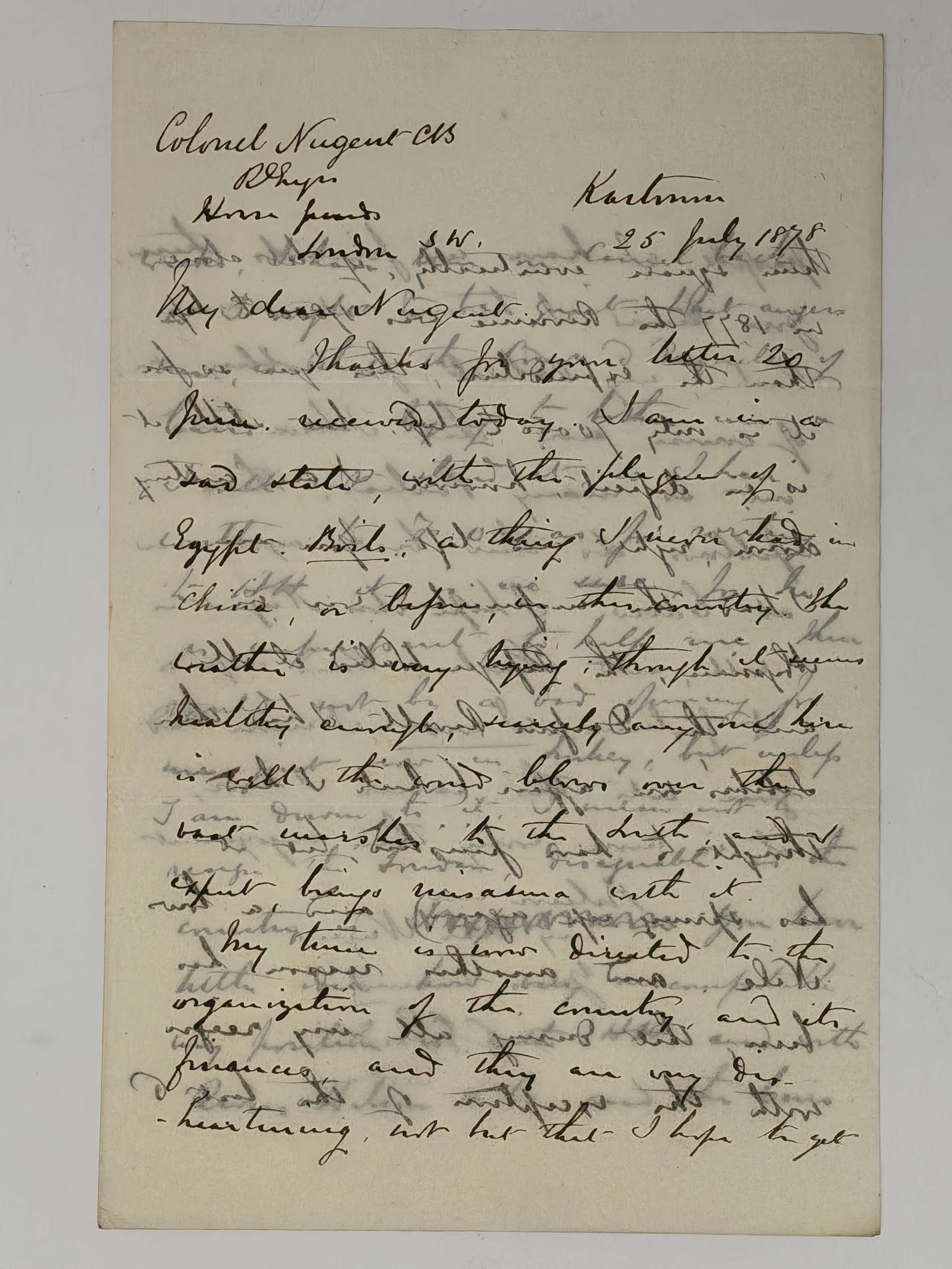
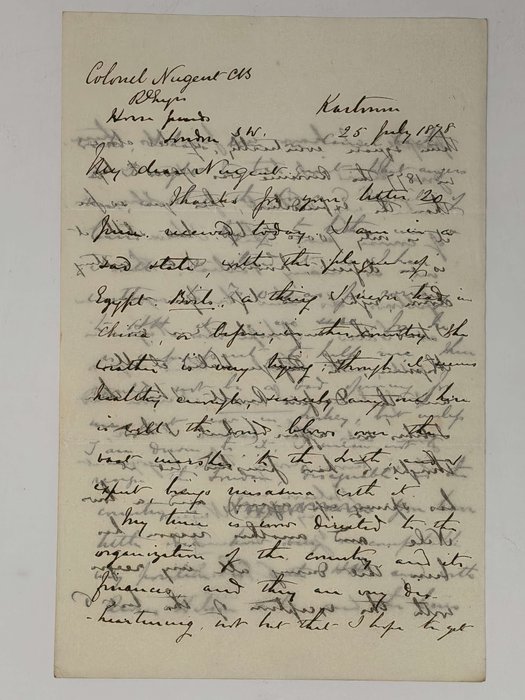
“Kartoum, 25 July 1878.
My dear Nugent, <…> I am in a sad state, with the plague of Egypt, Boils, a thing I never had in China or before in this country. The weather is very trying, though it seems healthy enough, scarcely any one here is well, the wind blows over the vast marshes to the south, and I expect brings nuisance with it.
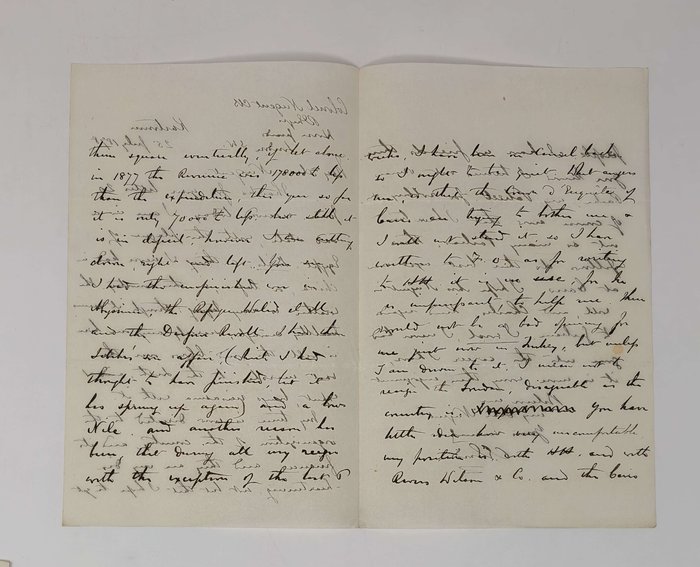
My time is now directed to the organization of the country, and its finances, and they are very disheartening, not but that I hope to get them square eventually, if let alone. In 1877 the Revenue was £178,000 less than the expenditure, this year so far it is only £70,000 less, but still it is the deficit. However I am cutting down right and left. You see I had the unfinished war in Abyssinia, the Refugee Walad et all, and the Darfur Revolt. I had then Sebehr’s son affair (which I had thought to have finished, but it has sprung up again) and a low Nile. And another reason has been, that during all my reign with the exception of the last [5?] weeks, I have been in camel back, so I ought to be quiet. What angers me, is that the cours d'enquête of Cairo are trying to bother me, & I will not stand it, so I have written to F.O., as for writing to HH it is no wise, for he is […?], to help me. There would not be a bad opening for me just now in Turkey, but unless I am driven to in, I mean not to resign the Soudan disagreeable as the country is. You have little idea how vey uncomfortable my position is, with H.H and with Rivers Wilson & Co. and the Cairo people. I have no friends there, you know I turned our Osman Pasha, my Vakeel, for robbery &c. <…>”
“Kartoum, 3 Oct. 1878.
My dear Nugent, <…> I have not much to tell you. The Nile at its junction with Bahr Gazelle in 90 N.L. is blocked up with grass, I have sent to have it opened out. You know it was this Sheik caused Baker such trouble. I have no idea if that will be the issue of H.H. <…> I do not believe in reforms from top to the bottom, they must come from below & rise to the head. It is disheartening this thought, and still worse when one thinks one is, to some extent, sacrificing oneself in exile, for no good <…>”
“Kartoum, 6 Oct. 1878.
My dear Nugent, <…> I am not well but am better than I have been, it is more worry than ill health, a sense of being deserted, and of being under used of, and preyed upon, has worried me. <…> Yesterday Nubar telegraphed to me, I send a copy of his telegram, this was the first telegram I had had for a month from Cairo <…> You see Nubar’s telegram says carte blanche and you know what carte blanche means, if things do not go well. I have not confidence in Nubar, though he will do well in Egypt, in past he was the only man to do well there, for he is rich & not afraid & he knows the country. H.H. is a timid man, and though capable of doing […?] things, he has no stiff obstinacy in his nature <…> How this affair will affect me, I do not know and I do not care beyond a certain point. I feel sure if I am removed, though no collapse may ensue, that they will have a deal of bother, for I have devoted my whole existence to my work, and I never may say, I take a holiday, indeed there is no holiday to take. <…>
Nubar’s telegram: H.H. has named me his Chief Minister. H.H. orders me to communicate with you. H.H. gave you full powers when he named you Gov. Genl. of Soudan. He does not cancel these powers H.H. knows you have done your work well and leaves you full power to deal with the slave question &.&.
There is nothing in the telegram to answer my query as to what I am to do with slave dealers! If I hang them what will H.H. say <…>”
“Kartoum, 27 Oct. 1878.
My dear Watson,
You are fond of statistics, so I send you the enclosed. I hope to balance the Expenditure & the Receipt. I hope to pay the debt in time, for <…> the debt is owed in the Soudan & not in Europe.
It is not a very lively lookout. Add to it, the Appleby contract and carry that out, with the expenses of making the Railway, and you have £1,000,000 debt with a deficit of mostly £100,000 per annum. I shall cut down right and left, and yet there is a difficulty in doing this. <…> you cannot turn the people out, as they do at Cairo, and not pay them their arrears. We have 23,000 soldiers in Soudan. H.H. did not do a bad stroke of business when he gave me the Soudan. Bahr Gazelle is still in revolt, I am going to cut down the Equator Province, only keeping the River up to Lake Albert <…>”
With the enclosure of two leaves of “Floating Debt of Soudan & Central Red Sea” (2 pp., dated 28 October 1878) and “Annual Expenditure and Receipts of Soudan & Litoral of Red Sea.”
“Kartoum, 23 Dec. 1878.
My dear Nugent, <…> Since I wrote, the slave dealers of Zebehr have made two attempts to get Shaka, but they were half hearted, & they were driven back & got terribly cut in that very wooded unhealthy country <…> I have no fear of them now, & they must soon disintegrate & then can easily be disposed of. I hear Johannes has sent an envoy with a letter to me to Kasala. I hear the letter is about the Frontier, but do not know. I have sent for the envoy to come here. Walad el M. after giving me a deal of trouble, has started <…> to make his submission to Johannes today.
I fear if the two come […?] and demanding more than I can give, I will give a good deal, but not a […?] even if he asks it, & if John, insists, I shall aid his enemies & […?] him, but I hope it will not come to this. Things look coming to a crisis, with Johannes. I see (by the newspapers) that they prefered to send me a coadjustor in the shape of a French General très distingué in Senegal, but I do not know if it is true or not, certainly, two Govr. Genls cannot stay in Soudan & I should vacate but it may be false news. <…> I have paid off a lot of money and hope to be [Gov.?] of Harar, Zula & Berberah, opposite Aden. H.H. asked me if I would object, I said “no, provided I have not to supply their wants,” since which he has not replied, though I telegraphed again for an answer. If H.H. orders me to supply those provinces wants, it will if not under my rule, cost £70,000 a year. I hear Appleby is going to demand £200,000! compensation for breach of contract <…>”
“Edowa, Darfur, en route to Shaka, [8 April 1879]”
“My dear Nugent,
I am now here half way to Shaka for which place I leave tonight. We have to go four days without water, for every pond is dried up. When I got here I caught two caravans with 46 slaves. Men, women, and children, however I expect I shall be able to put a stop to the trade now by driving all the Gallabats out of the country which I am doing as I go along. I heard from Gessi, he was in want of powder, he had 4000 men, Sebehr’s son 3000. I have sent up 800 more troops to him and I hope he will soon finish the business. When I got up this morning, my servant told me that I had company during the night for when he came in early, he found a slave woman asleep in the corner of my hut, who objected to go out. She was chained by the legs, and had escaped from the master (of course my three sentries were fast asleep <…>) so I let her have her wish and took her from her master. I hope she slept well. It is not satisfactory to me, that people can come in thus at night, especially when the Arabs are so furious with me.
The day I came in here, I had lain on the ground during the night, and after I started almost a couple of hours, I felt a sharp pain in the knee. I knew what it was but could not get at it for I had garters on. A small scorpion had crept up my trousers. When on the ground, I was obliged to crush him on my knee. He gave me a good deal of pain for two hours and more. Sebehr’s son set fire to Gessi straw huts, but as Gessi had buried his powder, it did not harm.
Since June 78 we have caught 63 caravans, but it will never end, till my rules are put in force, which are no one is to travel to and fro or reside in Darfur except with passports, now as Darfur surrounds Kordofan, all slaves must pass through it, so if these rules are carried out, the trouble is over.
8 April. Gessi has now mostly crushed Sebehr’s son, who has only 800 men left, while Gessi has 7000. He has moved his powder &c. & it in full force to crush the rebellion. I am clearing out this place Shaka (which I reached 7 April) of the slave dealers. I cannot tell you the details of Gessi’s work, but will do so later.”
“Massawa, 14 Dec. 1879.
My dear Nugent, <…> 79 out of 89 days I had been on mules back, bullied by the Abyssins. The King and I fell out at once, on 27 & 28 Oct., it continued till 8 Nov. when he sent me off, then arrested me & kept me a semi prisoner till I left his land on 8 Dec. I have suffered a good deal, we had […?] & first en route and every disagreeable you can imagine. No tobacco or drink, therefore I look forward to your promised dinner. I cannot now write details of my voyage, send to my sister to get them. I had, when first arrested to burn all my letters […?] of H.M. & of compromising others. The King will listen to no one, he cuts off the nose of those who […?] & the lips of those who smoke, he is much more hated than […?] was. A nasty sullen […?] of 47, he never smiles or looks you in the face. We had but words, & he got at the risk of my life as good as he gave. <…>”
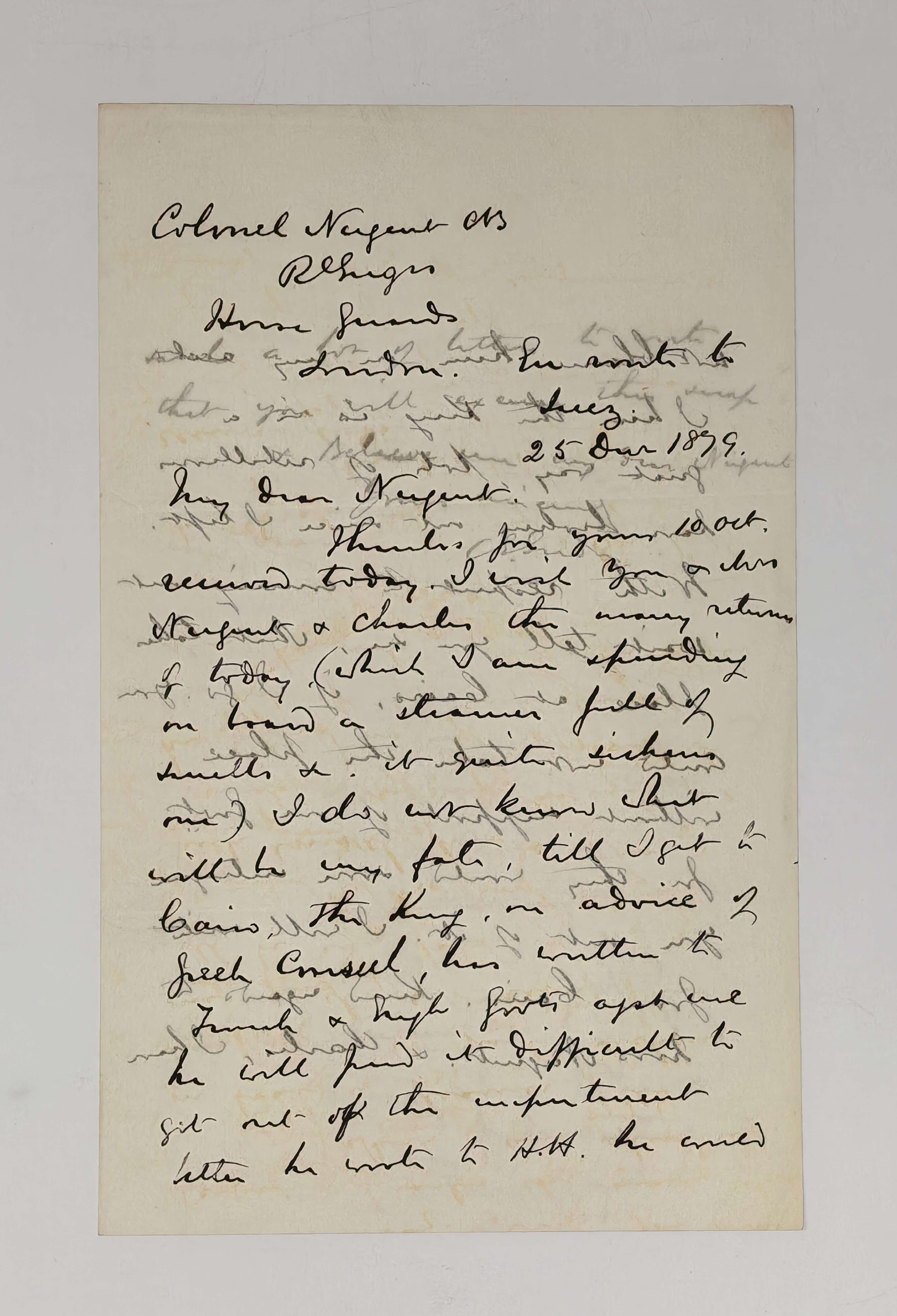
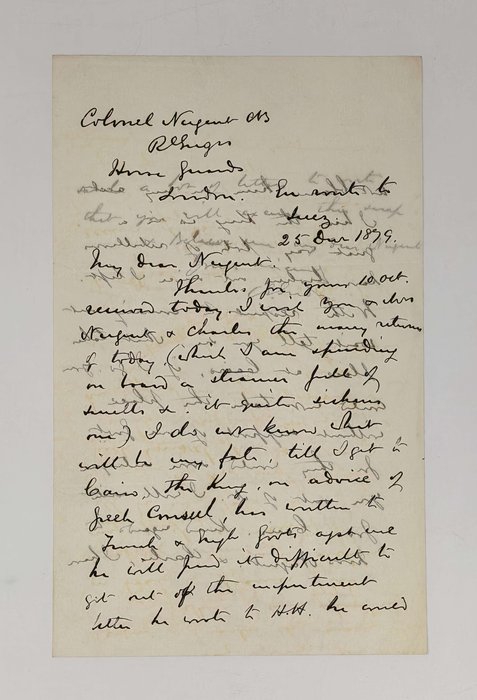
“En route to Suez, 25 Dec. 1879.
My dear Nugent, <…> I wish you & Mrs. Nugent & Charles the many returns of today (which I am spending on board a steamer full of smells &c., it quite sickens me). I do not know what will be my fate till I get to Cairo. The King, on advice of Greek Consul, has written to French & English Govts […?] he will find it difficult to get out of the impertinent letter he wrote to H.H. He could not blame him on my acct. I hear the King is in a great way, lots of rebellions have broken out since I left. With respect to coming out wait till you see what taken place at Cairo, if I go you could not take the place without support of our Govt. <…>”
G. Wrottesley’s ALS:
“24 November 1882.
My dear Nugent, I have waited to congratulate you and Lady Nugent until I could lawfully give you your new title. This will reach you after your return from Windsor, with all your blushing honors thick upon you. Do you remember my telling you to stick to the army as long as you could. The profession in quite a lottery, that you should not withdraw your ticket so long as there any possibility of a prize turning up. This will give you a claim for future employment as a M. General or <…> try again a small governorship like the Isle of Man or one of the Channel Islands. <…> I was rather angry with Sir Garnet for leaving you behind, when he was going to storm entrenchments &c. <…> Did you ever hear of Sir Garnet appointing himself to the command of the Ashantee expedition? It was in August, and the Duke was at Homburg. Sir Garnet was D.A. General at Hd. Quarters. A letter came from the W.O. to request the Duke to name three regiments & a Colonel to command them for an expedition to Ashantee, and as the troops would have to return before the main commenced, to send an answer by return of post. Wolseley named three crack regiments, the 42nd, 3 rd Battn. Rifle Brigade & a Fusilier Regiment & himself to command them. He then telegraphed off to the Duke & told him what he had done. The Duke was very indignant at first, but acquiesced for at that distance & without anybody at his elbow to advise him he was powerless. <…>”