
#MD76
1815
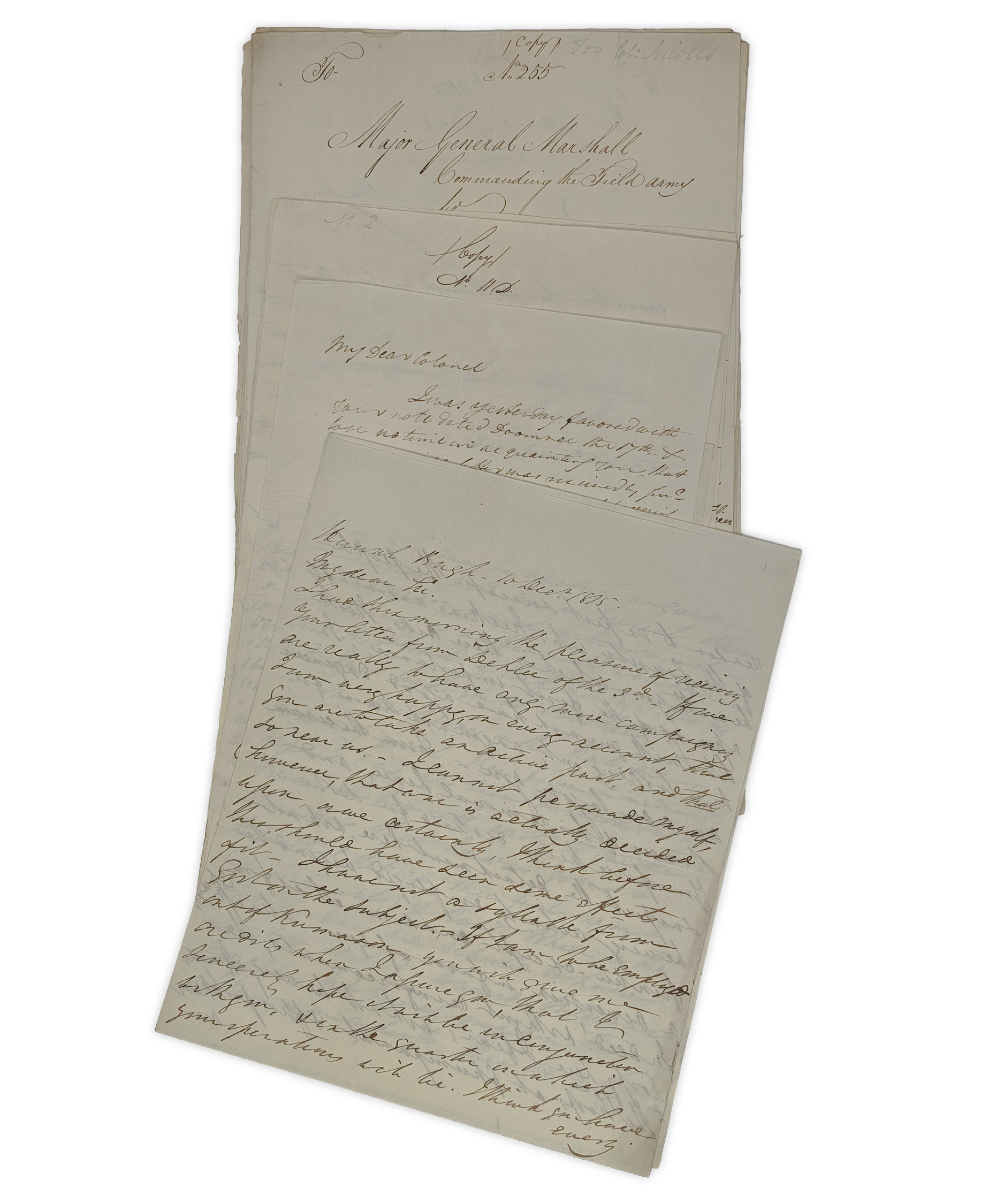
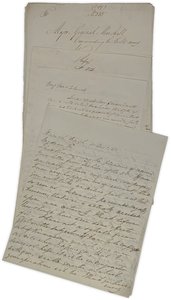
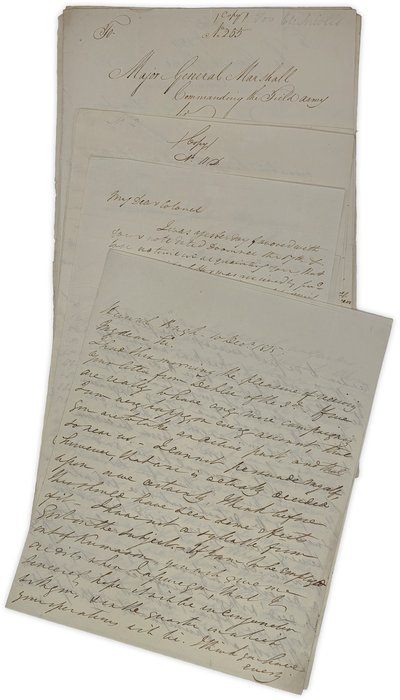
Eleven original manuscripts, including seven Folios from ca. 32,5x21 cm (12 ¾ x 8 in) to ca. 31x19 cm (12 ¼ x 7 ½ in) and four Quartos from ca. 25x20 cm (9 ¾ x 7 ¾ in) to ca. 22,5x18 cm (8 ¾ x 7 in). Brown ink on watermarked laid or wove paper. Documents from 1 to 6 pp. each; in all 30,5 pp. of text. Three official dispatches are signed by the superiors (G.H. Fagan, W. Lumsdaine, J. Nicol); three are certified as a “true copy” or a “true extract”; two documents are docketed on the last leaves. Fold marks, occasional minor creases or stains, one autograph letter by Edward Gardner is incomplete; overall a very good collection.
Historically significant collection of eleven original rare manuscripts, providing a valuable insight into the process of preparation of a British advance to the western Kingdom of Nepal in December 1815 in the course of the Anglo-Nepalese War of 1814-1816.
Caused by the rapid expansion of the Kingdom of Nepal in the 18th – early 19th centuries (in particular, the conquest of the princely states of Kumaon and Garhwal bordering the territories of the British East India Company), the war consisted of two campaigns. The first one culminated in the capture of the Gorkhali Malaun Fort by Sir David Ochterlony in May 1815, which led to the withdrawal of Nepalese troops to the territory east of the Kali River, leaving Gahrwal and Kumaon to British India (both are now parts of the Uttarakhand state of India). A peace treaty was signed “at Segowlie on the 28th November 1815, and was ratified by [British] Government with the usual salute, on the 9th December. <…> Under the impression that peace was restored, the preparations for the second campaign were suspended, and the commissariat officers, in their zeal for economy, went beyond the bounds of due discretions, discharging great part of the transport establishment and selling much of the grain collected in the frontier depot” (Frontier and Overseas Expeditions from India. Vol. IV. North and North-Eastern Frontier Tribes. Simla, 1907, p. 25; see more). Nevertheless, during December 1815, it was discovered that the Nepalese government had not ratified the treaty, and the second campaign started south of Kathmandu in January 1816 with the decisive British victory near Makwanpur in March. According to the peace treaty of Sugauli, Nepal ceded roughly one-third of its territory, including Kumaon, Gahrwal and parts of the Terai; a permanent British representative (Resident) was stationed in Kathmandu (Edward Gardner, two of his letters are in this collection); and Nepalese troops, known as Gurkhas, started to serve in the British Indian army, where they were regarded as some of the finest and fiercest soldiers.
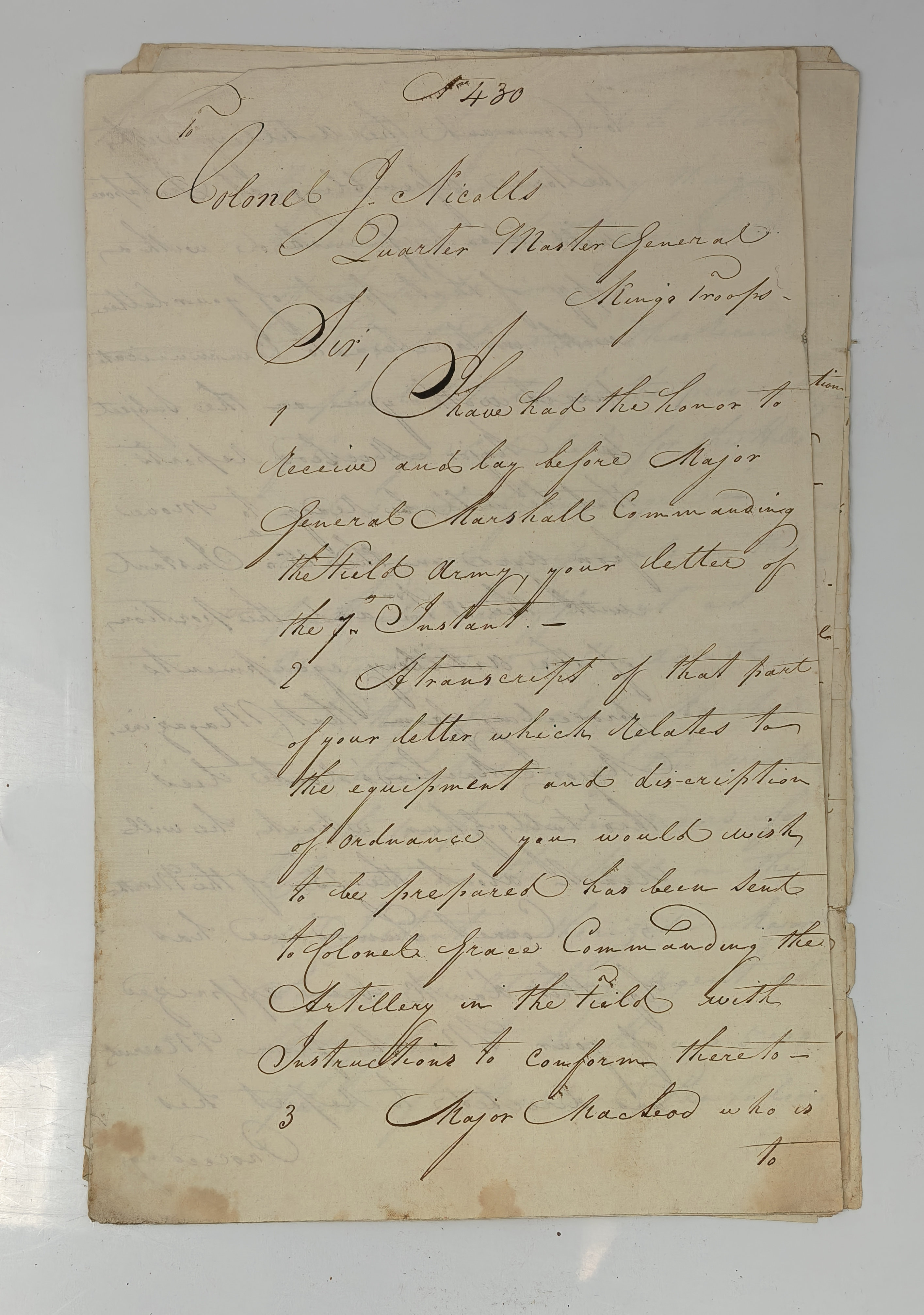
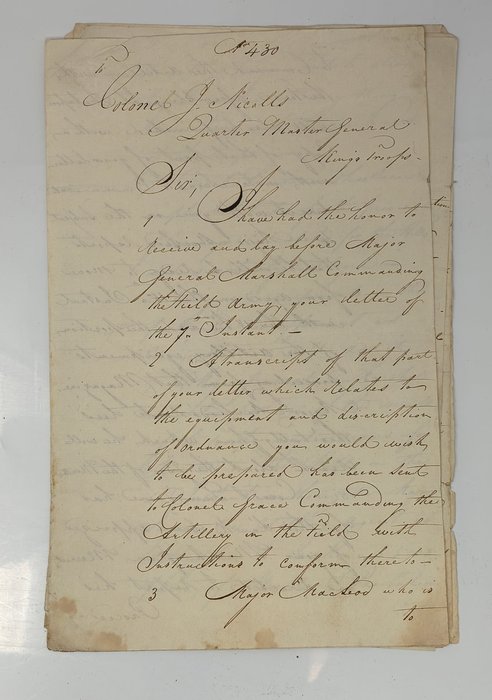
The documents from the collection date back to November-December 1815, the time of the first signing of the peace treaty and the subsequent discovery by the British that the Nepalese government intended to continue military actions. All manuscripts are related to the organization of the British military force, which was being formed in Sitapur (now Uttar Pradesh state of India) under the command of Colonel Jasper Nicolls (future Commander-in-Chief of the Madras Army and Commander-in-Chief, India), with the goal “to penetrate into the provinces of Doti and Salena” in western Nepal (Frontier and Overseas Expeditions from India. Vol. IV, p. 32). Ultimately, Nicolls’ force didn’t take part in the military actions, as a quick, victorious campaign by Major General David Ochterlony south of Kathmandu effectively ended the war.
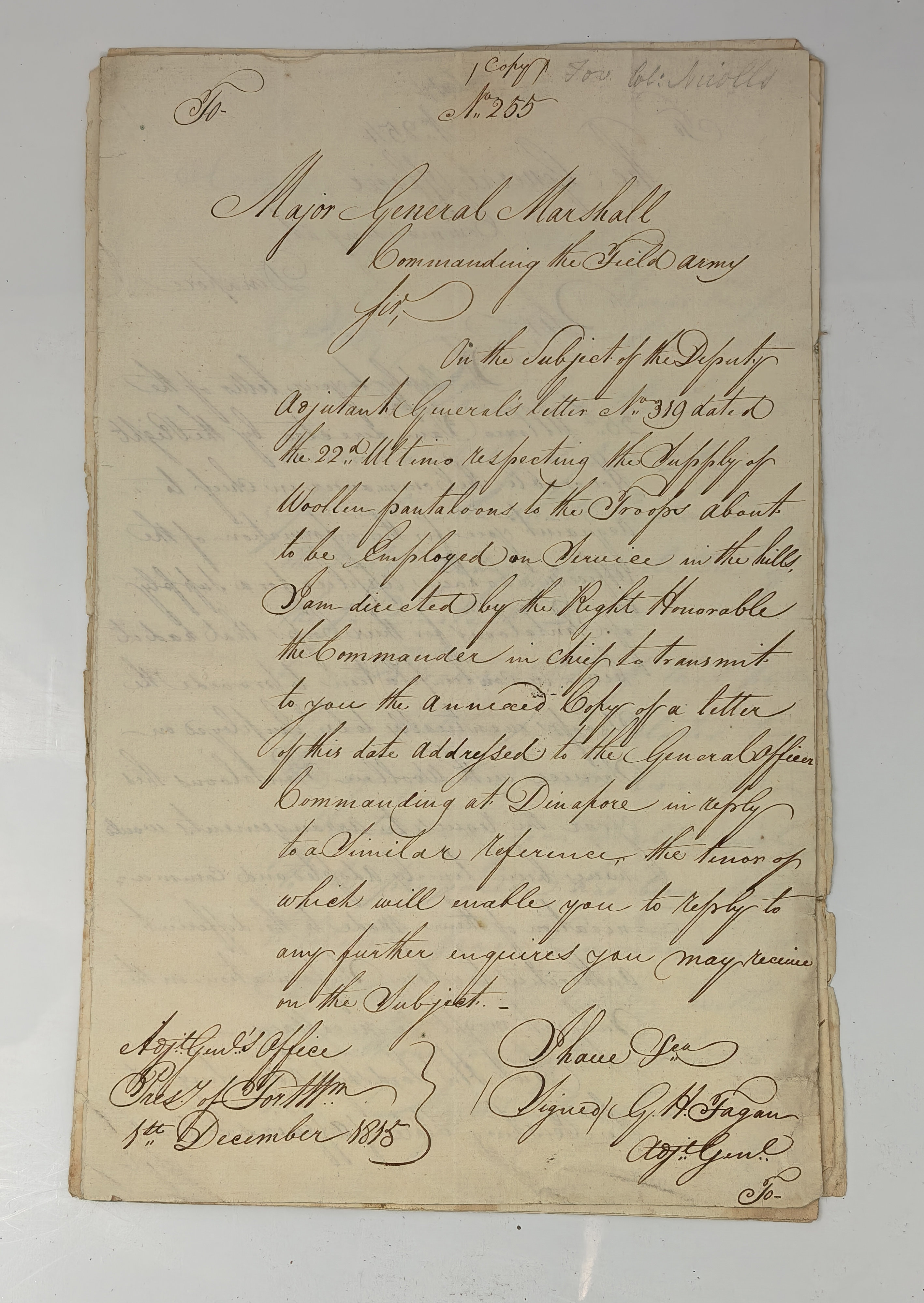
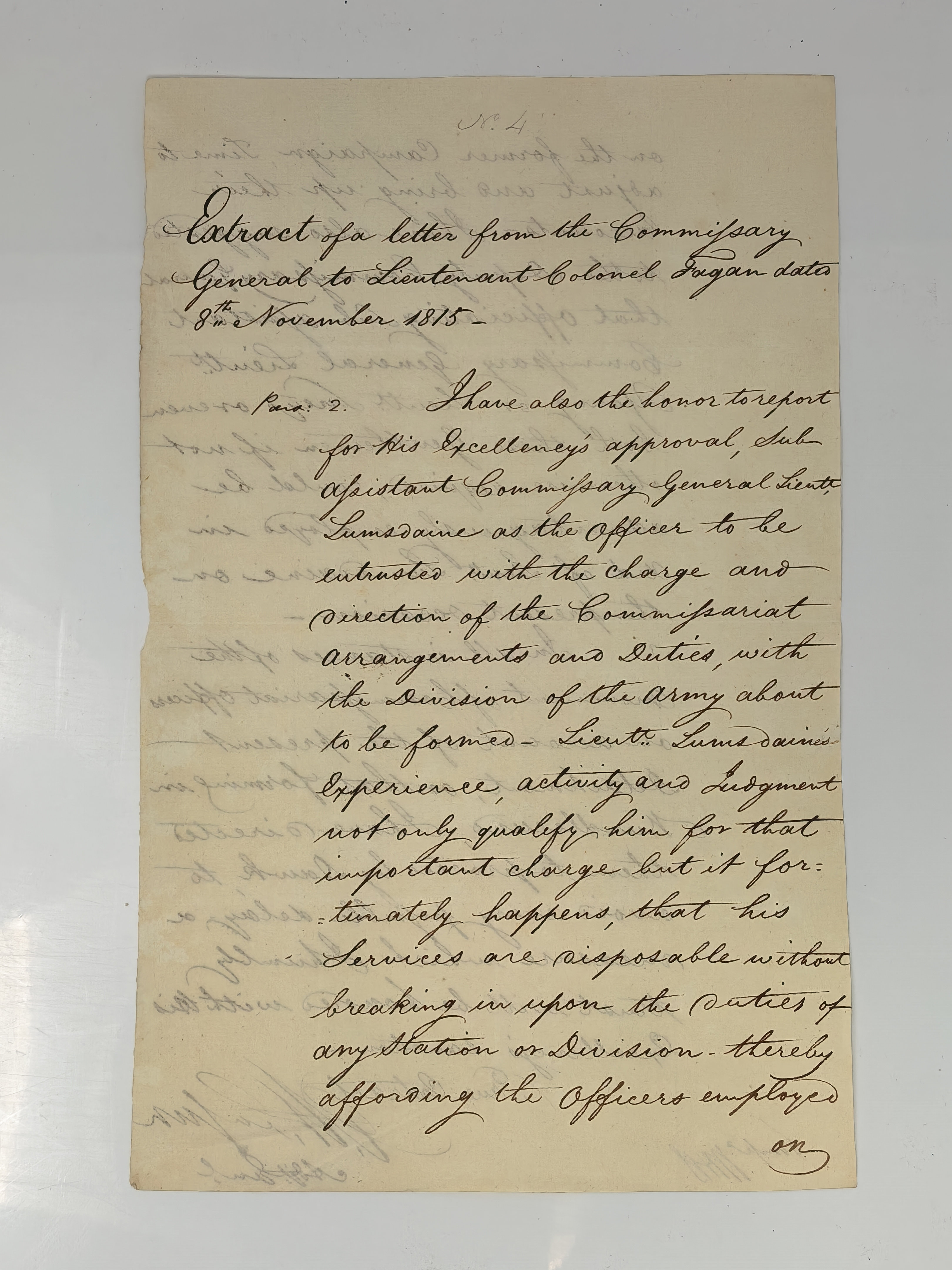
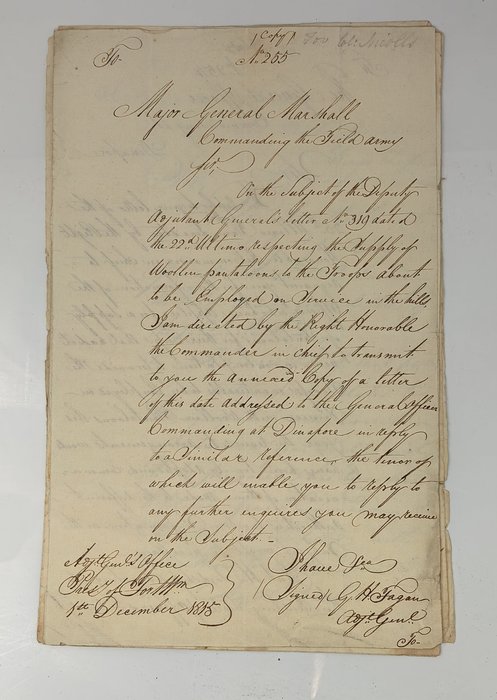
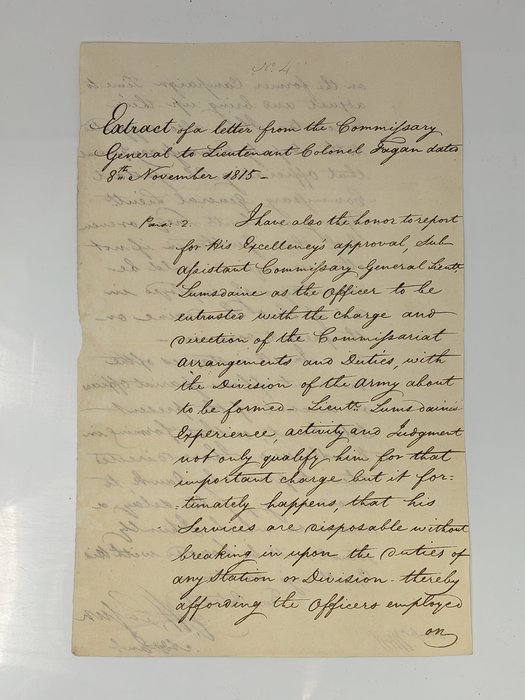
The documents contain valuable information on the history of operations of the British Indian Army in Kumaon and along the border of western Nepal. Originals or copies of official dispatches from Adjutant General George Fagan, Commissary General of Bengal Thomas Weguelin, James Nicol (Office of Deputy Adjutant General, Field Army) and Mayor William Lumsdaine (“Deputy Commissary General, Nepal”) refer to the formation of the British force in Seetapore, appointment of the Commissary Officers (William Lumsdale and others), issues with the supply of “woolen pantaloons to the troops about to be employed on service in the Hills” (Fagan’s despatch, December 1), and disbandment of the force “in consequence of the ratification of peace with the State of Nepaul” in late December (Lumsdaine’s despatch from December 22).
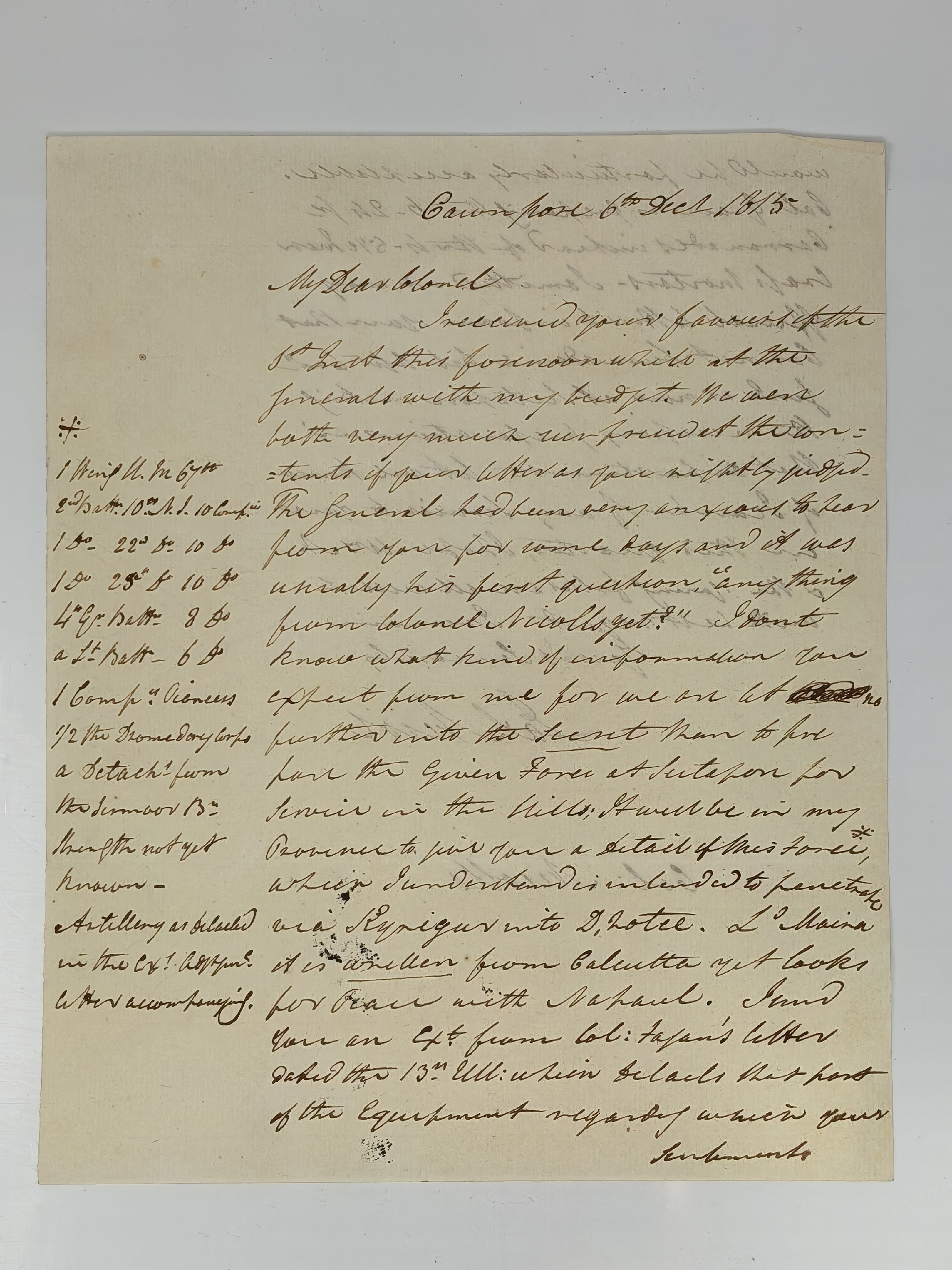
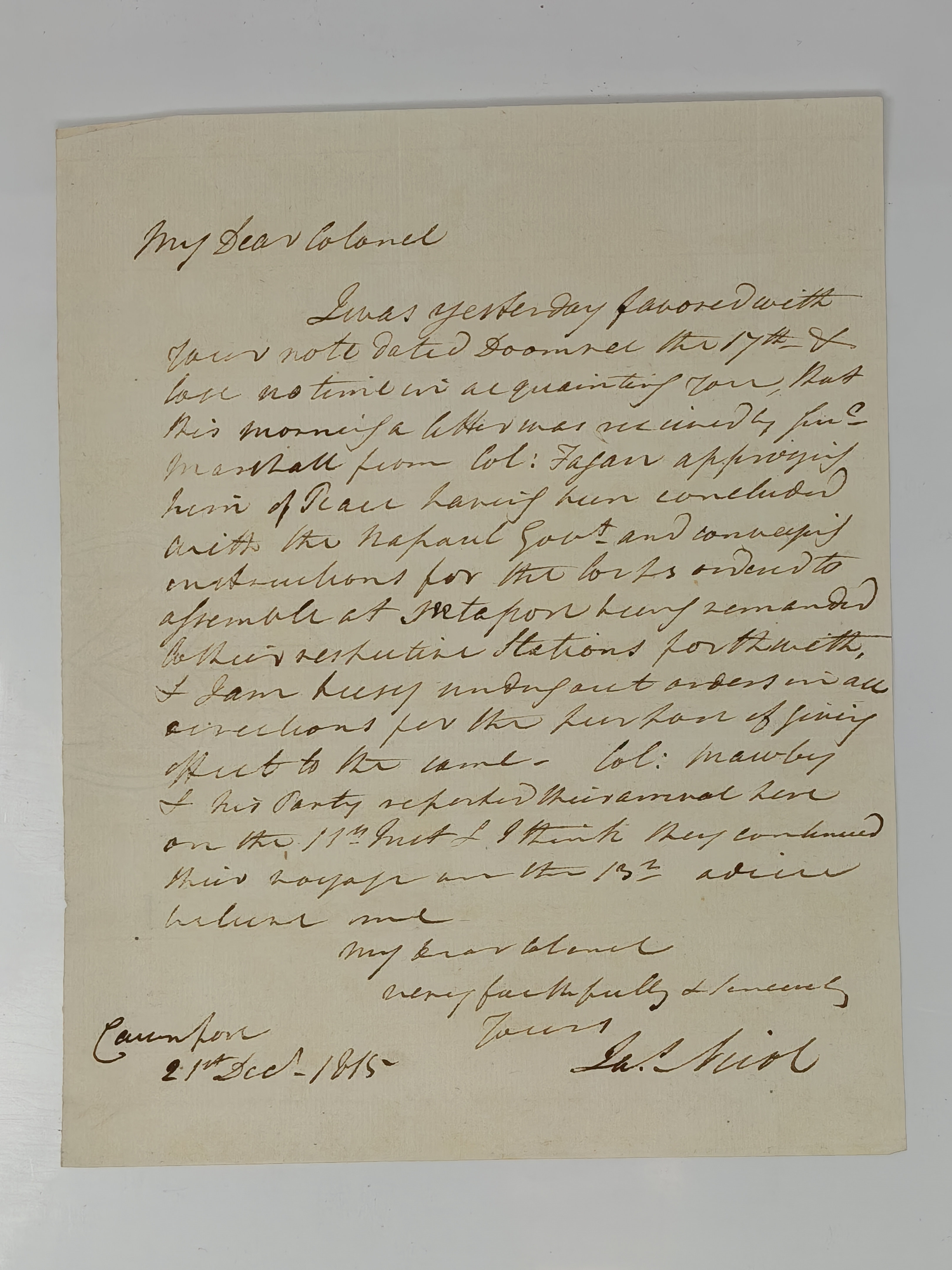
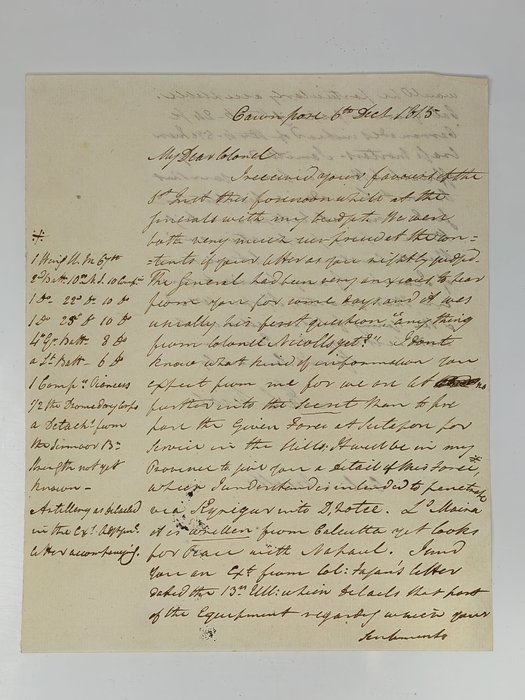
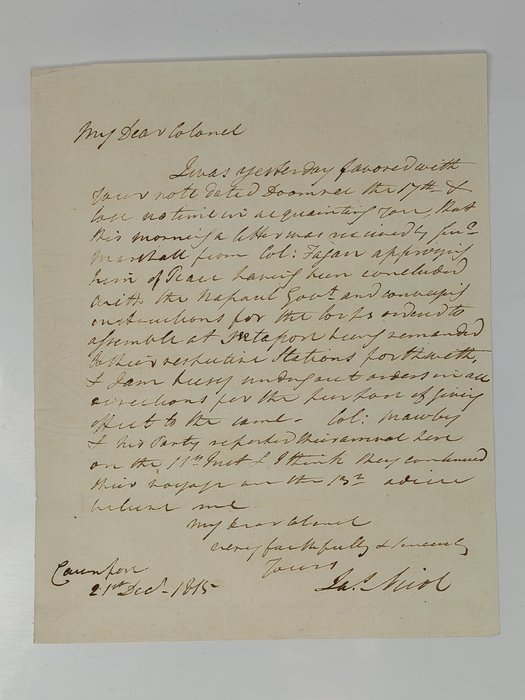
Two private letters from James Nicol to Colonel Jasper Nicolls provide more inside information, talking about the apparent goal of the force “to penetrate via Kyrigur into D’Hotee,” Lord Moira’s (then Governor General of India) hopes for “peace with Napaul” (December 6) and news of the “term of peace having been concluded with the Napaul Govt.” (December 22).
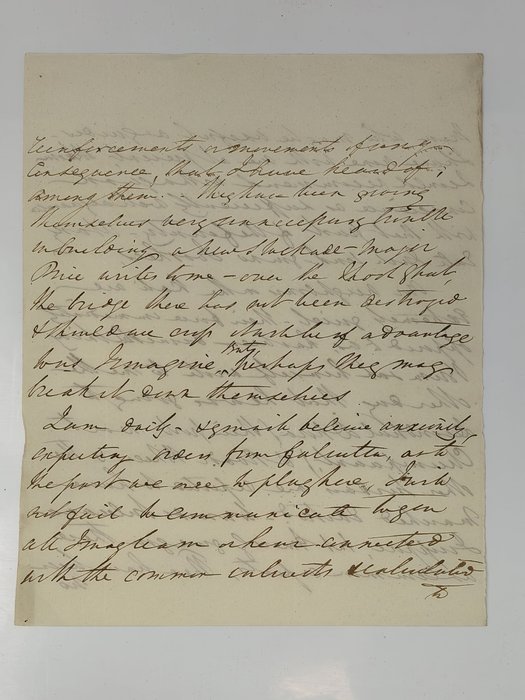
Very interesting are two extensive letters by Edward Gardner, then a British political agent in the newly occupied Kumaon, who was soon to be appointed the first British Resident in Kathmandu, where he served for 13 years (1816-1829). Both letters are apparently addressed to Colonel Jasper Nicolls in the wake of his planned advance into western Nepal and contain the latest reports about the state of the British India troops in Kumaon (including the increase of “disgust & dislike of the Seapoys in general to the Hill service” and desertions of Sepoys due to cold weather), strength and movements of the Nepali troops east of the Kali River (“there have been no reinforcements or movements of any consequence that I have heard of among them”), names and locations of Nepalese military commanders, existence of mountain passes into “Dotee & Saleena” and promises to provide local guides in the “vicinity of your operations,” surviving bridges over the Kali River, &c.
Overall, an important content-rich archive of original manuscripts, detailing the British operations in Kumaon and western Nepal during the Anglo-Nepalese War of 1814-1816.
Excerpts from Gardner’s letters:
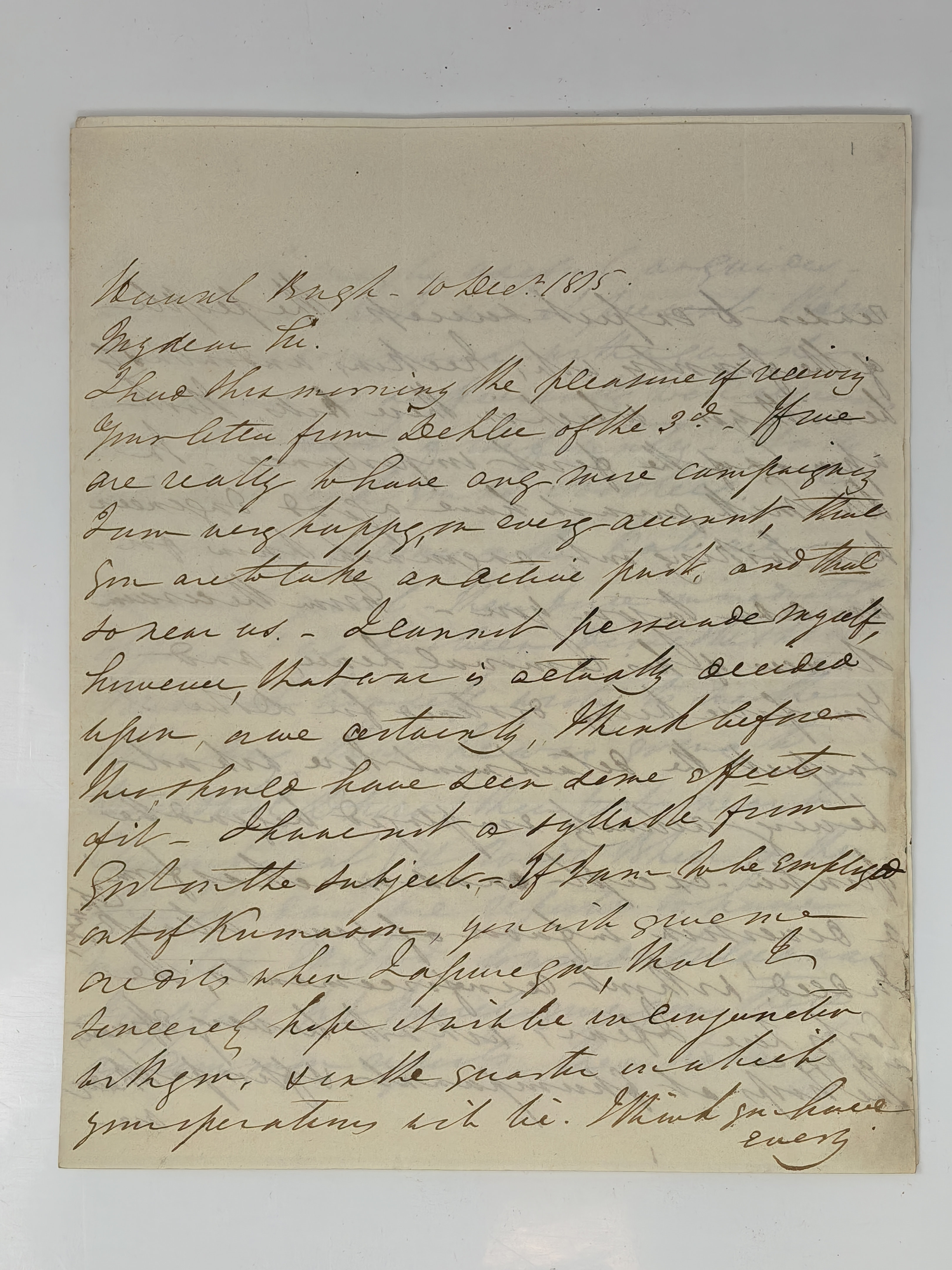
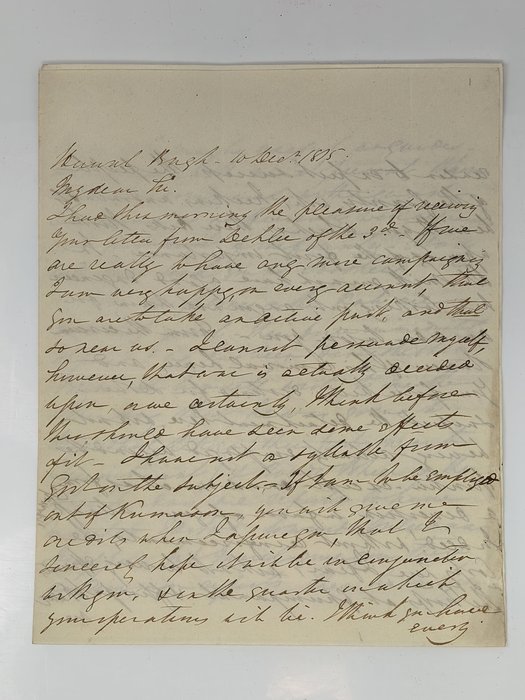
Huwal Bagh, 10 December 1815. 6 pp. [Incomplete].
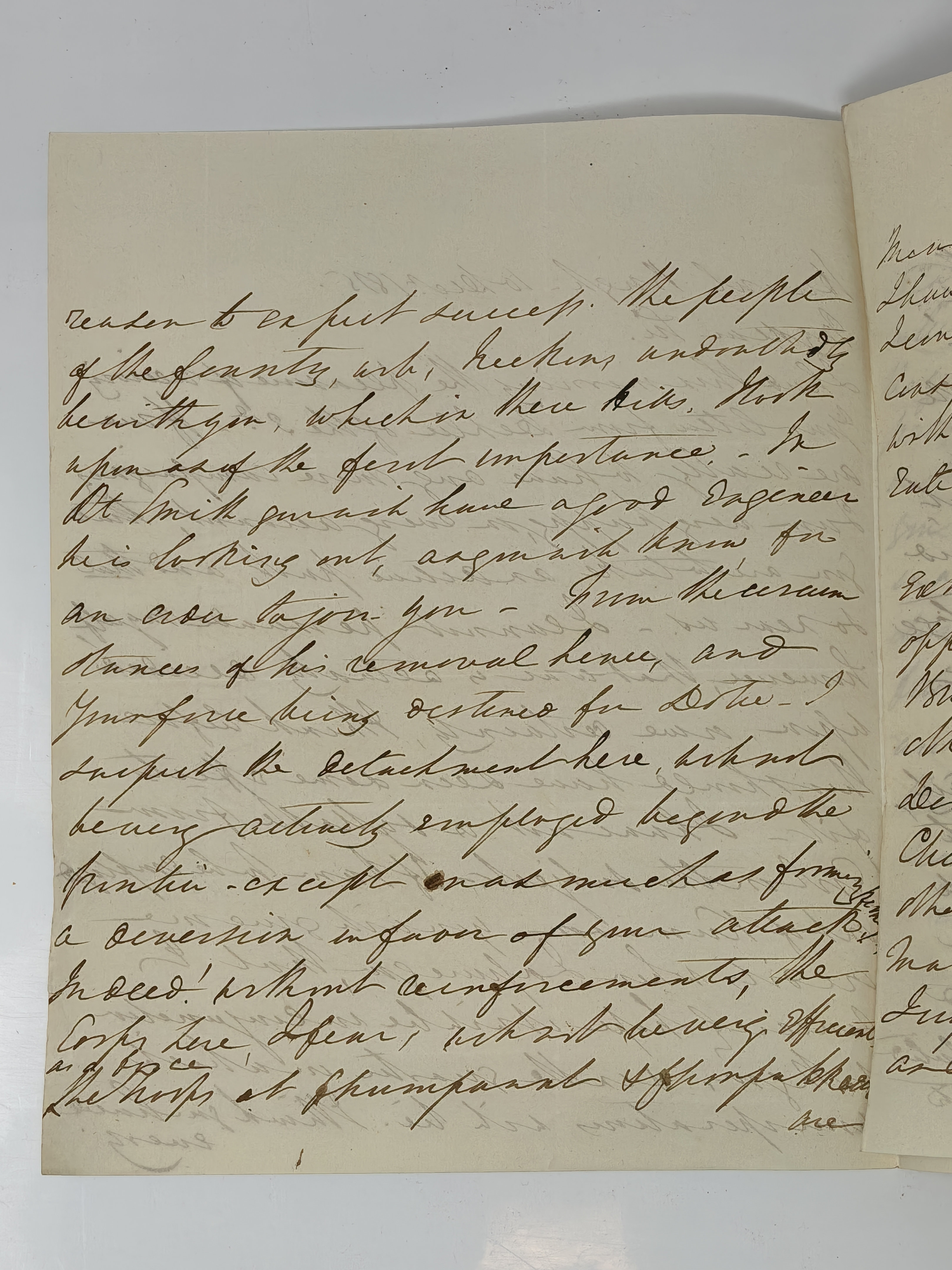
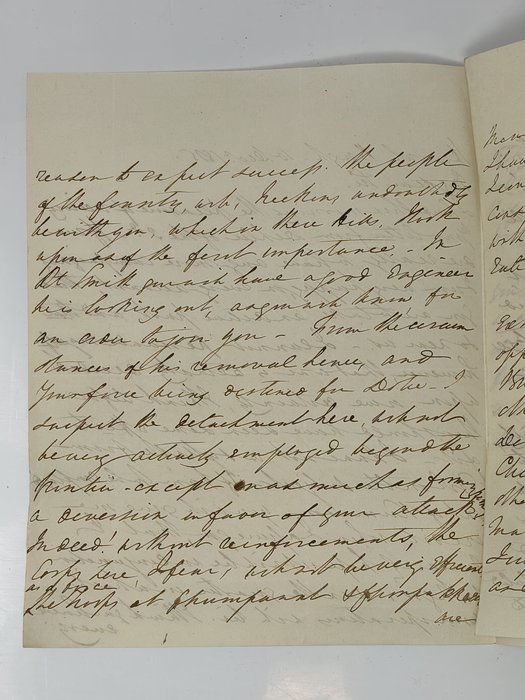
“<…> If we are really to have any more campaigning I am very happy, in every account, that you are to take an active part, and that so near us. I cannot persuade myself however that war is actually decided upon, or we certainly, I think before this, should have seen some effects of it. I have not a syllable from [Gvt?] on the subject. If I am to be employed out of Kumaon, you will give me credits when I assure you that I sincerely hope it will be in conjunction with you, & in the quarter in which your operations will be. I think you have every reason to expect success. <…> In Lt. Smith you will have a good engineer, he is looking out, as you will know, for an order to join you. From the circumstances of his removal hence and your force being destined for Dotee, I suspect the detachment here will not be very actively employed beyond the frontier, except in as much as forming perhaps a […?] in favor of your attack. Indeed! Without reinforcements the Corps here, I fear, will not be very efficient as a force. The troops at Champawat & […?] are greatly reduced & those that are still called fit for duty are not the men they were. <…> what is worse than all, the disgust & dislike of the Seapoys in general to the Hill service is rather [increased?] than otherwise & desertions <…> have lately become frequent. The 11th which I believe was the most effective Corps we had, has been relieved by this time I believe by the end of the 13th which I understand is very week. All these circumstance are really serious in contemplating any active movements across the Kali and I am very happy <…> that your operations will be in that quarter.
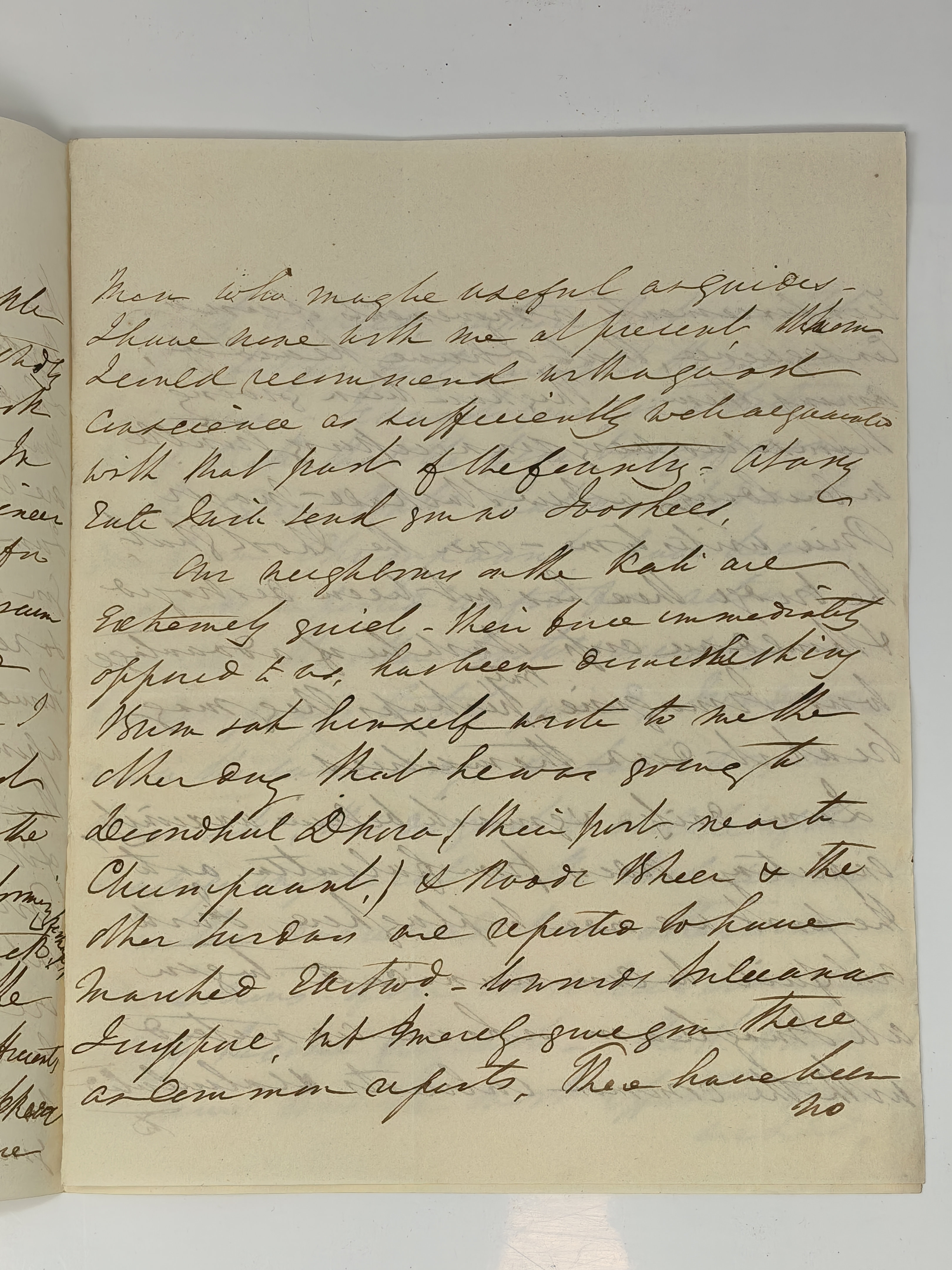
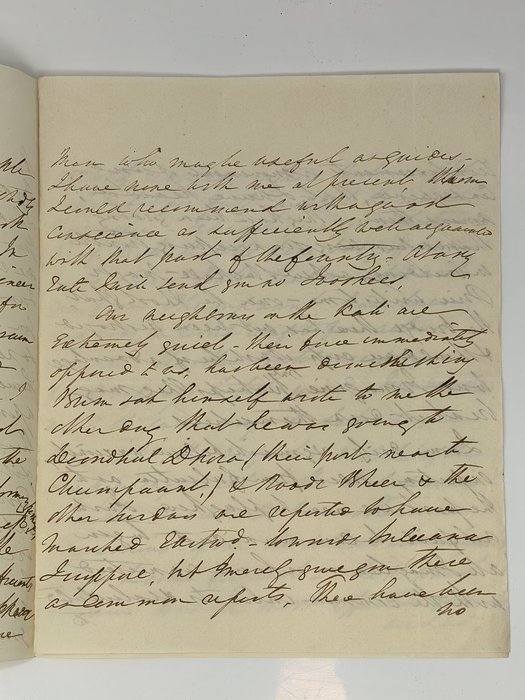
Of the passes into Dotee & Saleena from the […?] I am really too ignorant to pretend to give you information, I will however set about procuring at the intelligence I can & lead it hereafter however trivial it may be, to be added to you stash of knowledge on those subjects. I will also endeavour to get you some men who may be useful as guides, I have here with me at present, whom I could recommend with a good conscience as sufficiently well acquainted with that part of the country. <…>
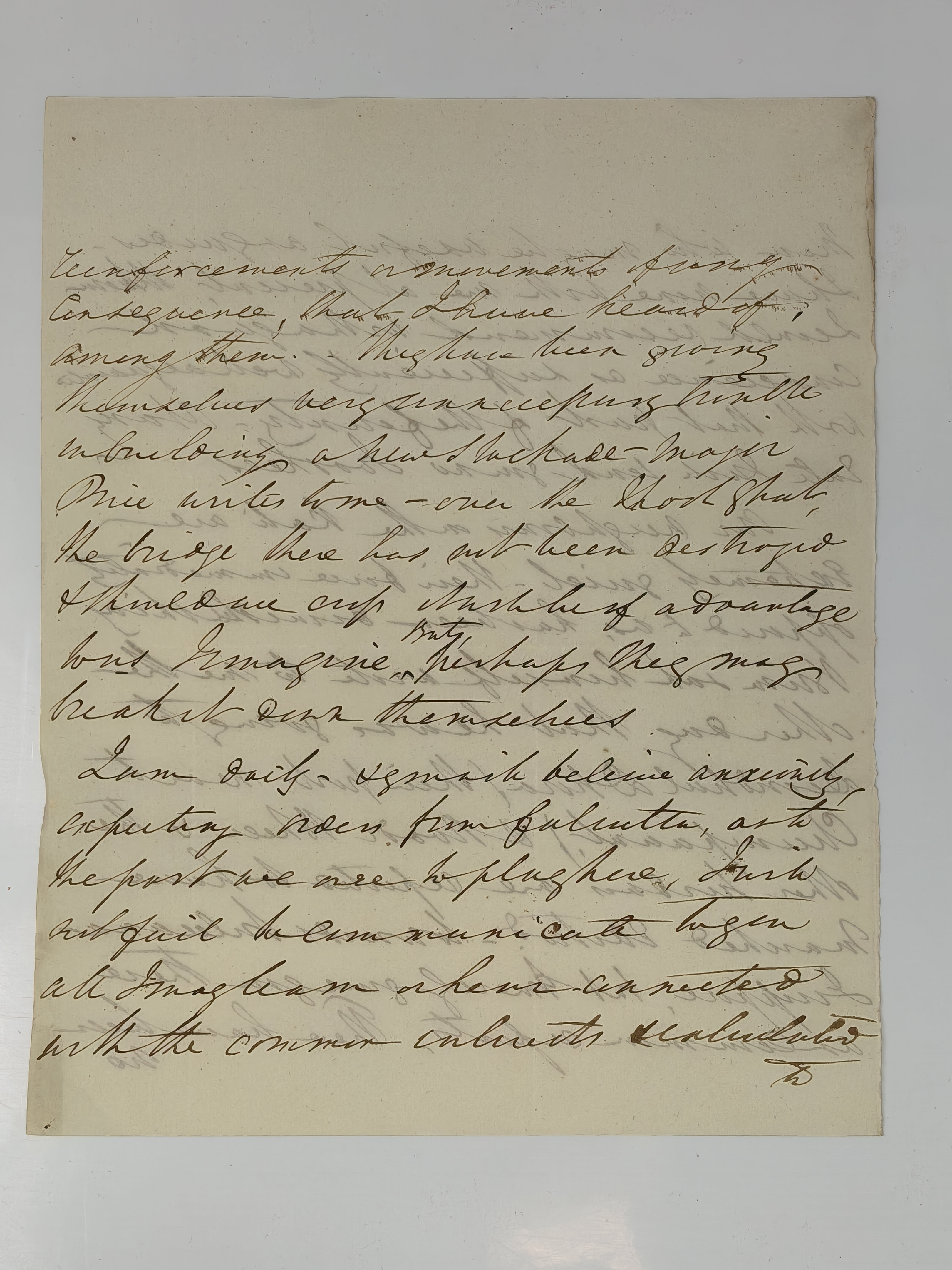
Our neighbours on the Kali are extremely quiet. Their force, immediately opposed to us, has been [dismantling?]. Bam Sah [Nepalese governor of the Kumaon province] himself wrote to me the other day that he was going to Deenhul Dhora (their post near to Chumpawat) & Noods Bheer & the other sirdars are reported to have marched eastward towards Inleecana. I suppose, but I merely give you these as common reports. There have been no reinforcements or movements of any consequence that I have heard of among them. They have been giving themselves very unnecessary trouble in building a new stockade – Major [Brie?] writes to me - over the [Shoot Ghat?]. The bridge here has not been destroyed & should we cross it will be of advantage to us I imagine. But perhaps they may break it down themselves.
I am daily & you may believe anxiously expecting orders from Calcutta, as to the part we are to play here. I will not fail to communicate to you all I may learn or hear connected with the common interests…”
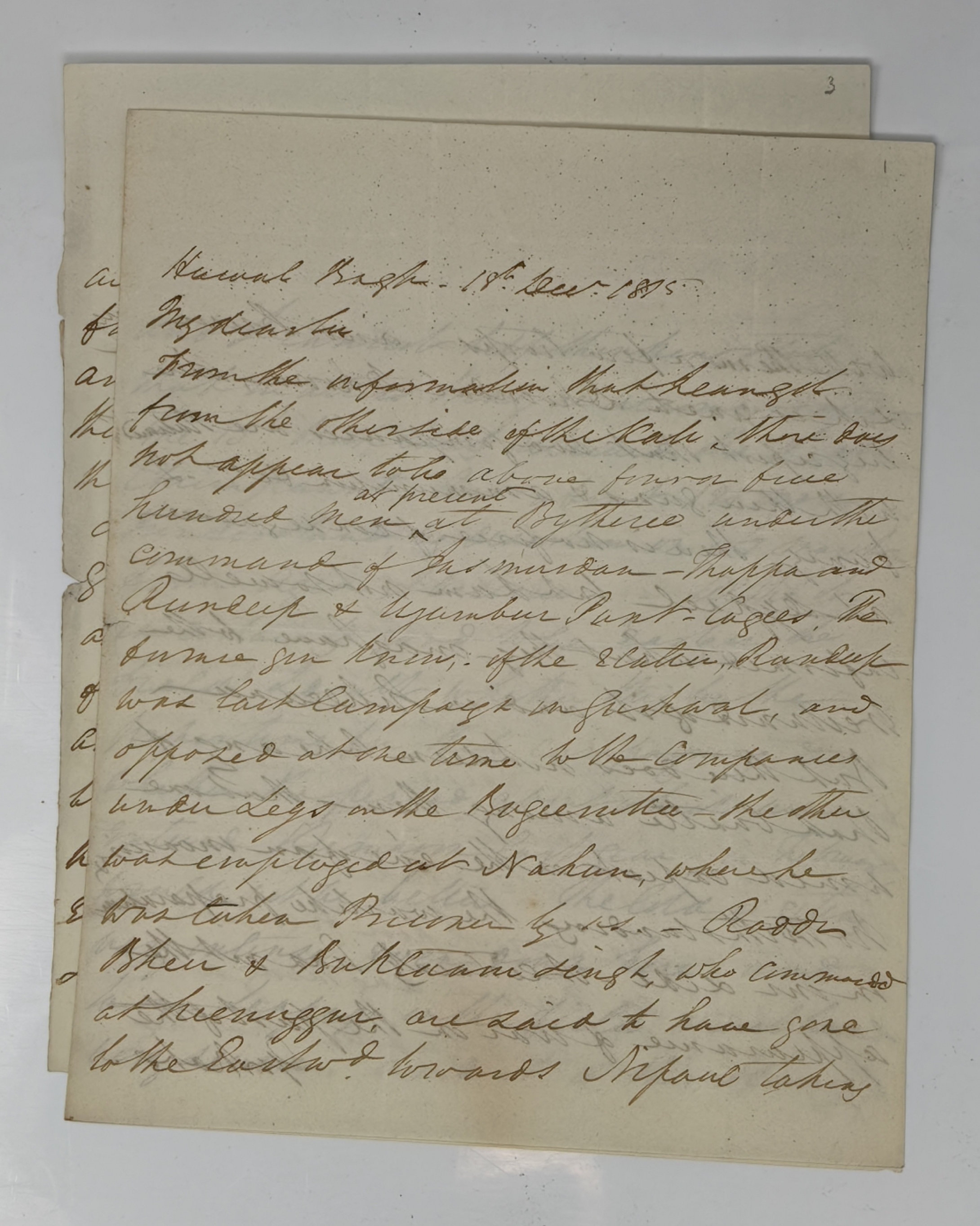
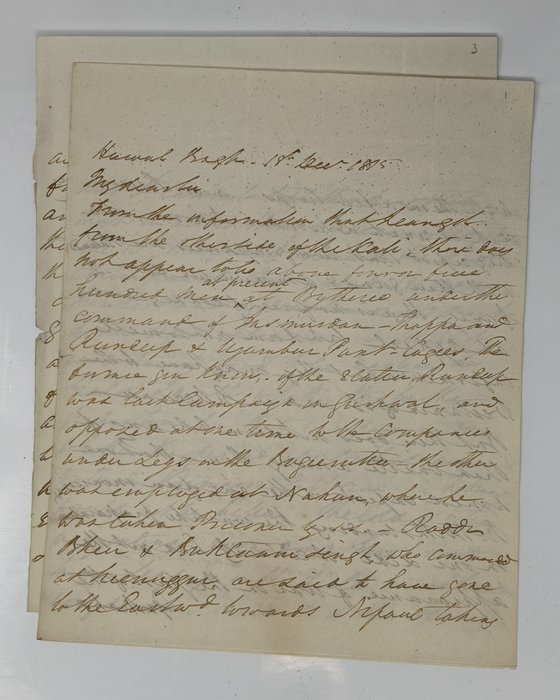
Huwal Bagh, 18 December 1815.
“My dear Sir, From the information that I have got from the other side of the Kali, there does not appear to be above four or five hundred men at present at Bytheree under the command of [names of Nepalese military commanders]. The former you knew, the latter, [Rankeep] was last campaigning in Gurhwal <…>, the other was employed at Nahun where he was taken prisoner by us. [Raddi Bheir & …] are said to have gone to the eastward towards Nipaul taking with them a few troops and Bam Sah is gone to Deenhul Dhora, where they report that two Companies are stationed with their guns & ammunition &c. <…> There does no seem to be any of that bustle among them that one should expect on the eve of an invasion notwithstanding the warlike preparations on our side – it certainly has not the appearance of war on the part of the Gurkhas. <…> The 13th that lately relieved the 11th at Chumpawat lost about 120 men I understand by desertion on its march from Agra <…> Altho’ it is certainly good to be ‘early in the field’ I doubt whether this be the proper time for this campaigning & whether the period about which we entered Kumaon last year – in February, should not be better, The cold is getting very intense even over here and to our Seapoys in the field must be very severe, and it is this I fancy, which they dislike and dread more than anything else <…> I have a letter from Col. Gardner in the neighbourhood of [Sotin] on the Goorukhpour frontier. He says nobody knows anything about the Gurkhas in that quarter. That they are neither seen nor heard of or appear from what he can learn, to be making any preparations for defence. However in not seeing them he says is no proof that they are unprepared for us <…>”