
#MC77
Сa. 1895-1906
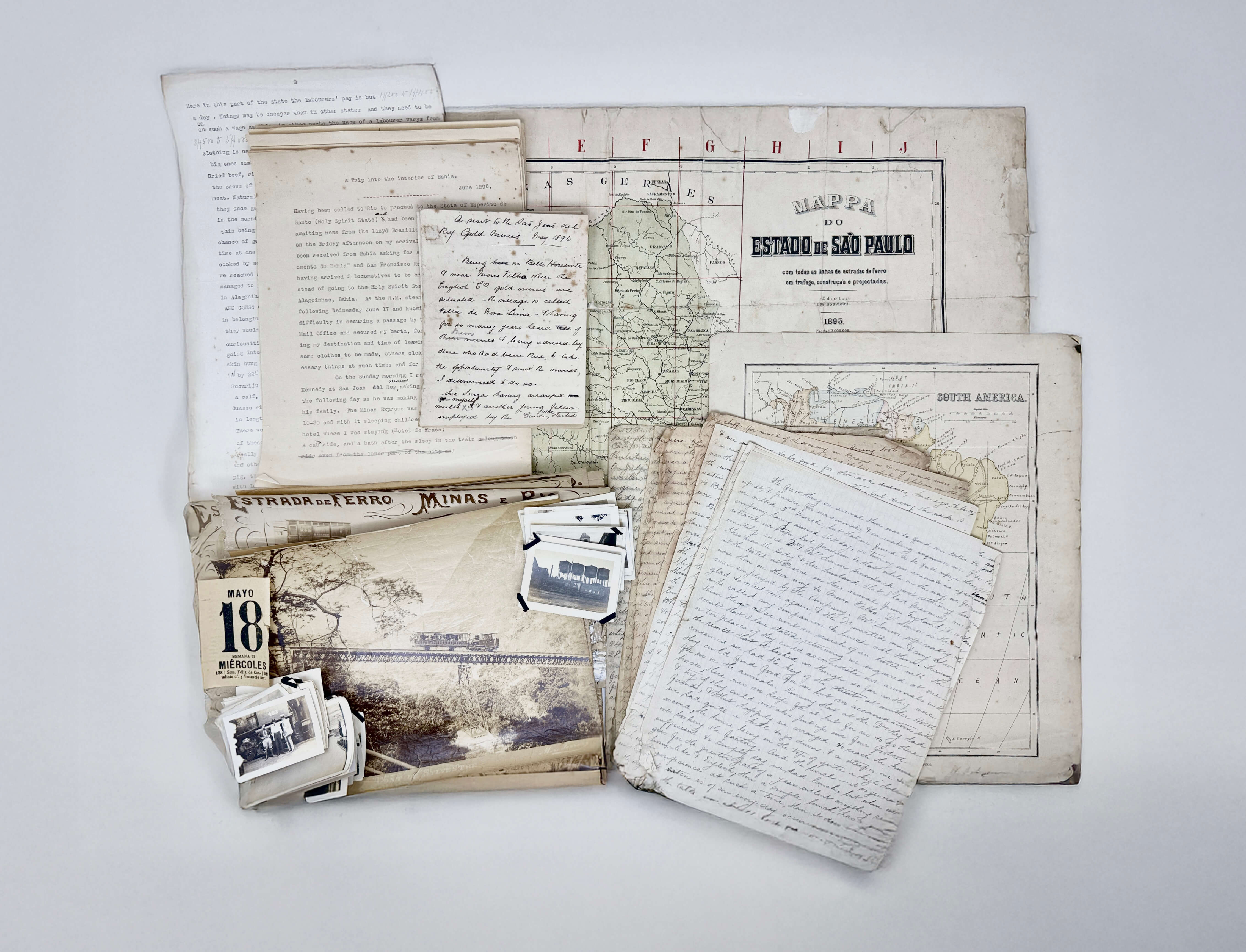
A historically significant collection of unique original materials, relating to the days and works of an English railway engineer in Brazil, the country he has traveled across for the purposes of installing the engines of different kind, often being on the road most of the days of the year, all well-documented in his dairy, they consist his observation on the economy and industry of the developing country, the role of English capital and specialists like himself in this process, the accounts of the meeting with the locals, the remarks on the recently abolished slavery and the lives of the former slaves, the interactions with the immigrants from different European countries and the companionships of the countrymen. Most of all, it gives a vivid account of the railroad system of Brazil in development, giving the ‘behind the curtain’ look at the subject Johnson was a specialist in. Being an eager observer, his accounts on the things outside of his speciality are equally interesting: he has witnessed and described the begging of 2nd planned city in Brazil, Belo Horizonte, now a 6-million megapolis, at the time of his visit a big construction sight, that was only 3 year old. Also important are his accounts of British-owned goldmines Saint John d'El Rey in Minas Gerais and the coming to power of President Campos Sales, the event he witnessed in Rio.
The amount of towns, villages and stations visited by Johnson and mentioned in the diary is close to a hundred, which makes it available source of life in Brazil outside of big cities at the time.
At the end of XIXth century Brazil was undergoing the economic transformation: in 1889 the Republic was proclaimed, ending the Emperial rule. In 1891 the Constitution was introduced, changing the landscape for the British companies in Brazil, tightening some rules, but opening the opportunities in other sectors. One of these sectors was railroad building: by 1890s Brazil had 9,583 kilometers of railways in operation, serving the then capital and fourteen of the twenty provinces. With the proclamation of the Republic, the Provisional Government decided to implement a plan for railway construction covering the entire country. The only way the plan could have been implemented is with the help of foreign capital and specialists. Between 1890 and 1895, another 3,383 kilometers of railways were opened to traffic. The pace of the construction was decent, but not revolutionary, as it was slowed down by the lack of structural organization, logistics and climate. In this time William G.Johnson, the specialist on installing and maintaining the engines, have found himself in Brasil.
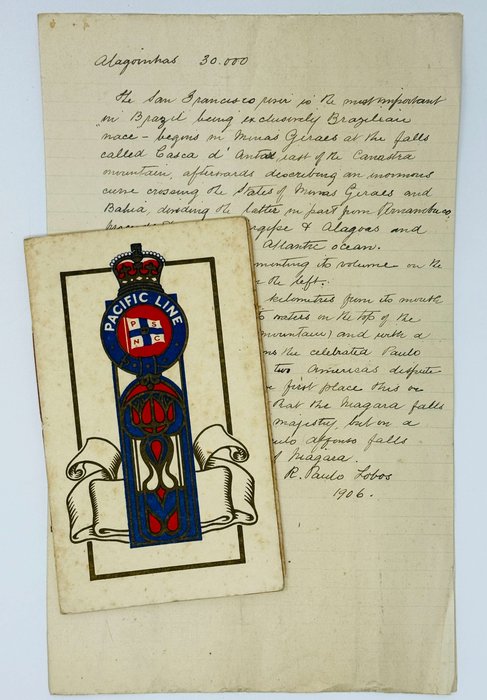
What we know about William G.Johnson is coming from the diaries themselves: likely originally from Ashford, Kent, he was assigned to a temporary job with the English company in Brazil in early 1890s, and then stayed for a longer periods of time in mid- and late-1890s, occasionally returning to England. He doesn’t mention the company he works for, but he writes about several partners the company had, one being ‘Conde de Santa Marinha’, a company found by Portuguese architect and engineer Antônio Teixeira Rodrigues, who is famous for being active in Brazil in 1890s and constructing a number of historical buildings. It is likely Johnson took jobs in other parts of the world, as a series of photographs form Havana suggest, but one manuscript in the collection from 1906 signed at ‘Villa Lobos’ and ‘Paulo Lobos’ (possibly in Rio), suggest he has either settled in Brazil, or returned there in 1900s as well. In his 1890s diary Johnson already took a liking to the locals, complemented on different Brazilians he met along the way and even used some Portuguese words in his writing (for example, ‘baldeação’ for changing trains).
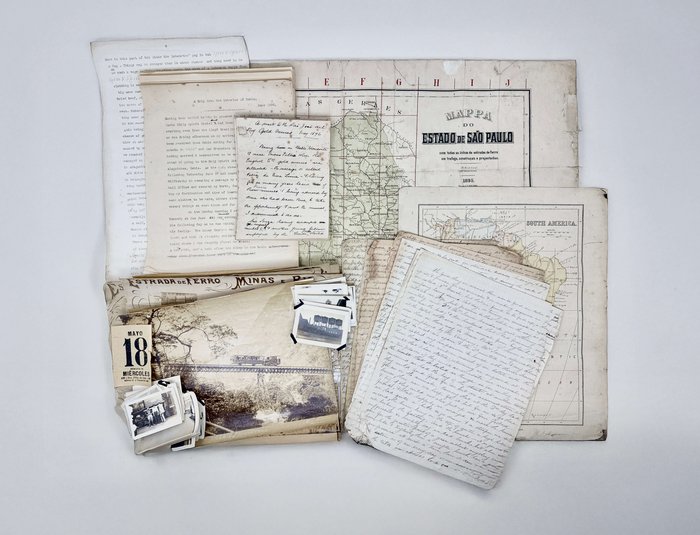
The collection includes:
I
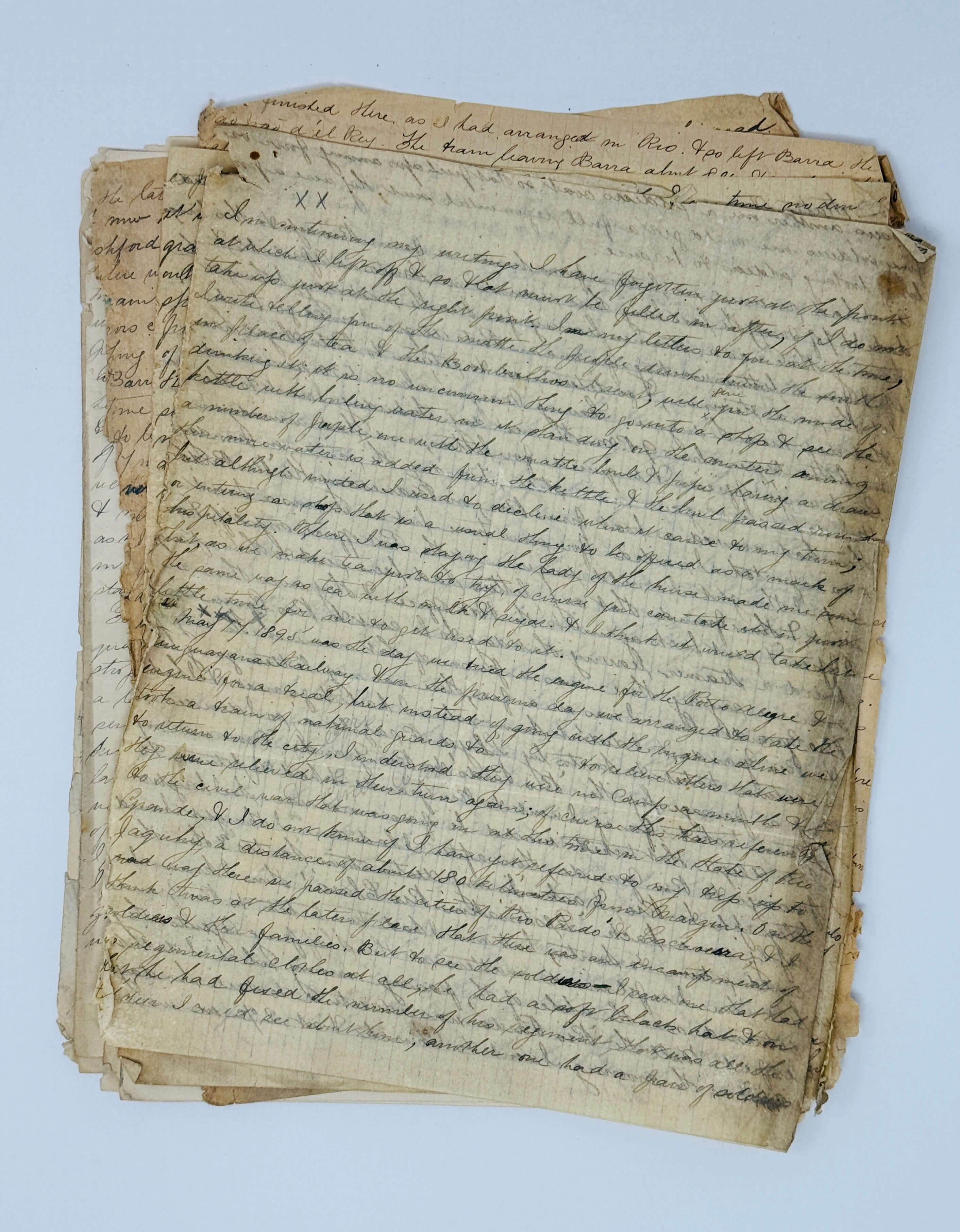
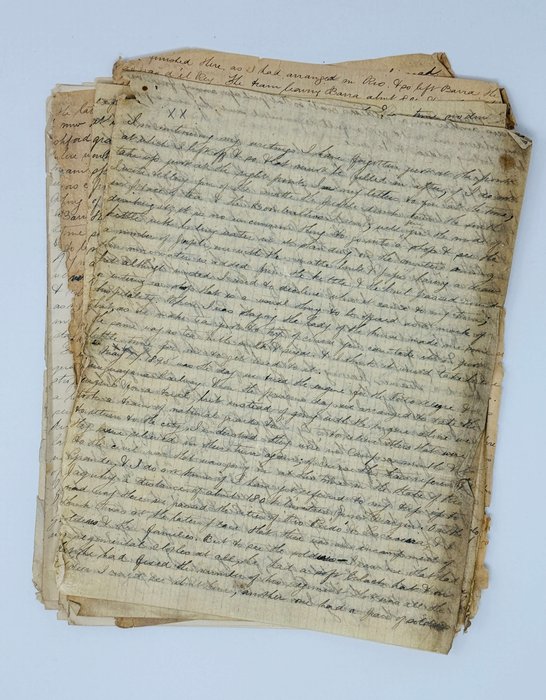
The diary of engineer W.G. Johnson, covering his work and life in Brazil from 17th May 1895 to 21th of June, 1896.
Quarto diary (ca. 26,5x20 cm or 10 ½ x 7 ¾ in). 46 pp. Manuscript text in ink on lined paper. The sections are separated with ‘XX’s, the text starts from the beginning of such section, but it’s unclear, whether the beginning the diary existed, while the last pages are definitely missing, as the p.46 ends in the middle of the sentence. No binding, the pages were stapled together with a iron clip (present) Manuscript with the signs of wear as the pages likely never had a binding or a folder. Some margins of the pages are missing and torn, most of the text is readable, as the hand is good and legible.
Mr. Johnson’s diary begins in May 1895, as he prepares to install a new locomotive engine at Porto Alegre. On the preceding evening, he notes with curiosity an unfamiliar custom at the local hotel—tea served with “Água mineral” added. His early entries situate him against the political unrest of the time, referring to the “State of Rio Grande civil war”, the concluding phase of the Federalist Revolution (1893–1895), fought between the federalist insurgents and the government of Júlio de Castilhos. Traveling through the region, Johnson remarks: “On the road that I have we passed the station of Rio Pardo & Cachoeira. I heard rumors at this latter place that there was an encampment of soldiers.” The presence of troops made him uneasy, particularly as he was unarmed.
His engineering company maintained offices in both Rio de Janeiro and Porto Alegre, and Johnson often found it challenging to coordinate correspondence between them. He describes the difficulties of receiving mail from Rio and England promptly, as his frequent travel and Brazil’s irregular postal service caused persistent delays. From Porto Alegre, he takes a steamer to Rio Grande, collects part of his mail there, and continued on to Santos, eventually proceeding inland to Rio Claro to oversee “the erecting of the 60 ton engine for the Paulista.” During this period he visited the newly founded Hospital Samaritano de São Paulo for revaccination—an institution, established in 1894, that remains active today.
Soon after, he describes Sorocaba as “a small quiet town,” recording visits to the local marble quarries and to a calico-printing establishment. Of the marble works, he writes: “operations with all the necessary machinery, I am sure that it will be a valuable industry. There are all colors of marble, gray, white, black, and gold, of great deal of very fine texture, being cut from the ground like great enormous rocks. I saw some pretty specimens of quite large pieces with the impression of ferns printed so perfectly and clear as possible.”
On the return journey, Johnson recounts witnessing a local man kill an iguana, describing the creature as “2½ feet long from head to tail lizard.” He later undertook business with the Hannal Ferrer Company in Campinas, then travelled to Itú to erect two small engines, before returning to Rio de Janeiro after several months of work “fixing the engines in different parts of Southern Brazil, traveled 1660 kilometers or 1250 miles.”
While in Rio, he attended services at both the Baptist Church—accompanied by the Portuguese cerise—and at the Methodist Church at Lago de Calette, recording his impressions of the congregations and their respective reverends. At the company’s Rio office, Johnson met Senhor Vieira (or Vierra), “who is the contractor for the new railroad from Piedade to Teresópolis.” Their discussion centered on the climatic difficulties of the proposed route: “in Petropolis there could be a great deal of rain and fog.”
Determined to assess the conditions himself, Johnson journeyed to Petrópolis, noting that there was no lodging available in Piedade and that a small diligence service ran between the towns. He provides a detailed account of the vehicle: “think that it is made more like a wagonette, only I remember, perhaps the same, a wagonette one along the side, while in this they run across, as an ordinary railway carriage, three seat benches facing each other, the roadway being dreadful in state and frequency.” He also comments on coffee transport logistics and the presence of a cotton factory employing an English worker. During this period, he witnessed a gunfight in Piedade, completed the installation and inspection of engines, and returned to Rio, departing again the next day for Barra.
In subsequent entries, Johnson reflects on the hazardous railways traversing Brazil’s jungled hills, where a single line served both ascending and descending trains. The arrangement, he writes, was unnerving: “strong people used to travelling at home would be a minimum—believe me afraid.” He goes on to compare technical railway practices in England, Ireland, and Brazil, remarking on the distinct engineering challenges of tropical terrain.
Proceeding to São João and then Galvão, Johnson meets another English railway specialist, with whom he spends some time. Returning to Barra, he begins the installation of another engine, lamenting the inadequacy of his workforce: “the engineer, the foreman, mason, mechanics, etc. They had plenty of competent men to undertake the work, so I expected to have to do while there was simply to look on, to pass my time. But I was very soon mistaken, for I must see & help the engine men to be got together in anything like decent order. I almost have myself to take them on hand, which I did... a Brazilian but of German parents, was not almost good at all.”
He spent both Christmas and New Year at work, to his disappointment, writing letters to England on Christmas Day. His diary from this period also records frequent journeys through mountainous districts, complete with detailed explanations of railroad gradients and steep passes.
A vivid account of Caxambu, then a fashionable mineral-spring resort, follows. Johnson remarks on “the curse of all places in Brazil—gambling,” and offers observations on the medicinal springs for which the town was renowned. Before completing his work at Barra, he was recalled to Rio de Janeiro to inspect newly arrived engines. He spent a period at Engenho de Dentro, examining machinery in the local workshops, before returning once again to Barra—this time forced to walk part of the way through rain-soaked roads with other passengers.
A brief but reflective passage contrasts the difference between “a house & a home” in Brazil and in England. Upon reaching Três Corações, he records meeting the local locomotive chief engineer, “Camarinha,” who spoke “perfect English with a Scottish accent,” having studied in Scotland. The railroad under construction from Varginha to Três Corações was the object of Johnson’s mission there. His description of the town includes details of its layout and population, along with encounters with fellow engineers and railway specialists, whose itinerant work caused them to cross paths in various parts of the country. To them he gives practical advice for travel in Brazil: “put a suitcase against the door when sleeping in the unpleasant hotels,” a precaution he himself adopted during his stay in Bello Horizonte.
Subsequent journeys took him to Lafaiete (now Conselheiro Lafaiete) and Amaro Brazílio, the nearest railway station to Amaro Bellos, where eight mines belonging to an English company were situated. Johnson remarks that “the company do not want a railway made to Amaro Bellos for their reasons.” His reflections turn briefly to immigrant life, noting the special immigrant station in Pinheiros, built specifically “for Poles,” and others designated for different nationalities.
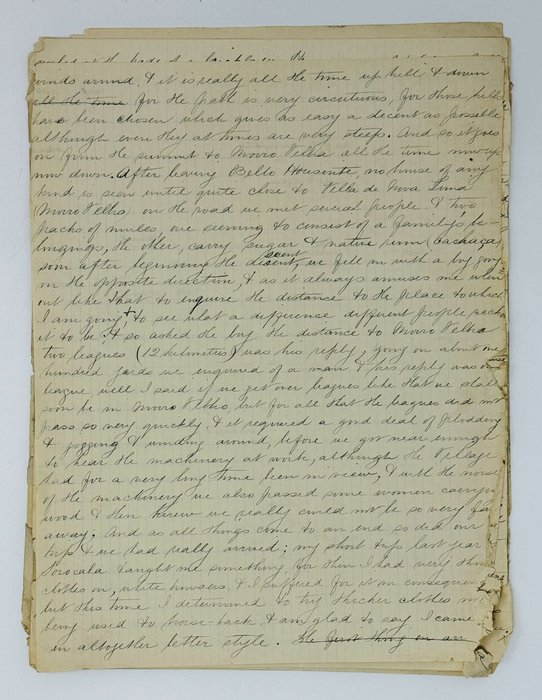
After arriving in Ouro Preto, the old town being a capital of mine country, he gives the account of the situation there: the old capital was considered too limited for space and as a result the government decided to create a planned city: thus Mr.Johnson witnessed the beggining of Belo Horizonte, the second planned city in the history of Brazil, now a home to 6 million people. Two pages are dedicated to the construction sight that was in place at the time for the city of ‘planned 150 000 inhabitants’.
Johnson expresses doubt and surprise on these plans, describing part of the precent population of the town: ‘you see the women perhaps eating their breakfast outside the huts, their table is an old board on the top of barrels, the mother sitting on the door step with her plate in her lap & the children on the ground with their plates & with their humble surroundings apparently happy. It is reckoned the earth works there are 1,100 mules & carts at work, and for the length of time that they have been employed, moving the earth it must be very well organized’.
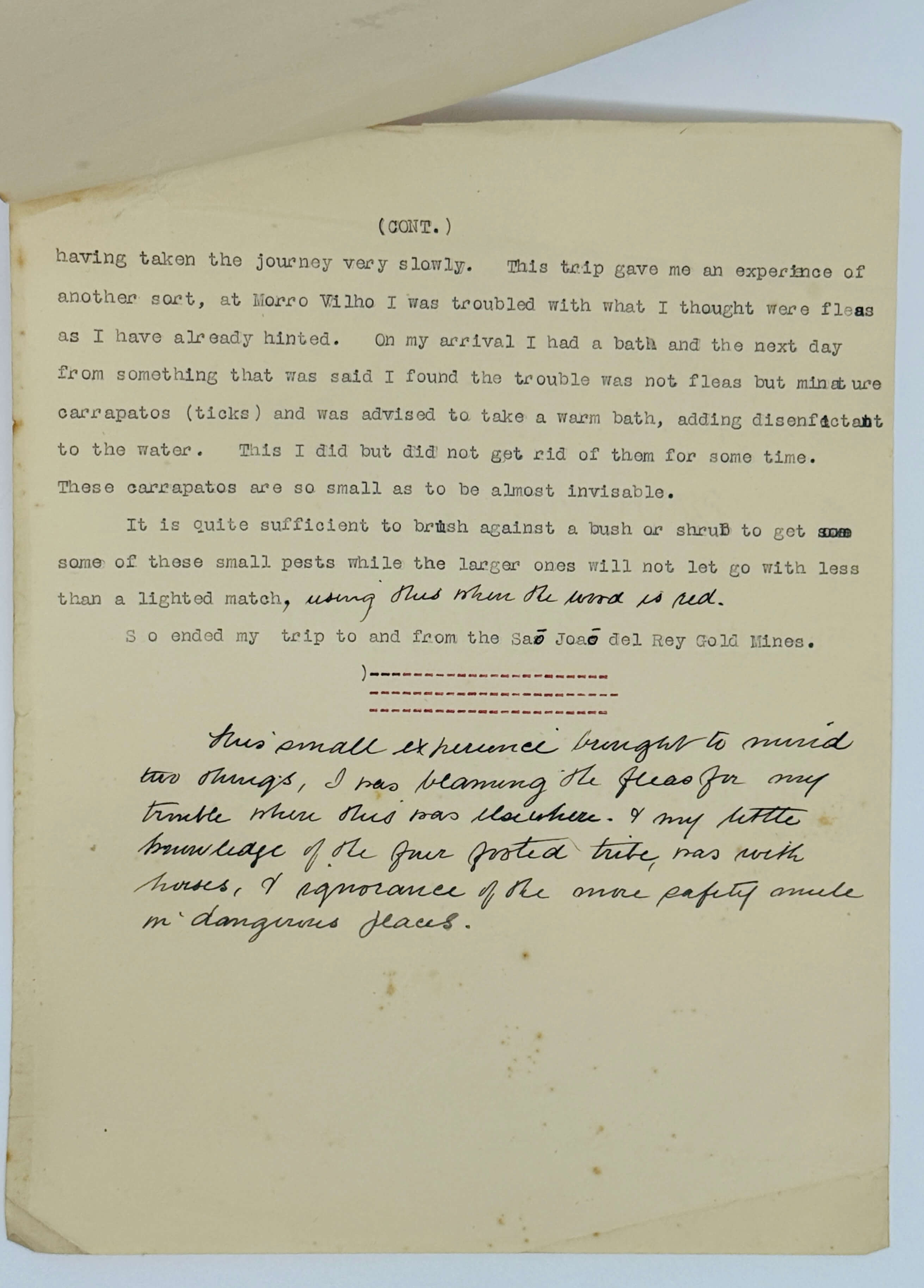
The rest of the diary covers the trip to Sao Joao Del Rey Gold Mines and the trip to Bahia, also included in the transcripts (see below), but with factual variations.
II
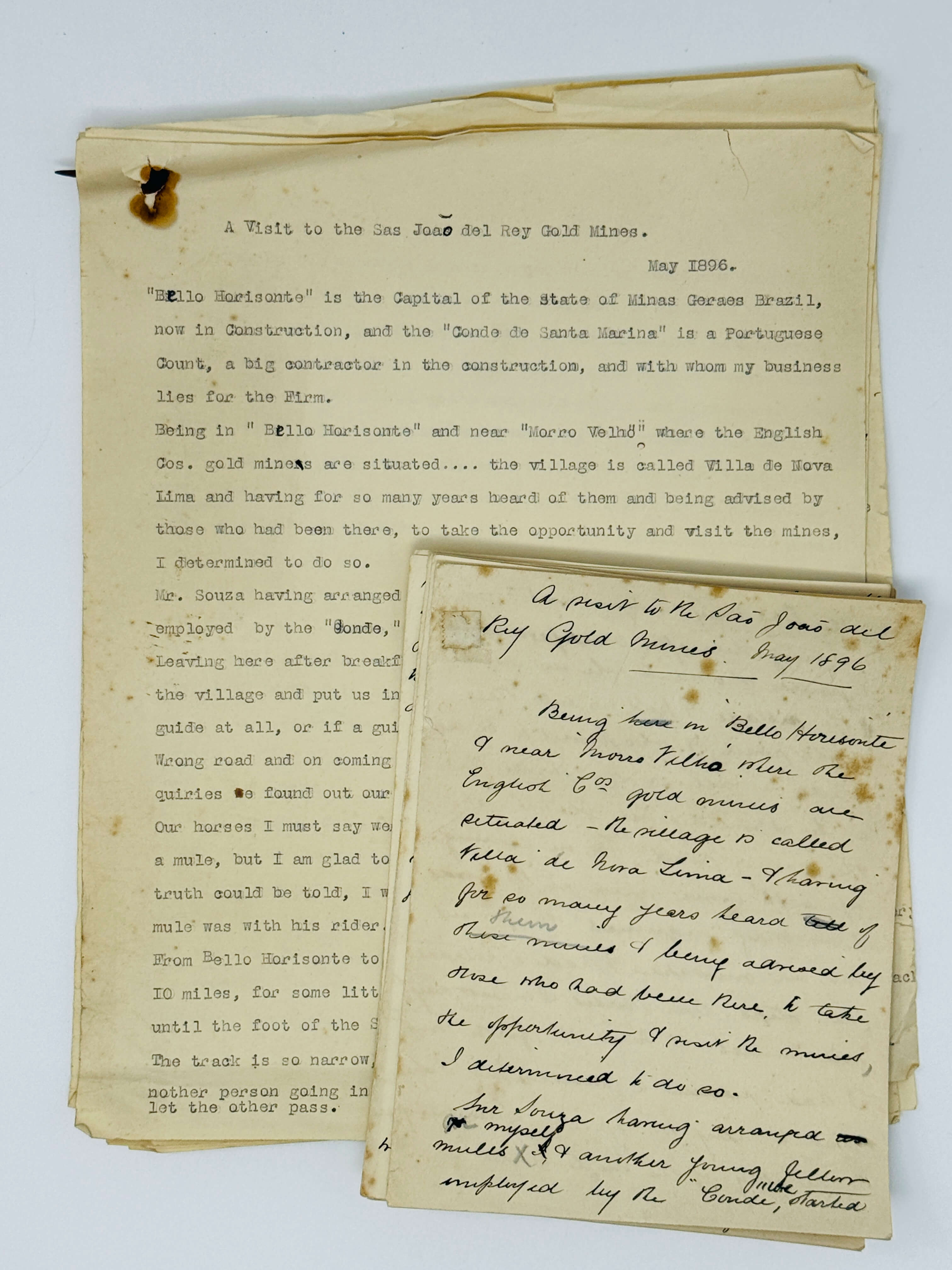
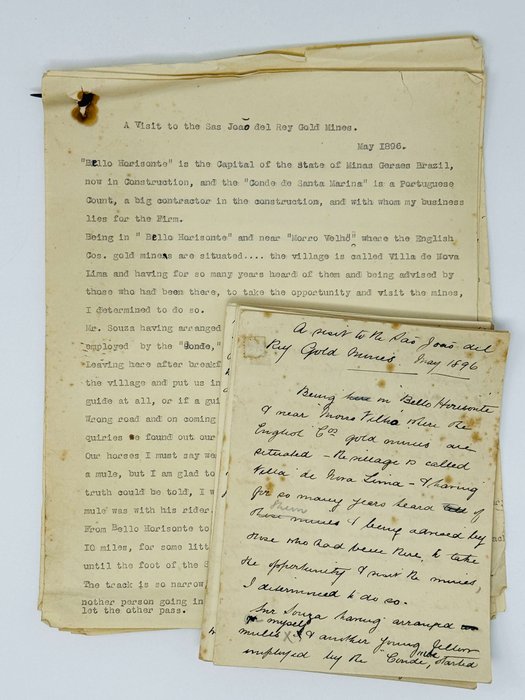
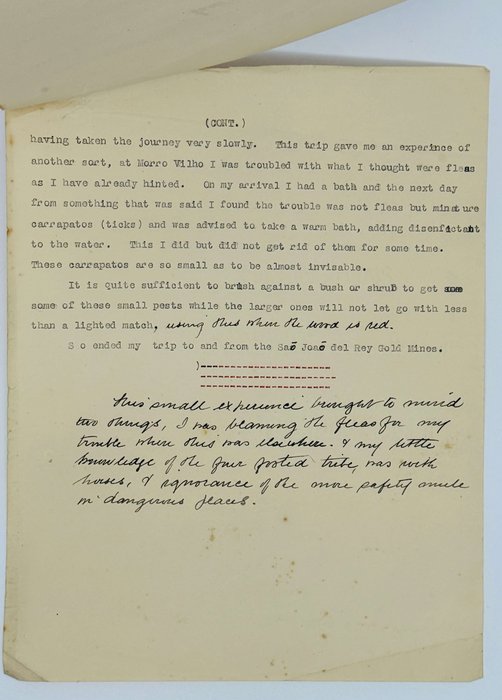
The article ‘A visit to Sao Joao del Rey Gold Mines’, typescript and manuscript (slightly varying in content).
Typescript. Quarto (ca. 26x20 cm or 10 ½ x 8 in). 8 pp. Black on rectos. The typescript was possibly intended for publication and has several omissions of the original manuscript text.
Manuscript. Quarto (ca. 16,5x12 cm or 6½ x 5 in.). 20 pp.
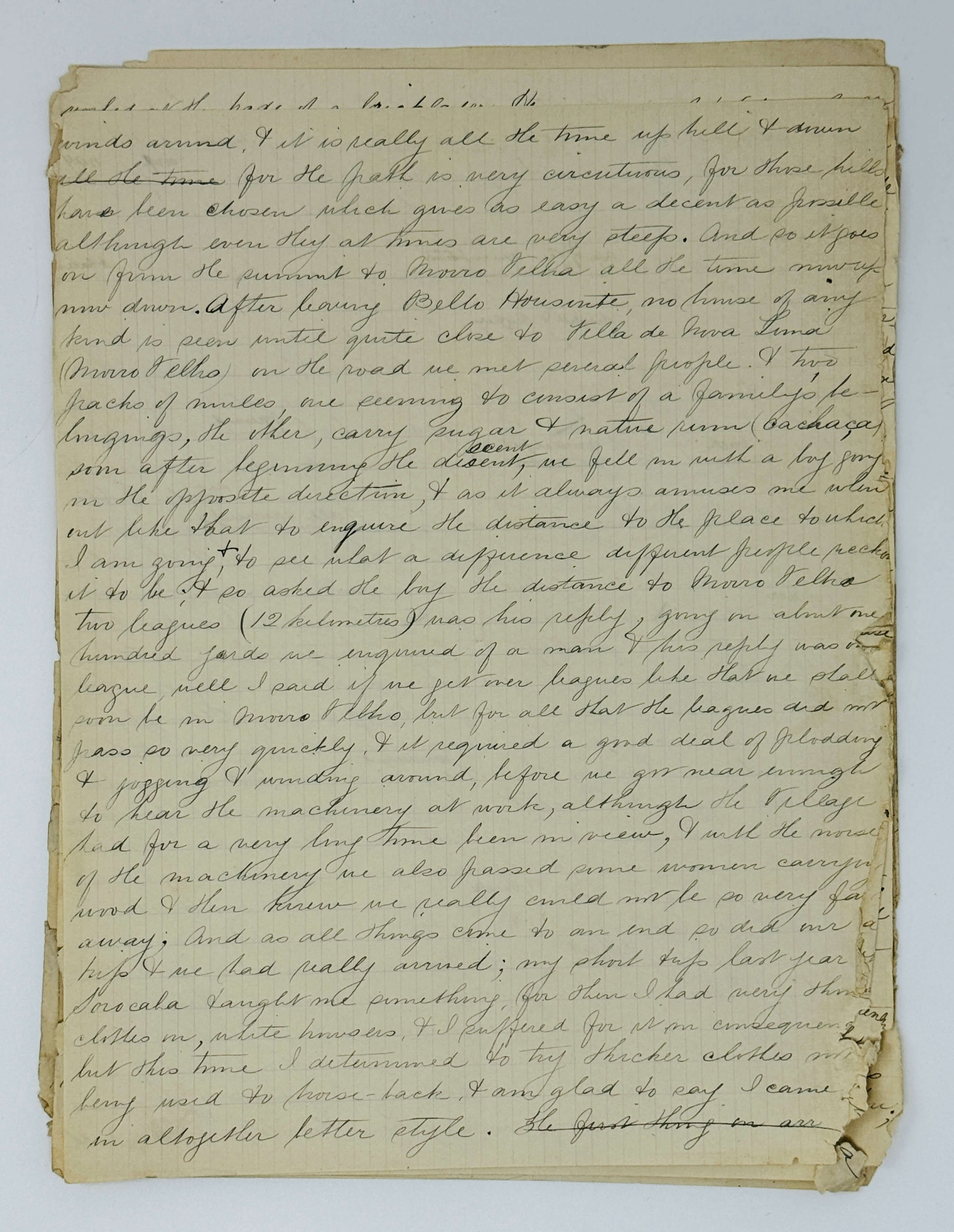
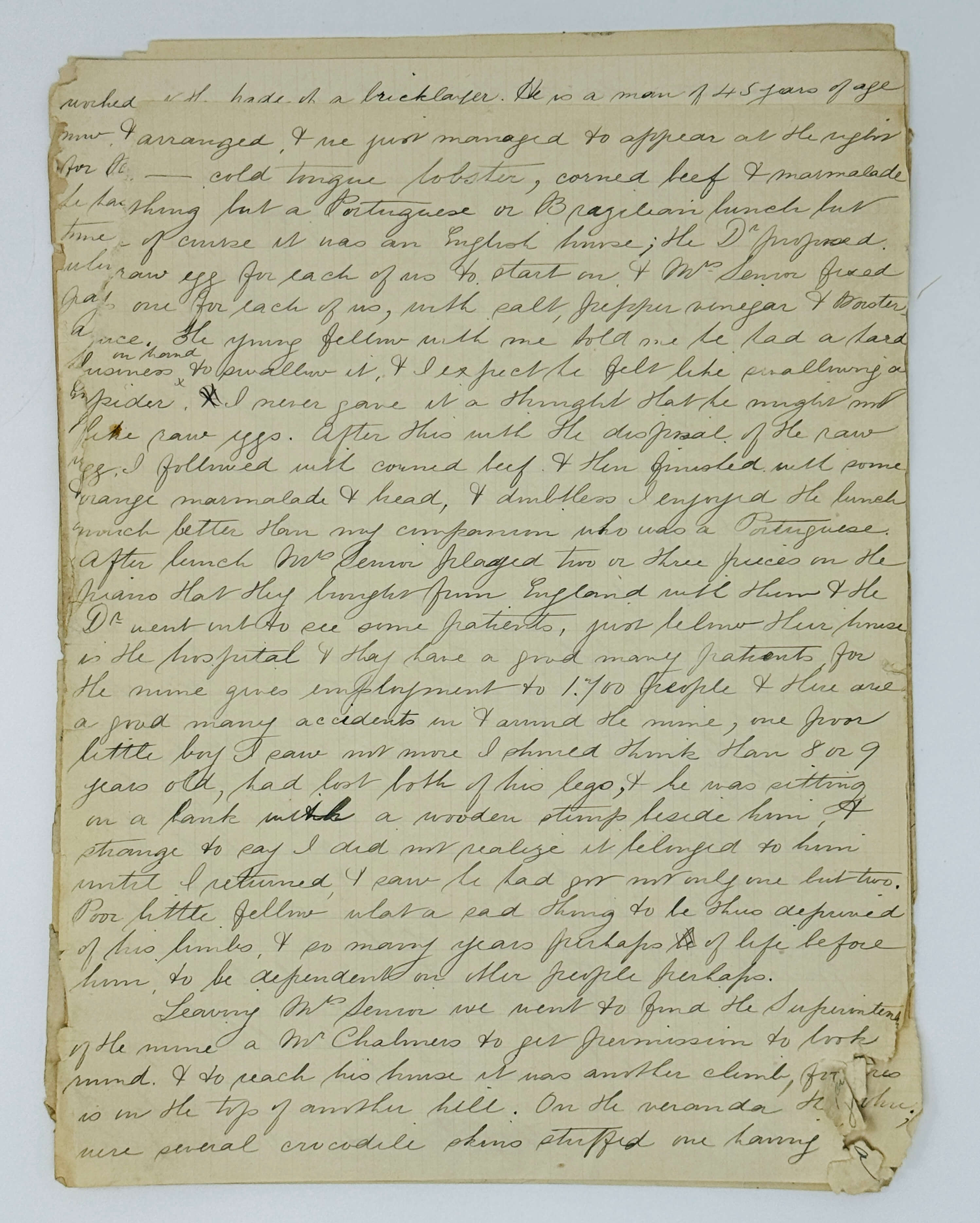
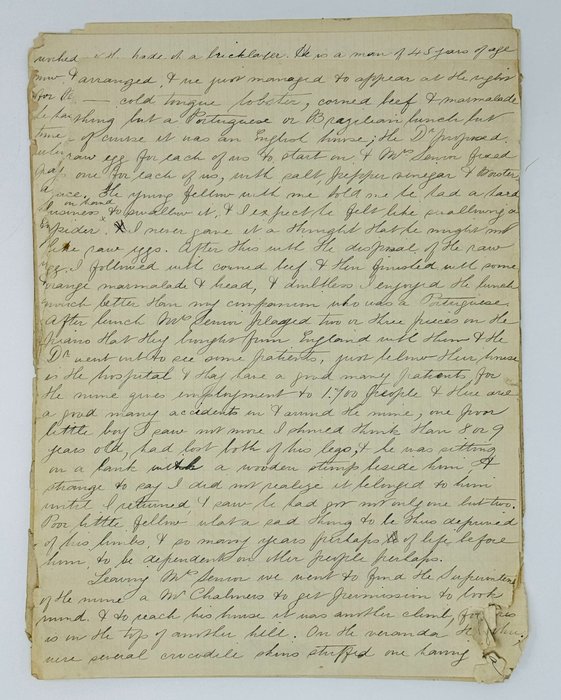
A VISIT to the SAO JOAO del REY GOLD MINES: Johnson's account begins in 'Bello Horizonte near Morro Velho where the English Cos gold mines are situated: Johnson has railway 'business' in the state of Minas Gerais with the Portuguese contractor 'Conde de Santa Maria. A proffered guide escorts Johnson on muleback, over a mountain with stunning views, to the mine; where he lunches with Dr. Senior 'the medico employed by the Goldmine Company ... just below their house is the hospital... there are a good many accidents in and around the mines. Mr. Chalmers, Superintendent of the mine, permits a visit where 'different processes for extracting the precious metal' are observed in their noisy detail. 'After seeing all the machinery necessary to work the gold mine giving employment to 1,700 people one cannot help thinking that to get gold it also costs gold'.
Johnson’s account commences in Belo Horizonte, near Morro Velho, the site of the English company’s gold mines. His presence in the state of Minas Gerais concerns railway business with the Portuguese contractor, the Conde de Santa Maria. A local guide offers to accompany him on muleback across a mountain, from which Johnson observes a landscape of striking beauty, before arriving at the mine itself.
There, he dines with the physician employed by the Gold Mining Company. Situated just below the doctor’s residence lies the company hospital, necessitated by the frequent accidents occurring in and around the mining operations.
Mr. Chalmers, the mine’s superintendent, grants Johnson permission to tour the facilities, where he witnesses in detail the various processes employed in the extraction of the precious metal—each accompanied by the characteristic clamor of industrial activity.
Having observed the extensive machinery and the labor force of 1,700 workers required to sustain production, Johnson reflects that “to obtain gold, it also costs gold”—a remark capturing both the economic and human expenditure inherent in such an enterprise.
III
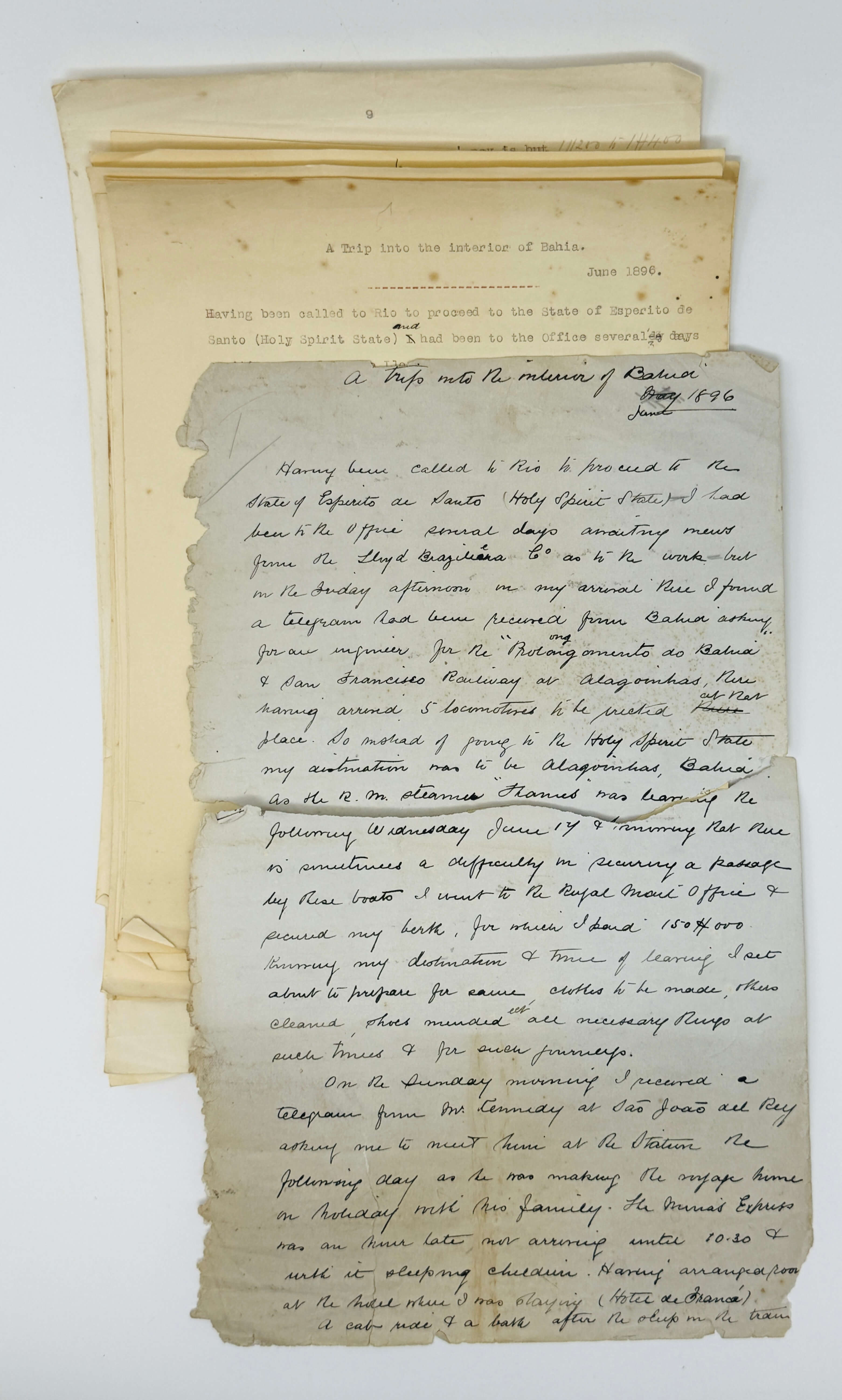
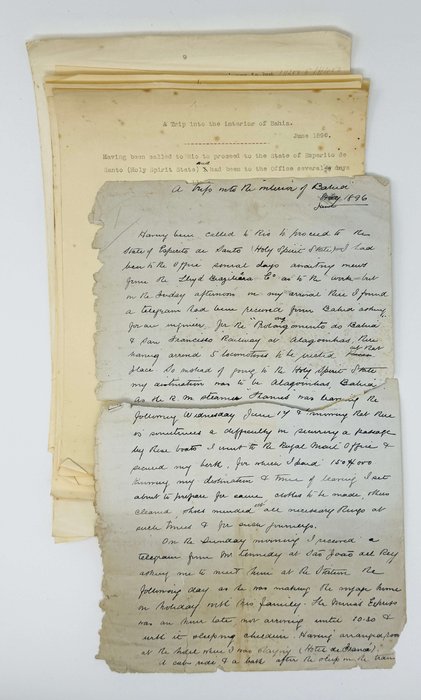
The article ‘A trip into the interior of Bahia’, typescript and manuscript (slightly varying in content).
Typescript. Quarto (ca. 26x20 cm or 10 ½ x 8 in). Black on rectos. The typescript was possibly intended for publication and has several omissions of the original manuscript text.
Manuscript. Quarto (ca. 29x20 cm or 11½ x 8 in.). Numbered in ink in the top left corners of the manuscript. Some pages are torn, others with missing fragments at edges: the manuscript was not kept well until recently, however the text is preserved and eligible.
While engaged in railway engine business, Johnson undertakes a journey into the interior of Bahia, arriving at São Salvador—the regional capital—after a succession of train and steamer voyages. From the deck of the steamer, the city presents an attractive prospect: “very pretty,” he writes, “there being an upper and a lower city.”
In the lower quarter, which constitutes the commercial district, Johnson observes narrow streets lined with old-fashioned houses of three or four storeys, largely inhabited by the poorer classes. In contrast, the upper city—both its business and residential areas—is of a “superior order,” characterized by broader thoroughfares and more substantial architecture. He notes that “one now and then hears the old men talking in a strange tongue,” which he surmises to be their native African languages, for these elderly men were once enslaved. Johnson remarks upon the recentness of emancipation: it was not until 13 May 1888 that general abolition was proclaimed in Brazil—“one day a slave, next day free.”
A local woman recounts to him a disturbing story of a slave who had been buried alive, a grim vestige of the cruelties of bondage. Johnson also records practical observations on the scarcity of coffee, the operation of railways, and the availability of arable land for cultivation.
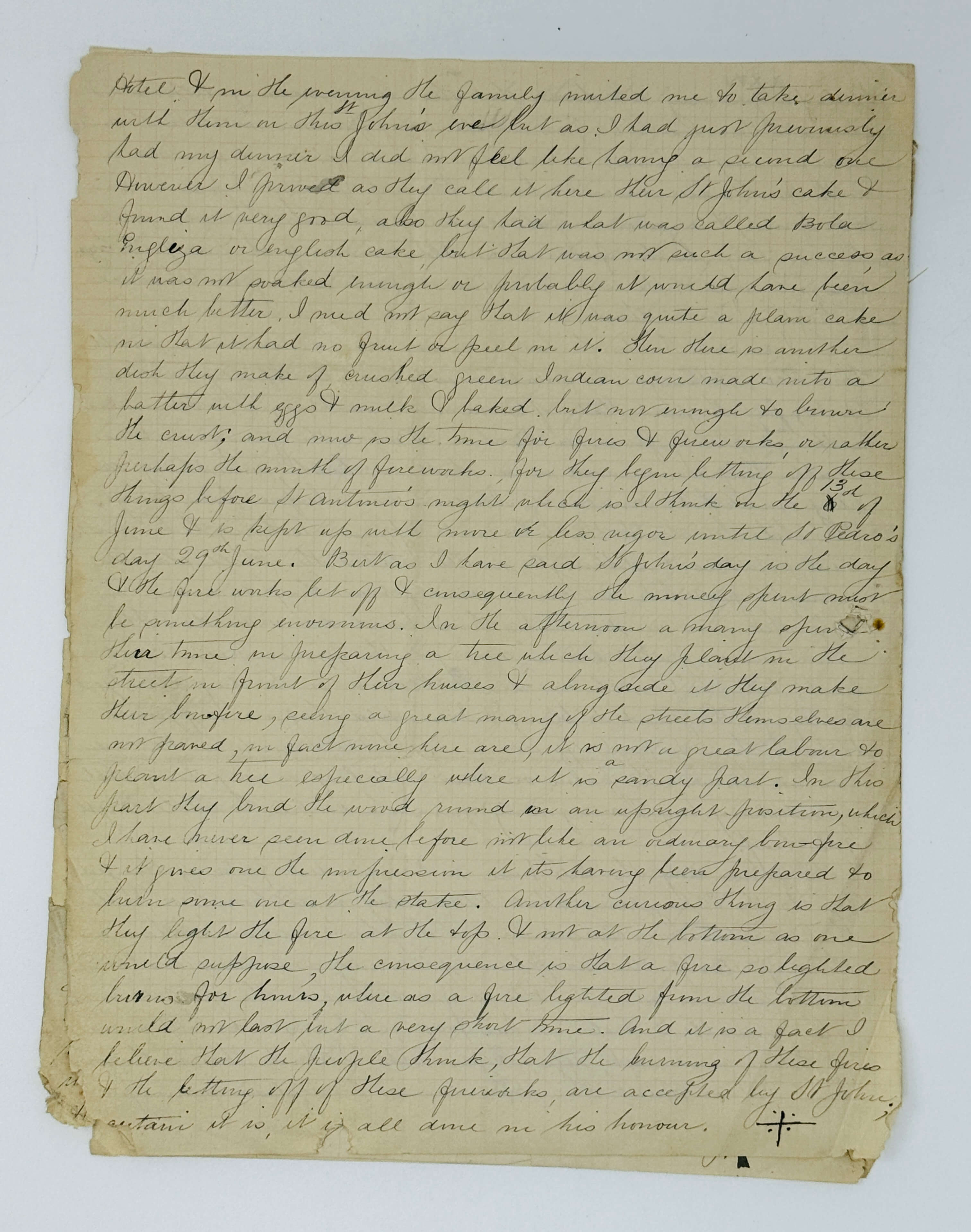
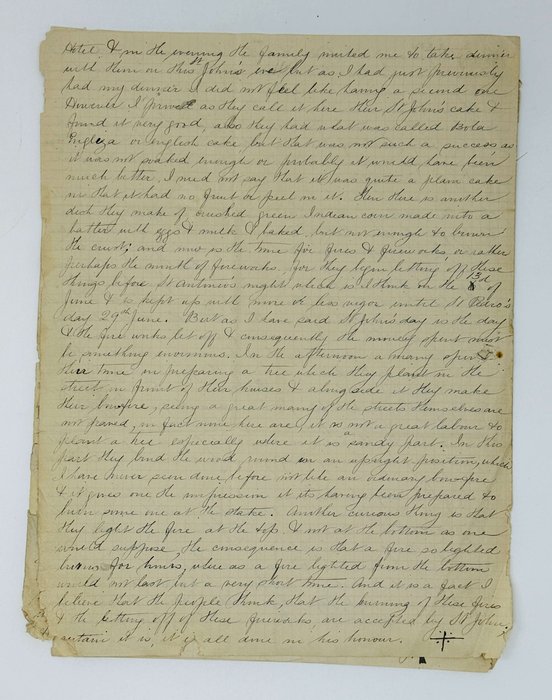
His account becomes particularly vivid in describing the festivities of St. John’s Day—the major feast of the region—“to the Brazilians what Christmas Day is at home.” He partakes in the celebratory fare, including Bola de São João, a confection akin to plum pudding, but composed of ground maize, coconut, eggs, and sugar. The city is alive with bonfires and fireworks, illuminating the night in jubilant display.
Johnson further comments on the wages of the working classes and the local manner of dress—or lack thereof. “Thanks to the poor man’s overcoat, the sun,” he observes, “little clothing is needed, as one often sees little boys and even older lads running about without a stitch of clothing.” Before departing, he acquires several curiosities and natural specimens, including a large snakeskin, as well as the skins of a wild cat, an opossum, and a wild pig.
IV
Manuscript diary from 1898, November to December, without the beginning or the end. 6 pp. Quarto (ca. 29x20 cm or 11½ x 8 in.) Edges torn and paper decayed at the bottom of the document. In need of restoration, the text however is almost all eligible and it is possible to reconstruct the words missing.
On 9 November, 1898 Mr. Johnson took a ferry to Petrópolis, where he was engaged to repair the local railway engine. During his time there, he encountered Mr. Herbel, an engineer responsible for installing engines in cotton mills throughout Brazil. These mills produced sewing and crochet cotton, and Johnson notes with concern the use of child labor, observing “little girls employed to wind cotton onto reels.”
He also visited a silk mill, and his impressions of Petrópolis were colored by the beauty of its setting: fine houses upon the hills, the residences of the wealthy, and gardens reminiscent of England, which filled him with homesickness. Especially evocative to him were the daisies, recalling the English countryside. Following his mother’s suggestion in a recent letter, he collected specimens of maidenhair fern, a small sentimental act connecting his travels to home.
Upon returning to Rio, Johnson found himself there on 15 November, the day when President Campos Sales came to power. The city was decorated for the occasion, yet amidst the festivity he detected whispers of political unrest. Choosing discretion, he refrained from entering the city center and instead withdrew to one of Rio’s quieter suburbs.
He soon departed from Rio to Belém, intending to return later to Perlão, but was compelled to remain in Belém due to outbreaks of cholera along the intended route. Eventually, his work brought him once more to Sorocaba, where he was tasked with the erection of four engines. Passing through Cachoeira, he later reached São Paulo, where the engines had only just begun to arrive. Consequently, he remained in the city for a time, partaking of his ‘Xmas dinner’ at Mr. Butler’s residence before proceeding onward to Sorocaba to supervise the installations.
Johnson’s description of Sorocaba conveys both hardship and rustic charm. The roads, unpaved and muddy after rain, made travel difficult, while the lodgings were rudimentary: “the floor had no other floor than Mother Earth,” and the bedstead “might have come from Father Adam himself—had he known how to make two parties and a door.” His host was an Italian, whose Brazilian wife, he observed, “worked a great deal harder than he did.”
In the town there stood four or five Catholic churches and a Presbyterian chapel. Johnson made the acquaintance of another Englishman, the superintendent of the Submarine Telegraph Company. He notes ‘one can see the old-fashioned sight of a man carrying a ladder to light the lamps with, unless on moon-light nights, when the city is illuminated with a cheaper light - that of the moon’.
The water supply was also inadequate, compelling women to carry tins or large pots of water on their heads, a task made no easier by the presence of fleas, which Johnson describes as pervasive.
His search for accommodation proved instructive. The first hotel, kept by a Spaniard, offered little comfort; the second, managed by a German, was marked by noisy drinking; the third, owned by a Brazilian, proved most congenial. The Brazilian proprietor recounted how an English engineer had once lived there for several months, dying without ever settling his account.
He comments on a place having ‘only Brazilian food, cut oranges and bananas to eat with your meat and vegetables , ‘nothing in the way of pies or tarts’, always doçe or cheese after dinner’.
Later travels took Johnson to the Sorocabana cotton mill, where he again observed industrial activity, and to scenes of daily labor along the waterways—washerwomen by the dozen, rhythmically beating clothes upon the stones. His journey extended further south, with references to Porto Alegre, Paranaguá, and Desterro, where he continued his engineering work on railway engines.
V
Manuscript pages from different diaries and drafts of the articles, 11 pages. Various sizes, 1890-1900s.
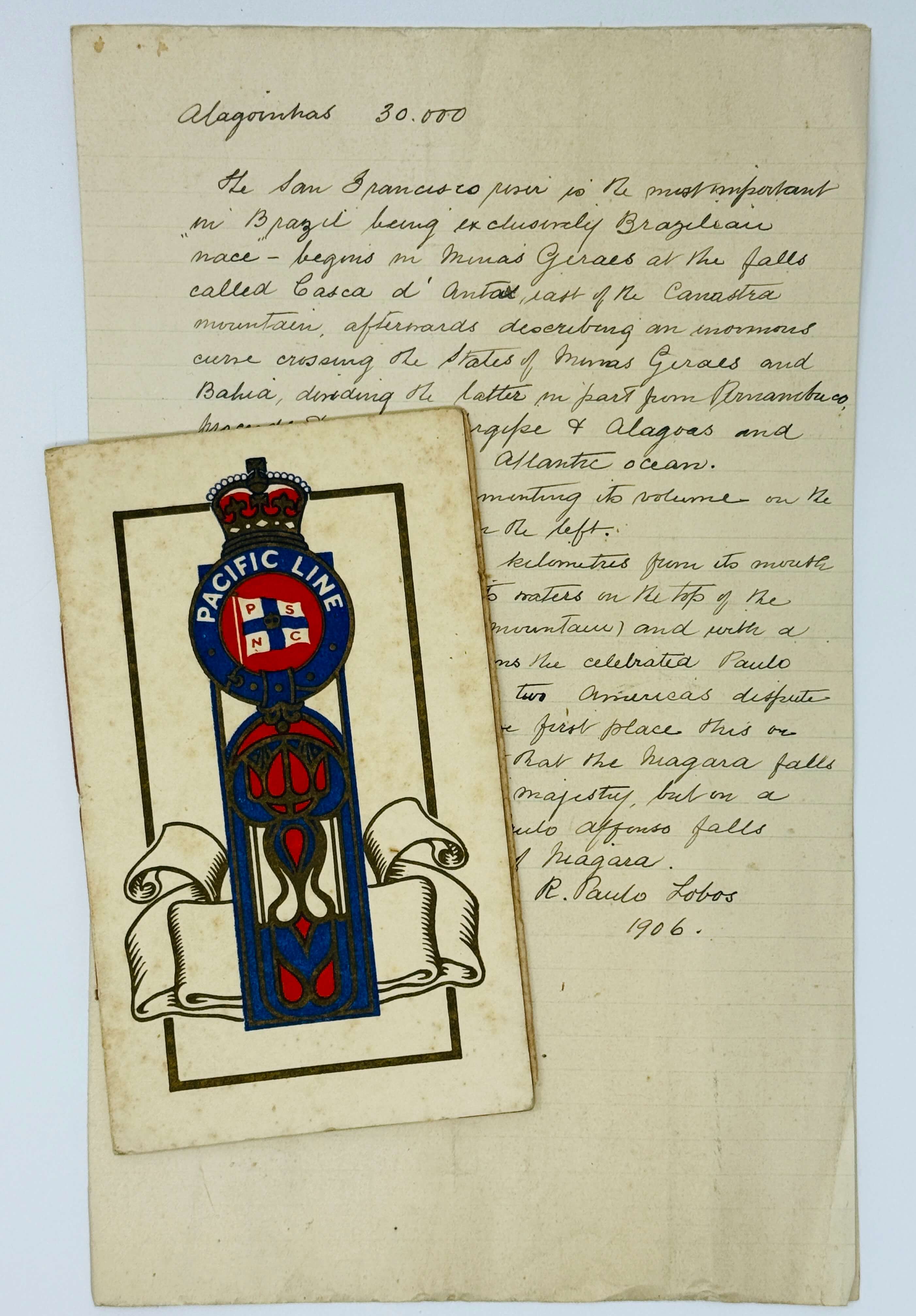
This lot includes 2 pages, written at ‘Paulo Lobos’ in 1906, including the account to Johnson communicating with the locas about him giving them a job, likely in Portuguese, one man asking him for any job ‘por amor de Deus’. Here also Johnson mentions not being employed by the railroad company anymore and not able to help the asking.
VI
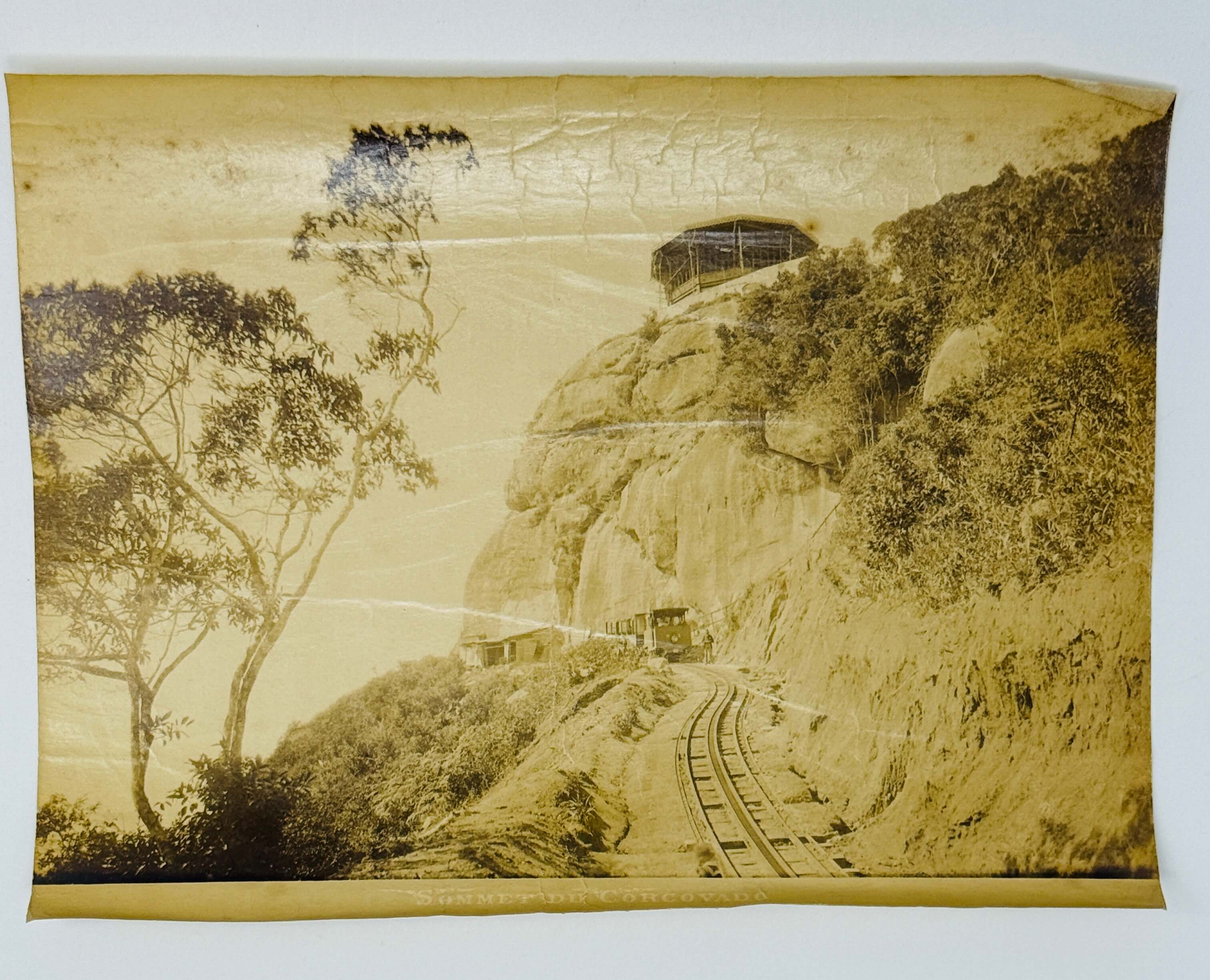
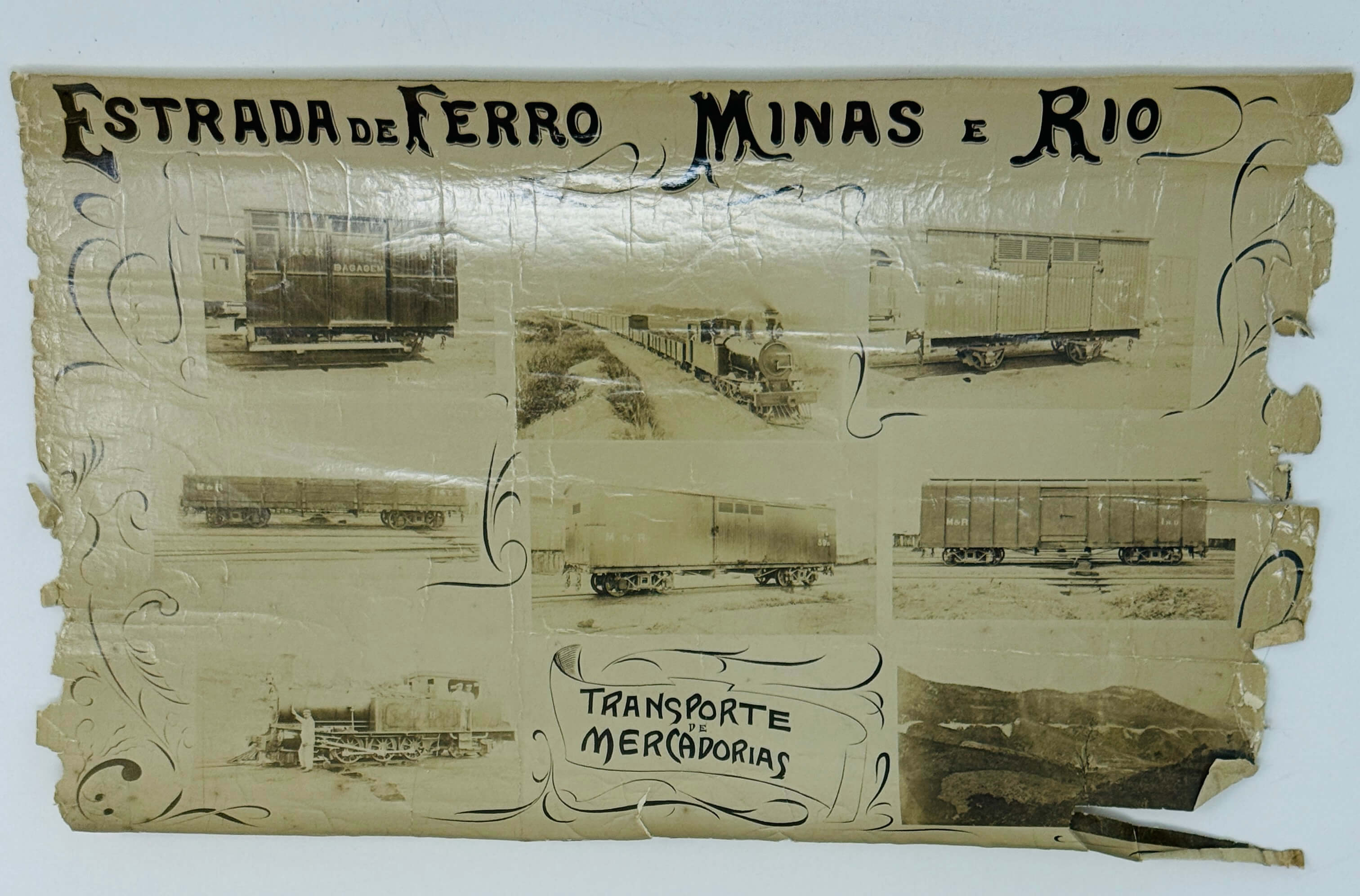
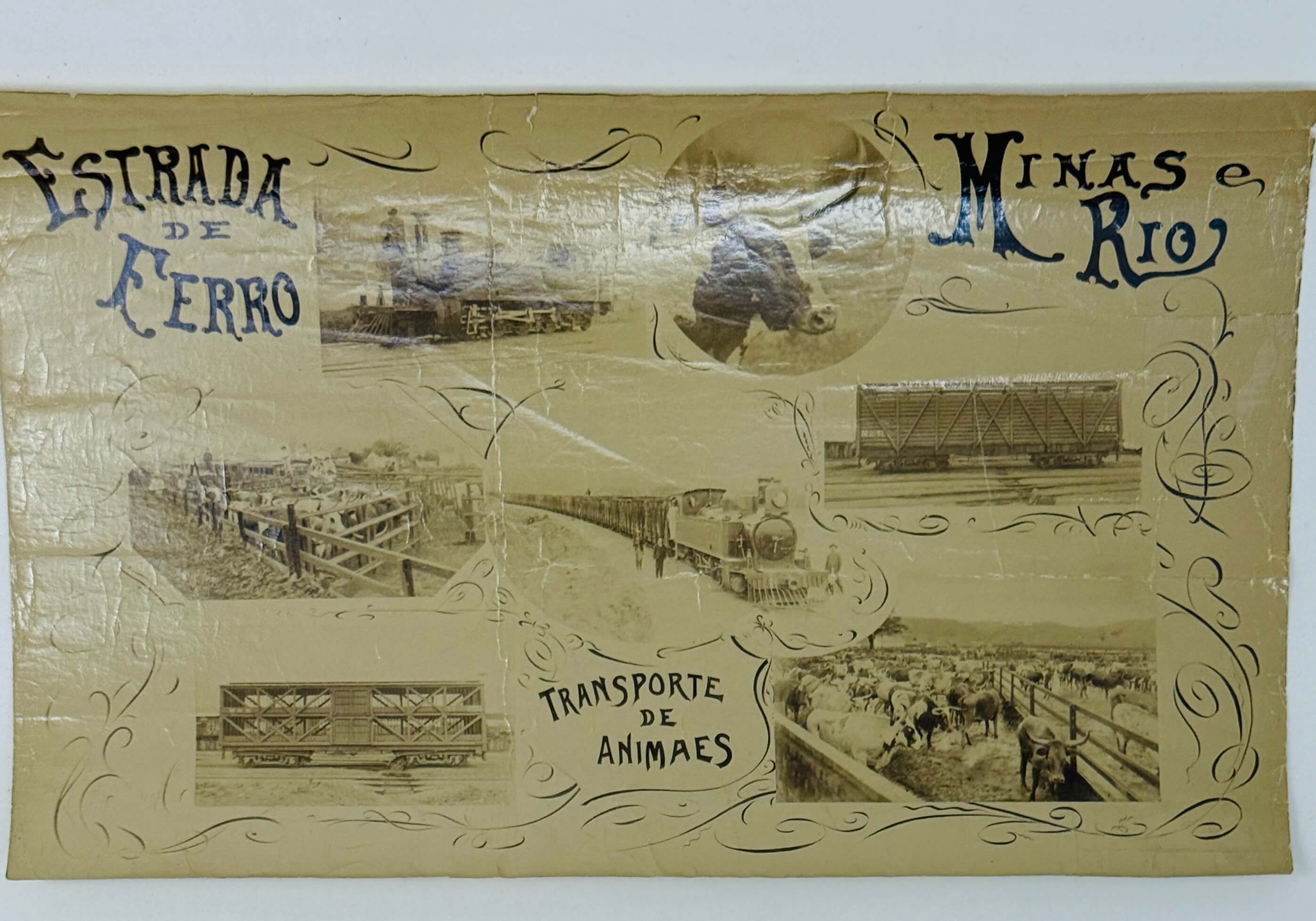
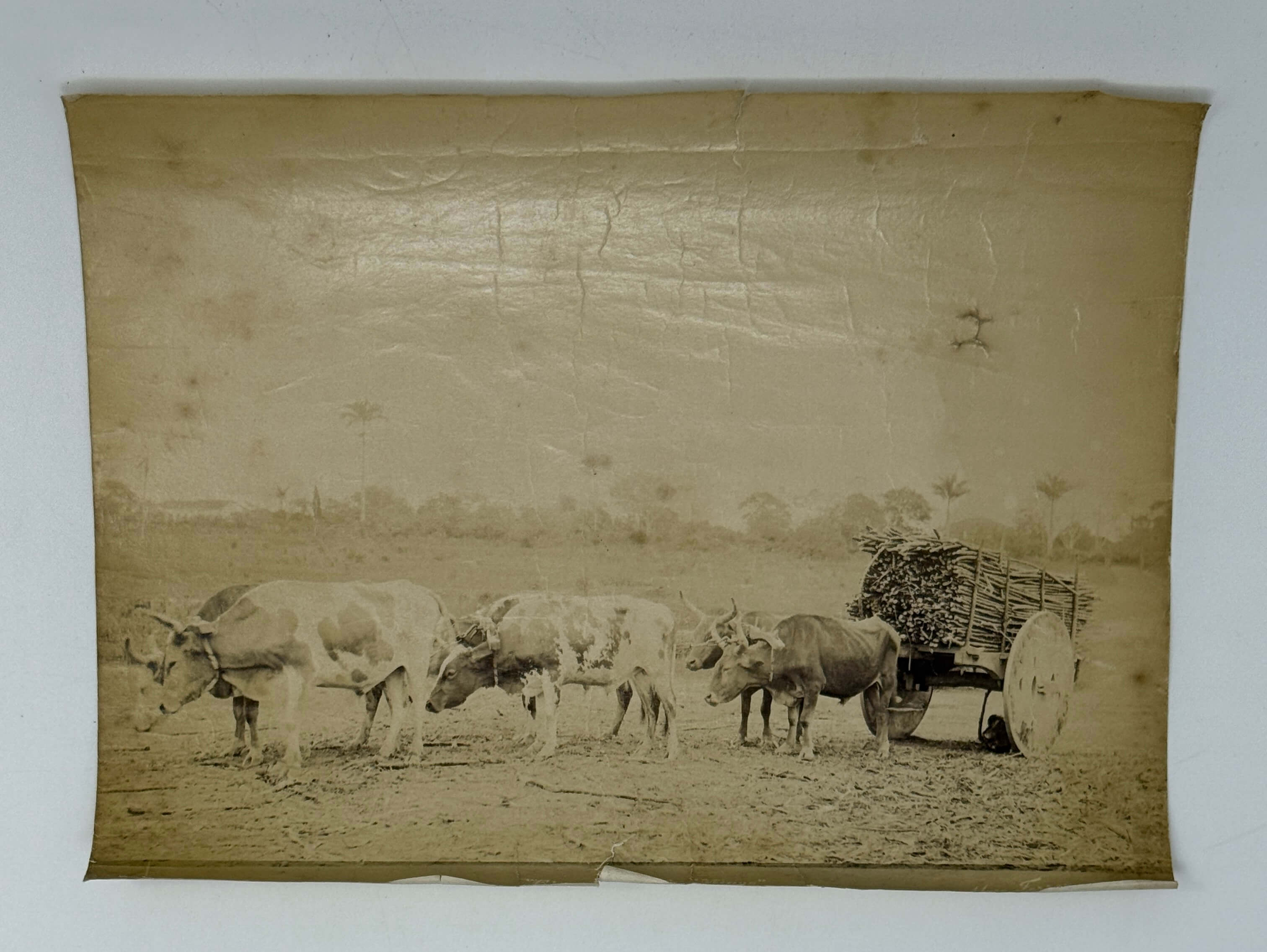
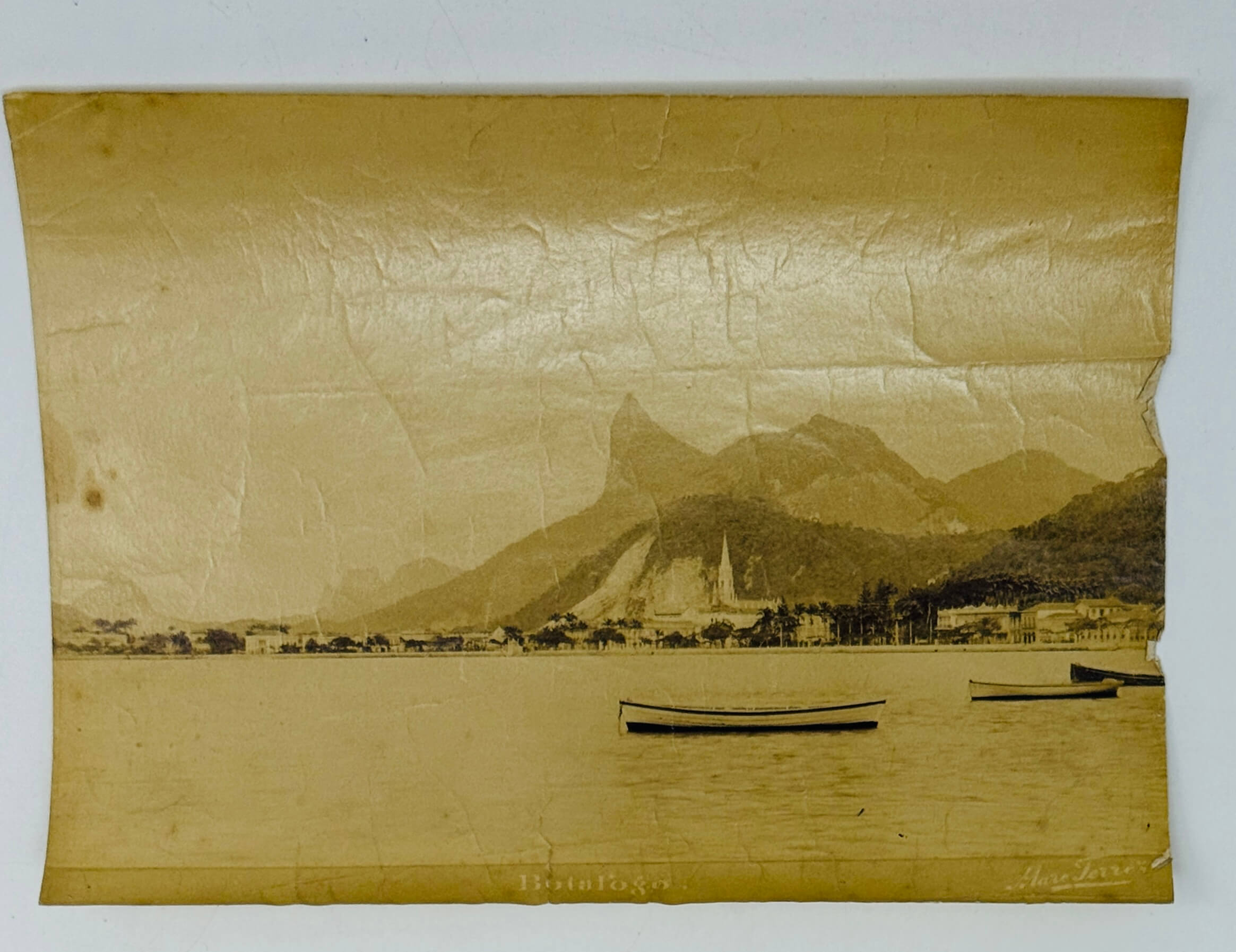
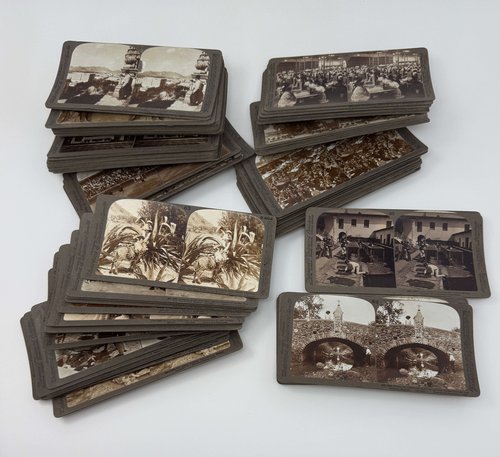
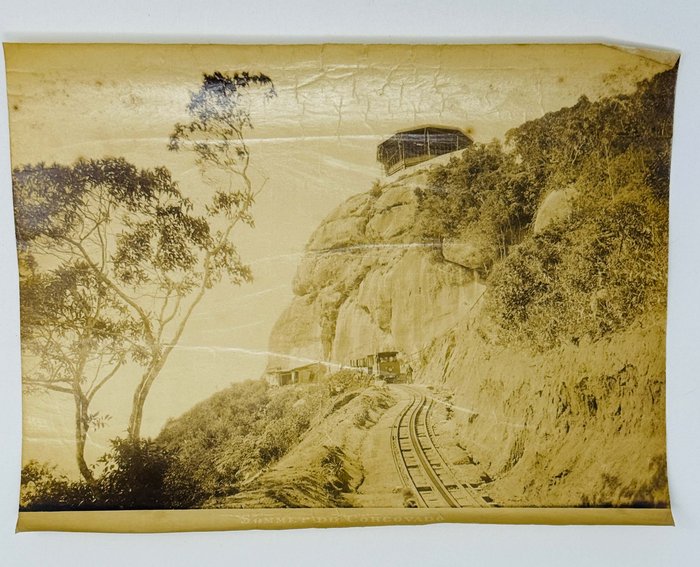
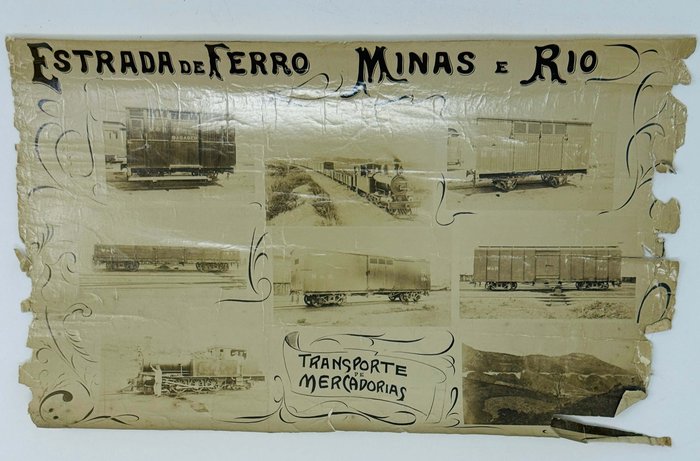
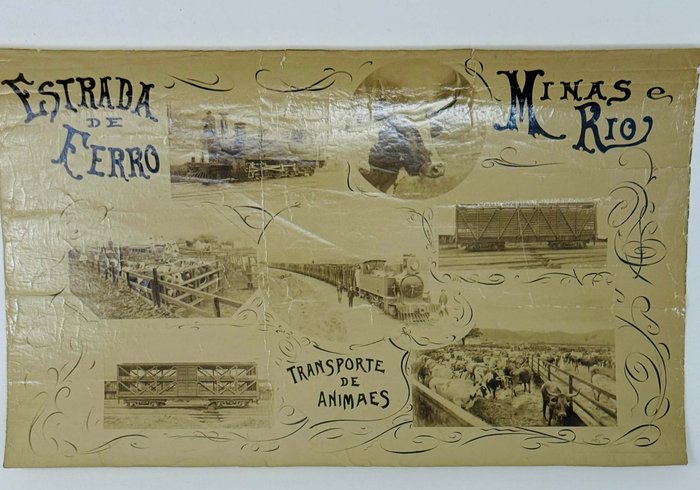
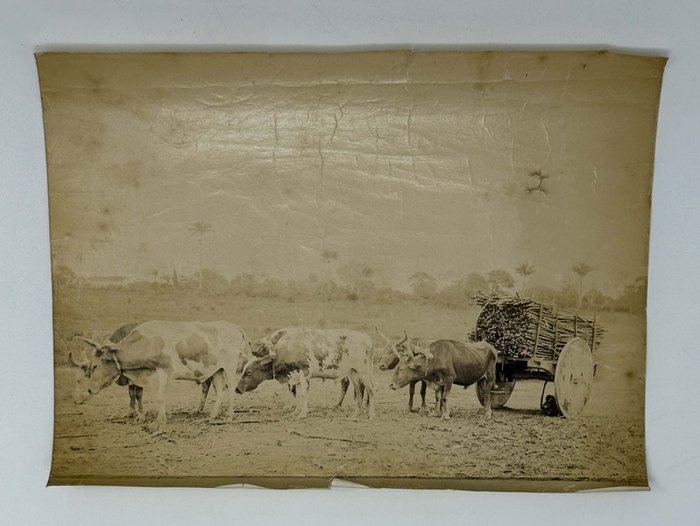
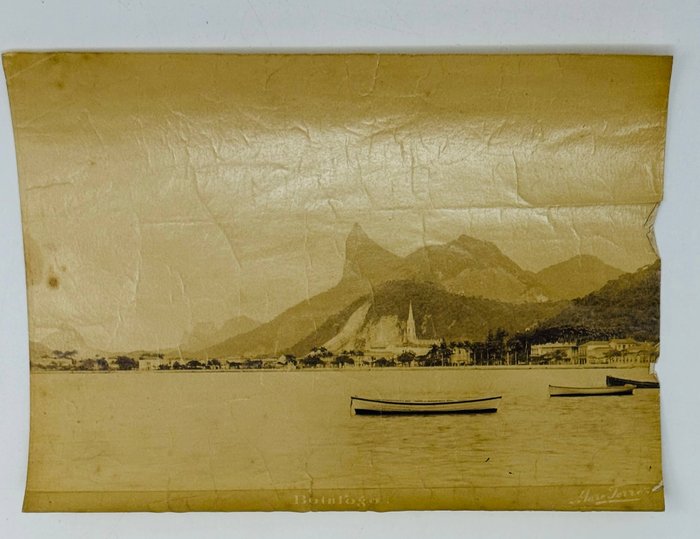
Eight studio photographs by Marc Ferrez relate to the Estrada de Ferro Railway Company Trains, ca. 1890s. Gelatin silver photos. 17,5x28 cm or 7 x 11 in. Photos are torn and faded. They show locomotives and wagons used by the company, rail bridges, the images of cattle being transported on the rail, two images of the train carrying passengers across the hill, as well as small panorama of Botafogo.
VII
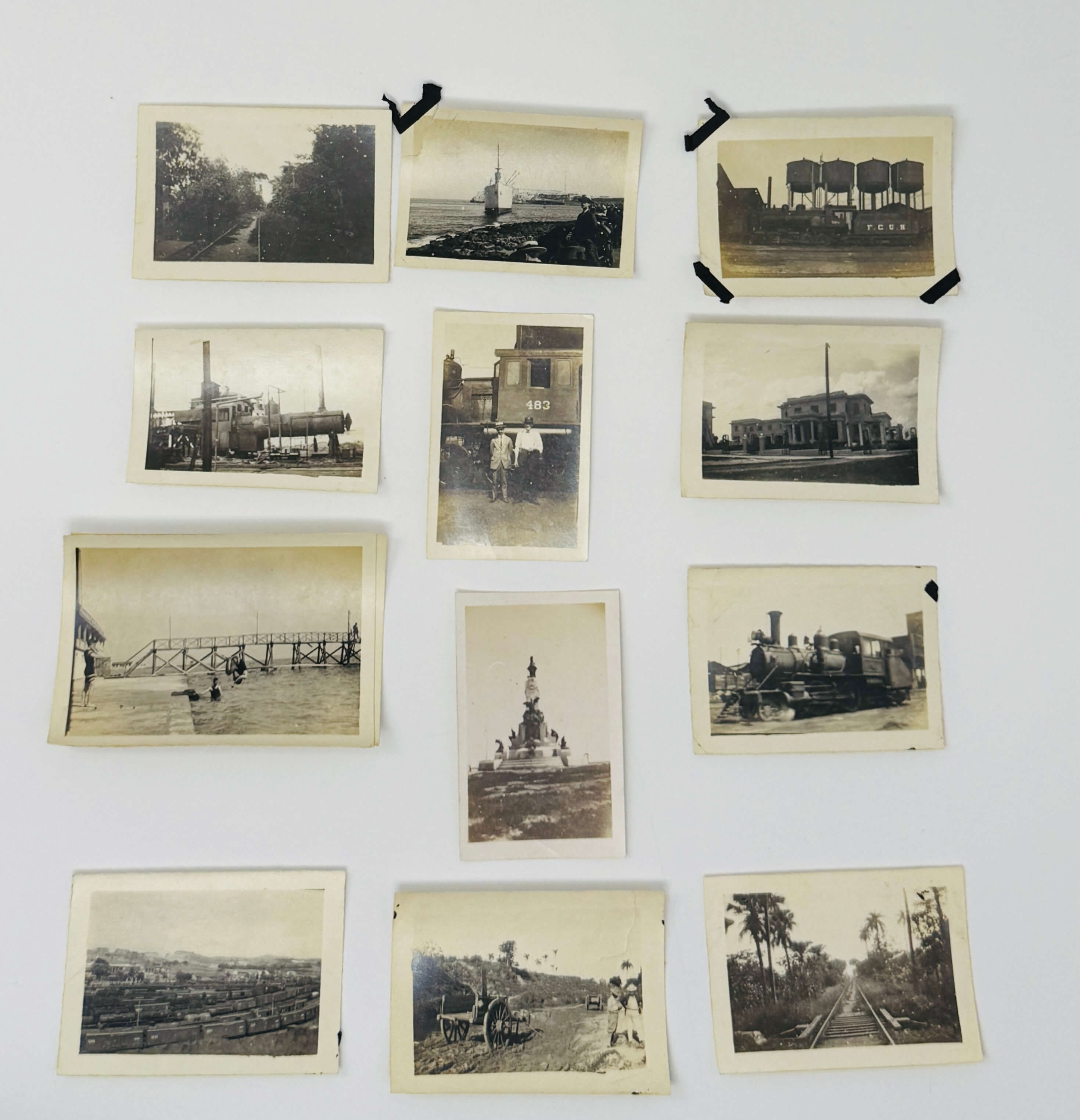
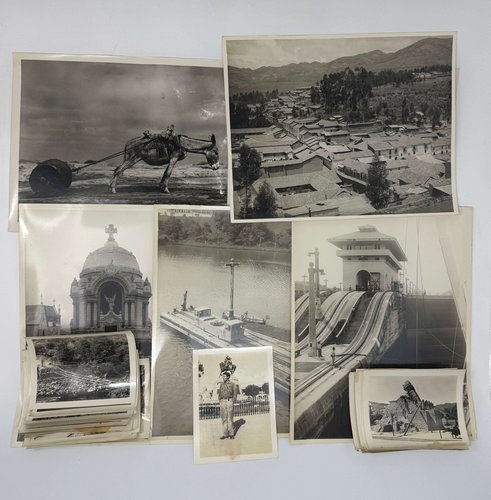
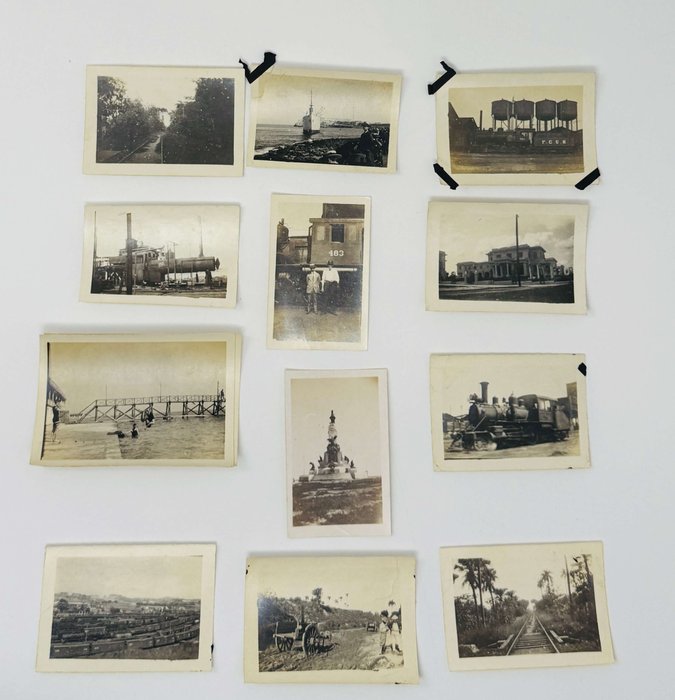
Forty Eight Photos of Johnson’s Work and Leisure in Habana, Cuba. From 7x4 cm (1½ to 2½ in.) to 9x6 cm (2½x3½ in.) Snapshots. Slightly bent and faded, but overall a good group.
The collection suggest Johnson did some work associated with the United Railways of Havana - their locomotives and machinery are shown, as well as the port of Havana, the historical sights of the city, an image of the carnival - people carrying the prop 'Vermouth Magno’ ad, also showing railway engines in construction, a locomotive siding, local stations, tracks in the jungle, Hotel Inglaterra and presumably the man behind this archive enjoying a company of other men at the local beach, bathing and diving.
VIII
A map of the South America, hand-drawn and signed by Johnson, 34x28 cm. (13x11 in.) All the countries are marked, as well as the most significant rivers and cities. Likely re-drawn from a printed version.
IX
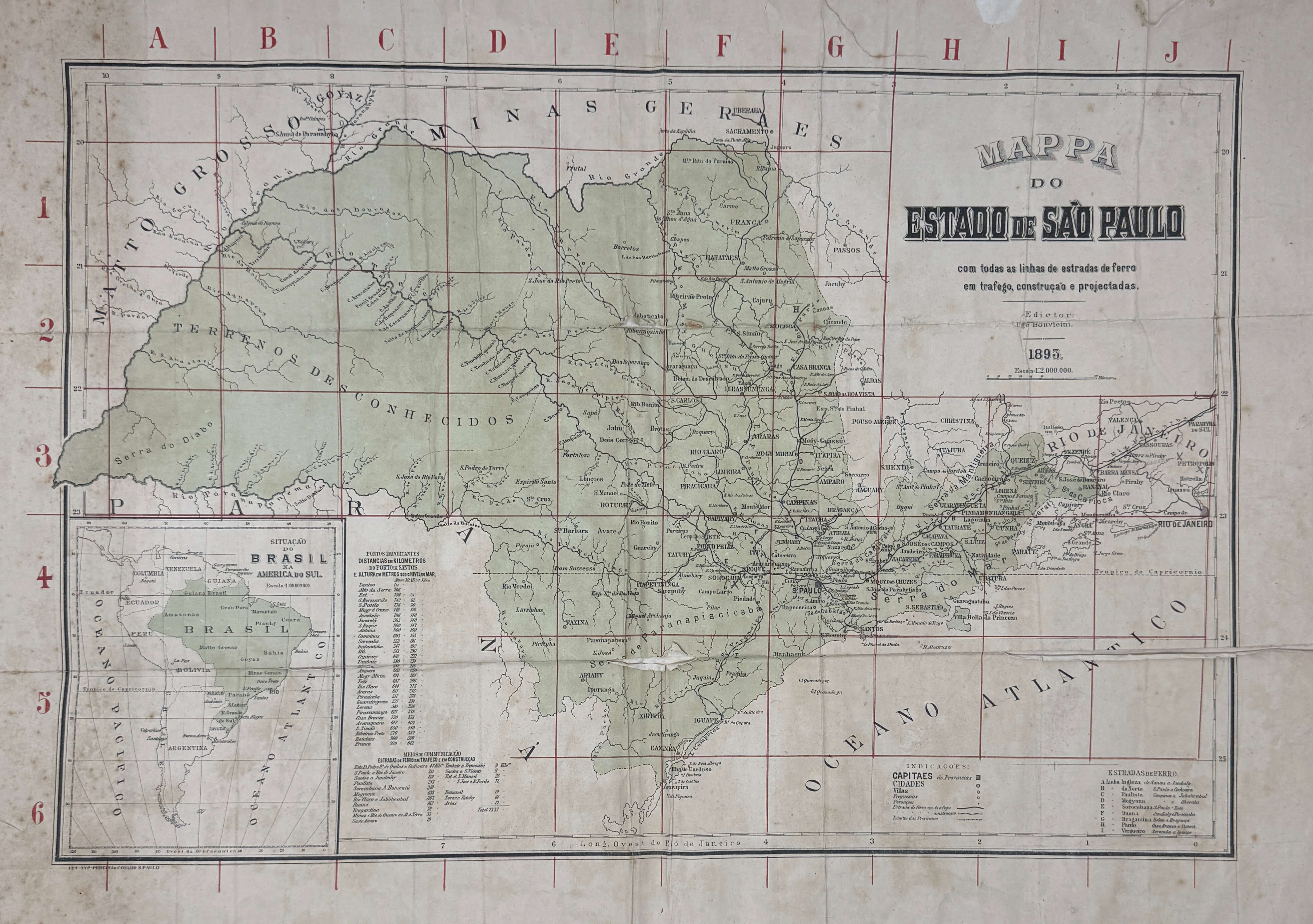
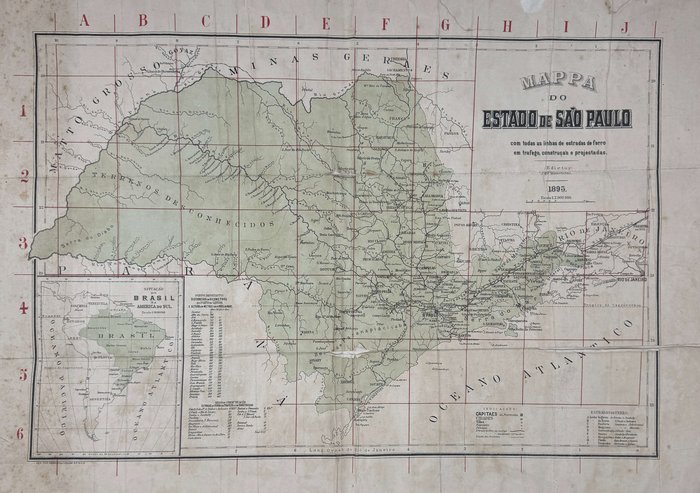
Mappa do Estado de Sao Paulo [i.e. Map of state de Sao Paolo]. Sao Paolo: Pereira & Coelho Lithography, 1893. 44x61 cm. (17x24½ in.) Original lithographed map, complied by Ugo Bonvieini. Torn at ceases, few peaces of the margins are missing, but not affecting the map itself. Worn, but still a good copy of this map, that was clearly in use.
X
A list of passengers for R.M.S. ‘Orita’ sailing from Liverpool to Rio de Janeiro and other places in South America on 16th of September, 1926, listing Mr. Johnosn as one of the passengers.