
#MC99
Ca. 1850s
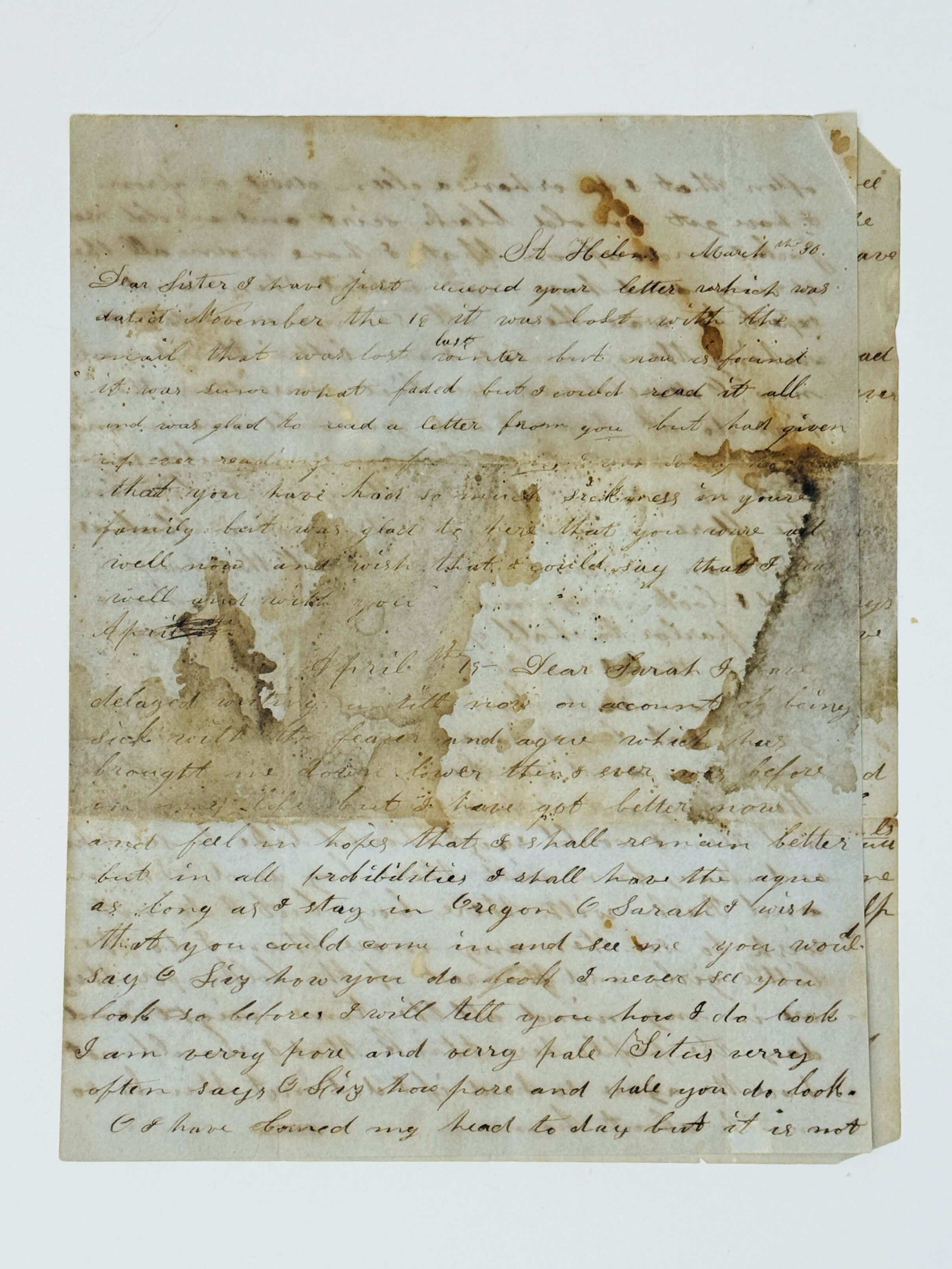
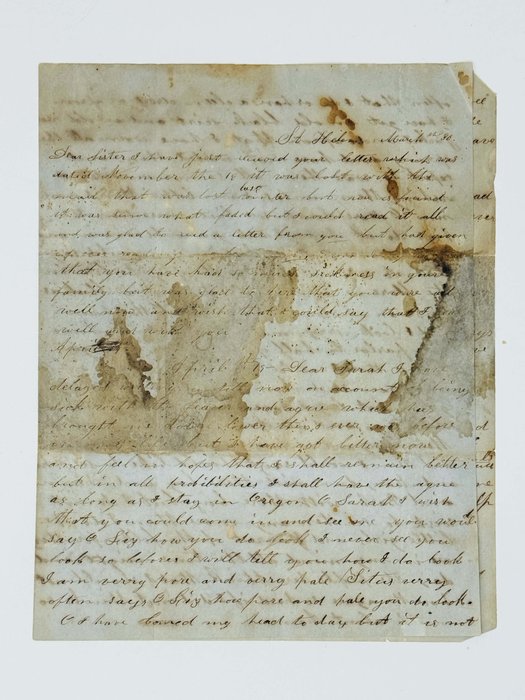
Quarto bifolium ca. 9,5x7,5 in. 4 pp. Brown ink on blueish wove paper. Fold marks, damp stains, the last page lacks a small fragment at the upper right corner, but overall a very good letter, written in a legible hand.
Historically interesting letter from a British female immigrant, talking about the unbearable living conditions in St. Helens (Inc. in 1889), Oregon Territory. At the time the letter was written (likely in the late 1850s), St. Helens was a small, still-forming river settlement along the Columbia River, with limited infrastructure, rudimentary housing, and a population of fewer than 250 people.
The author, Elizabeth Taylor, originally from Norfolk (England), emigrated with her parents first to Quebec and later to Westfield, Orleans County, Vermont. She married Titus H. Taylor (ca. 1831-1893) on 21 January 1853 and a year later, the couple moved to Scappoose, Oregon Territory. In 1868 Titus H. Taylor built and operated the Taylor Hotel in St. Helens for three years and later acquired several properties, including the Cunningham place at the foot of Sauvie Island, part of the original McNulty claim near McNulty Bridge, and real estate in East Portland. Elizabeth died in St. Helens in 1882, leaving four children - Florence, Norah, Clarence, and Lillie.
In the letter to her sister Sarah Hitchcock (ca. 1829-1900) of Vermont, the author describes her struggles for survival, extreme poverty, and harshness of life in Oregon Terrtiory. Elizabeth reports a prolonged fever that has left her “lower than ever before,” and repeatedly contrasts her condition with the comforts of home. Especially interesting is the author’s depiction of typical life in St. Helens, writing “we live worse than pigs do,” with flooring “as black as dirt can make it” and a dwelling scarcely fit for human habitation. She also details an extreme scarcity of food, noting months without a single drop of milk, only eight pounds of butter since the previous November, and a diet reduced to bare staples (potatoes, meat, bread, tea, and coffee). In the rest of the letter, the author talks about the purchase of a cow, the unpaid debts, and her wish to return home as soon as possible.
The letter likely dates to the 1850s, as Elizabeth mentions her little nephew Charles Hitchcock (ca. 1854-1917), the son of Sarah Hitchcock, who was born in 1854.
Overall, historically interesting letter describing the early life in St. Helens, Oregon Territory.
Excerpts from the letter: “Sarah I have delayed writing until now on account of being sick with the fever and agree which has brought me down lower then I ever was before but I have got better now and feel in hopes that I shall remain better but in all probabilities I shall have the agree as long as I stay in Oregon. O Sarah I wish that you could come in and see me you would say O Lizy how you do look I never see you look so before. I will tell you how I do look I am very pore and very pale. Titus very often says O Lizy how pore and pale you do look. O I have - my head to day but it is not often that I do or have a clean dress or apron. I have got an old black scirt and an old red jacket and apron that I have worn all the spring and have not washed them and expect to ware them all summer without washing them unless I am better then I am now. O dear Sarah we live worse then the pigs do at home I wish you could come in and see the house that we live in you would say that it was not fit for the pigs to live in the flore is up criff bords and as black as dirt can make it but after all the house and I look very much alike but the house is a parlor to half of the houses in Oregon. I wish that I could come in and take supper with you and Sam to night and that grate fat boy I have after said to Titus come let us go and see Sam and Sarah and see there boy and see how Sarah acts with it and then I would say I should like to see Thom and Mary Ann with there boy and Thom and Bash with there boy but I do not wish to see then any more then I do the little girls and the rest of the folks for they are in my mind all the time night and day…”
“I am alone to day Titus and the man that we live with are gon to get a cow home that he bought the other day and now I expect to have a little milk I have not had a drop of milk neither sweet nor sower for more then four months and all the butter that we have had since last November is eight pounds we never lived so poor before we have potatoes and meat and bread enough and tea and coffee enough such as it is we have an old hen and rouster and that is all the poultry we have she has a nest in one corner of the house and she comes in every day and days. So you see that I am in a fare way to have a custard pie of which I have not had for many a long day tell Mother I wish she would come in an do a little for me as she yoused to Mary Ann for I think I need a little help more as much as any of. Titus has done the baking for a long time and the washing to with a little of my help I have now quite a large washing to do and I wish you would tell Mother that I should like to have her come in and help me a little while. I think that if nothing happens that that we shall come home next fall or next spring if we can get enough to come with I want very much to come next fall but Titus thinks that he cannot come any way he has lost about two hundred dollars landing it out and cannot get it the men that owed him failed and he has lost it the man that we live with says that he is going home next spring and I think that we shall come with when he comes he is from New York. I intended to come home this spring but Titus could not get his money so I was obliged to stay a little longer give my respects to all enquiring friends from Elizabeth.”