
#N4-041
Ca. 1628
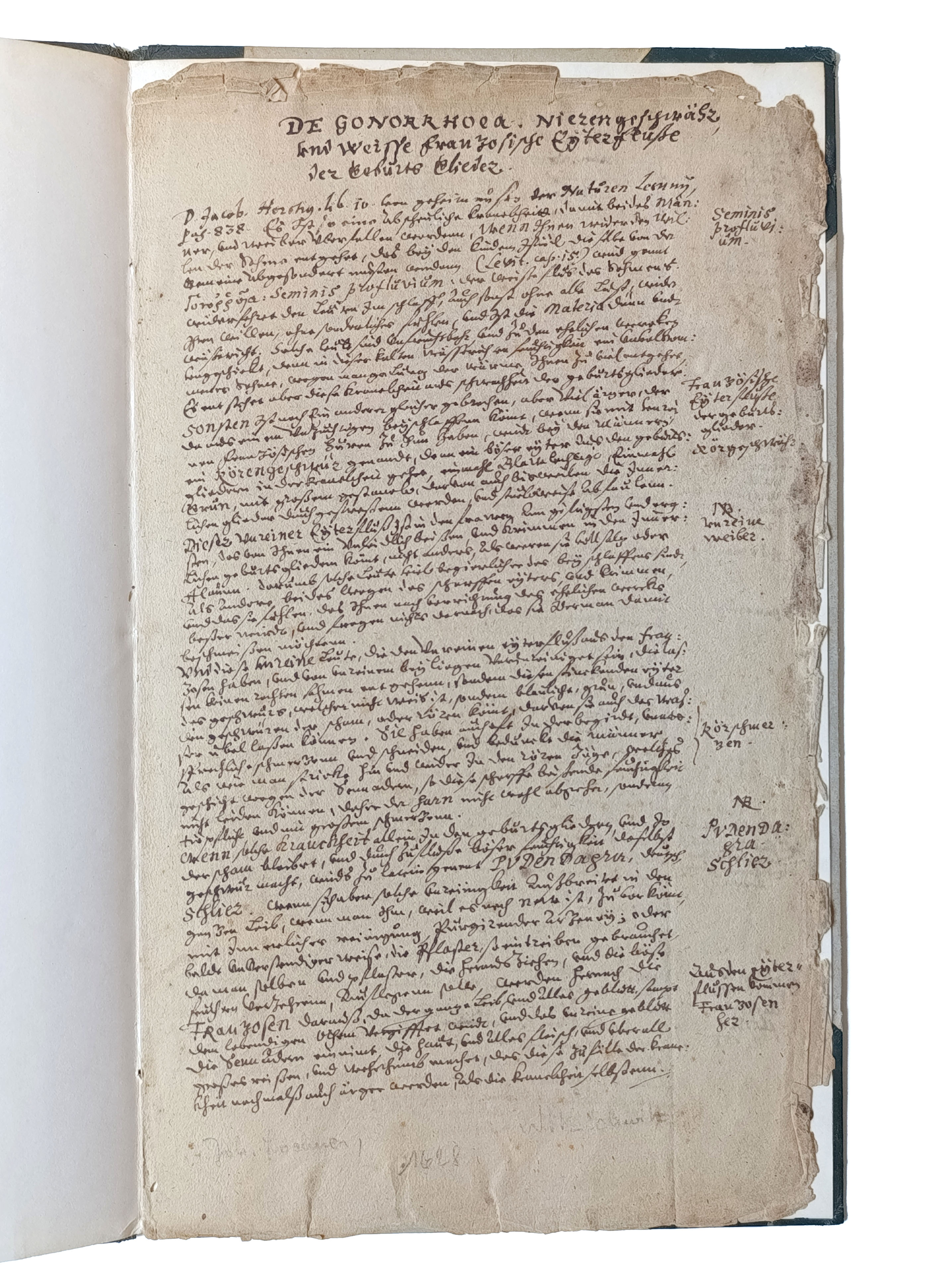
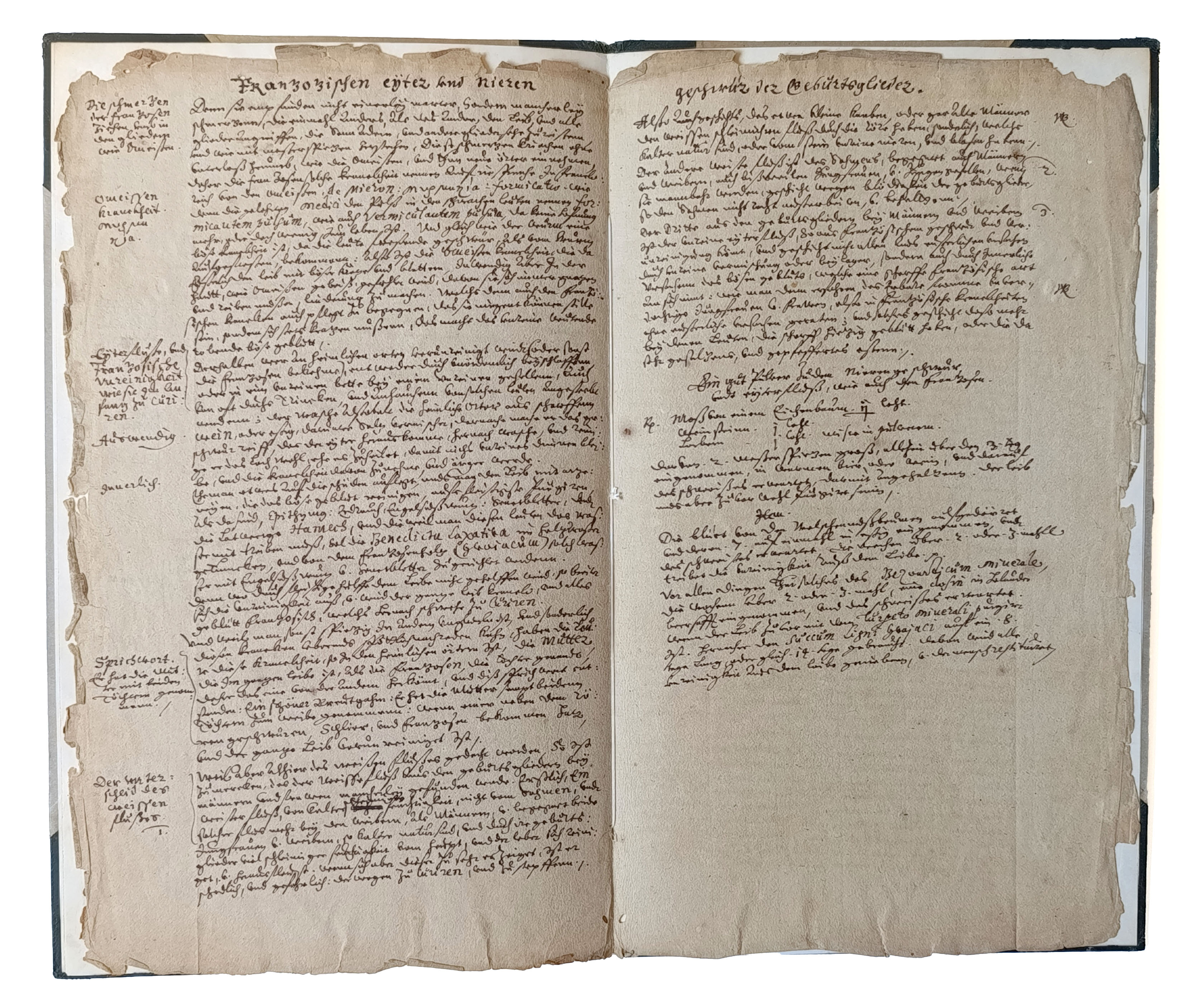
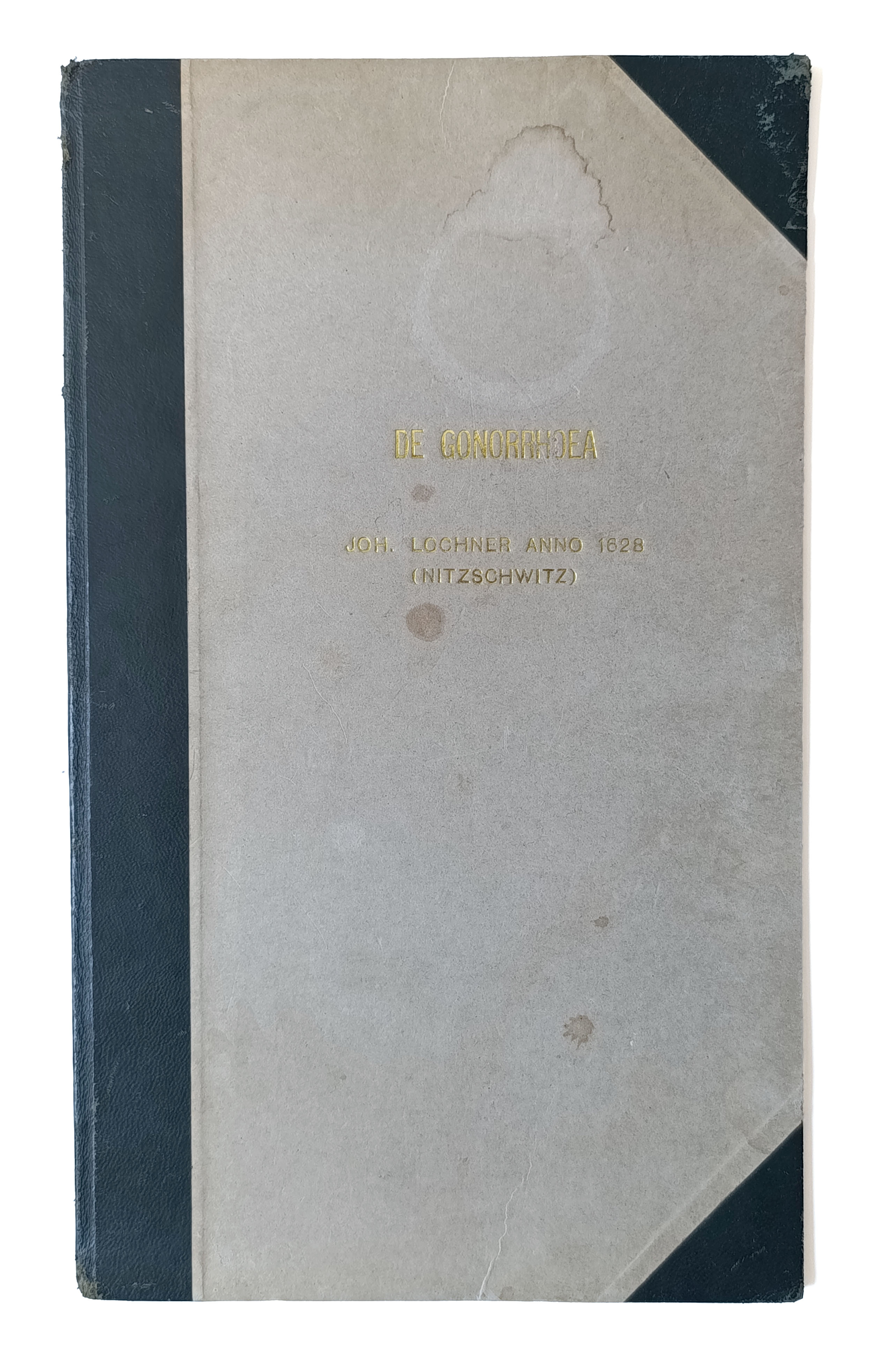
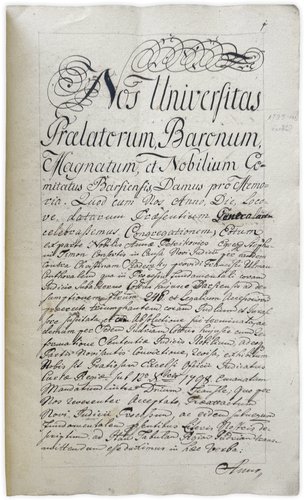
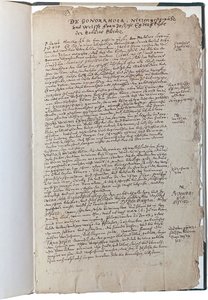
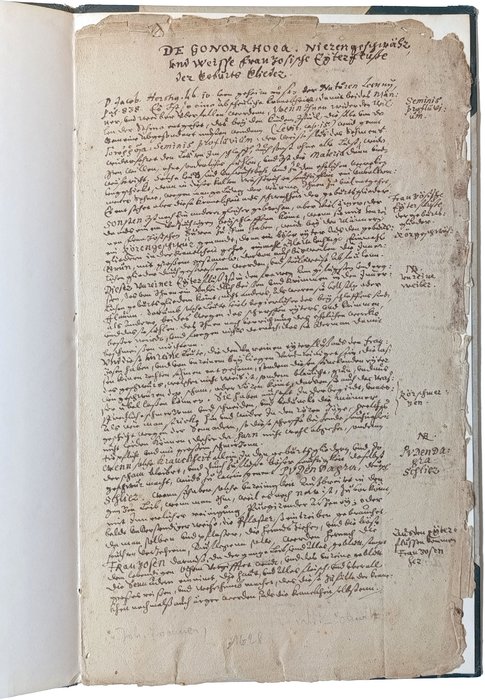
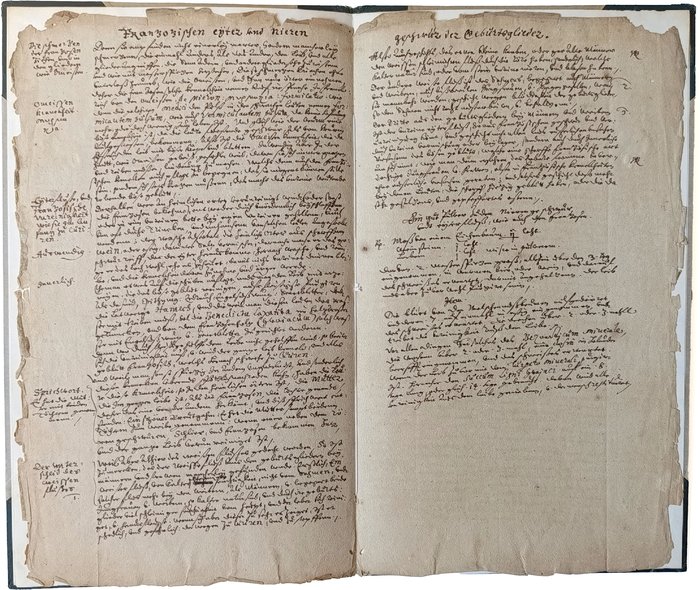
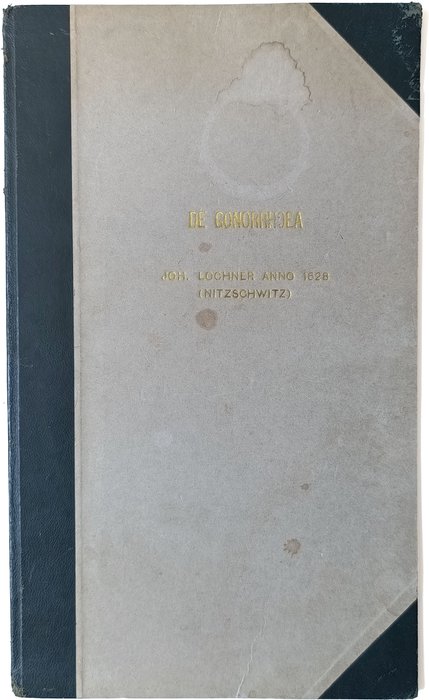
3 pp. Ca. 12 ¾ x 7 ½ in (32,5x19 cm). Bifolium in a newer half-leather binding with gilt title on the cover: “De Gonorrhoea. Jon. Lochner Anno 1628 (Nitzschwitz)”. In German with Latin and Greek insets. Written in cursive bookhand with notes by the same hand at the margins. Paper with watermark "Two crossed hammers in a crowned shield" close to Briquet 2006 (Magdebourg 1599), Briquet 2009 (Magdeburg 1598), Briquet 2008 (Annaberg 1579) and Piccard-Online 122032 (Halle, Saale 1611). Author, place and date are noted in pencil at the bottom. Stains and rubbing on the binding, bifolium with tears and small losses at the edges not affecting the text. Overall, in very good condition.
Historically significant document compiled during the Thirty Years' War (1618-1648), which gives an interesting glimpse into the medical theory and practice of the Early Modern period in Europe. Being mostly an excerpt from the 16th-century manual, it represents the state of venerological knowledge at the time — specifically the views and misconceptions around gonorrhoea and syphilis, one of the most menacing diseases of the period. At the same time the manuscript is of considerable interest as an example of an everyday memo used by a practising physician.
The manuscript is mostly composed of the German edition of “Occulta naturæ miracula” by Levin Lemnius printed in Leipzig in 1588 (pp. 838–845). It contains the chapter on gonorrhoea written by the translator of the book German physician Jacob Horst (1537–1600). It is a typical medical treatise, starting with the Bible references and talking about symptoms, onset and course of the disease, its various manifestations and its treatment methods. It reflects the century-long misconception in which gonorrhoea and syphilis were combined into one so-called French disease or French pox (morbus gallicus). This denomination goes from the first significant syphilis pandemic, which started in 1495 among the French soldiers and Spanish mercenaries of Karl VIII invading Italy. The disease quickly spread all over Europe, taking lives of nearly five million people, making syphilis one of the deadliest maladies of Renaissance Europe. In Italy, Germany and Poland it was called the French disease, in France — the Italian, and in Holland and Scotland — the Spanish, representing political feuds among the countries. Syphilis or the French disease in general remained one of the most widespread diseases in Europe for centuries, affecting from 10 to 20 percent of patients in different countries. The issue of the treatment was particularly relevant during periods of wars, as soldiers and mercenaries were among the main spreaders of venereal diseases. The ongoing Thirty Years' War contributed to a renewed epidemic of venereal diseases, which may have been one of the causes of the creation of such a specific manuscript.
The manuscript also reflects the most common treatment methods of the time, on the borderline between folk medicine and alchemy. The author's recipes include diaphoretics, washes and herbs, in particular, guaiac wood ('succum ligni guajaci') and mineral bezoar ('bezoardicum minerale'). The latter was an artificial antimony remedy that frequently featured in the works of alchemists, followers of iatrochemistry, and paracelsians. In addition, the very form of the manuscript is of particular interest. A separately excerpted chapter with notes and added treatment prescriptions points to both the practical nature of the manuscript and the perceived importance of the problem.
The compiler of manuscript Johann Michael Löchner (1597–1665) was a German physician from Schwäbisch Hall, a Free Imperial City within the Holy Roman Empire located between Stuttgart and Nürnberg. He started studying medicine in Tübingen around 1619, then from 1627 to 1629 worked and studied in Strasbourg. After his return to Schwäbisch Hall, he served as a physician there until his death. He never acquired a prestigious and profitable job of city physician though — in 1635 his application was rejected by the city council because it turned out that he had not graduated from the university. He also never acquired the title Doctor of Medicine because he lacked the financial means to do so (Stadtarchiv Schwäbisch Hall; source). Nevertheless he worked closely with the city physicians and even married Katharina Morhard, the widow of the renowned city physician Johann Morhard, and after her death in 1635 inherited his house (Häuserlexikon Schwäbisch Hall; see more). The note “(Nitzschwitz)” on the cover is the result of an error and refers to the priest Johann Löchner (died 1636) from Nischwitz.
“Since the mid-16th century, even smaller towns, which previously could not afford it, increasingly employed university-educated physicians as town doctors. In Hall, there was even a physician as early as 1438, as the heading "Town Physician" in the town accounts shows. By 1486 at the latest, the town had a paid and permanently present physician. Nevertheless, non-academic physicians remained as cheaper alternatives; they even treated patients together if they suffered from both internal illnesses and had also sustained open wounds.” (Ewert, Samuel. Johann Morhard — Haller Stadtarzt und Chronist (1554-1661) / Württembergisch Franken, 2020).
Overall, the manuscript is highly interesting as an example of a practical manual for the treatment of venereal diseases, compiled and used by a practising physician during the Thirty Years' War, as well as a representative example of Early Modern medical theory.