
#MD5
1881
Octavo ca. 8 x 5 in. 10 pp written on both sides. Brown ink on yellowish lined wove paper. Slightly age-toned, but otherwise a very good interesting letter from the early years of Los Angeles. Starts with p.3, but likely complete.
Historically significant original content-rich letter, offering a first-hand account of Los Angeles just before the great land boom of the mid-1880s.
At the time of writing, Los Angeles remained a quiet, semi-rural town, defined by its agricultural economy and the Southern Pacific’s transportation monopoly. The arrival of the rival Santa Fe Railroad in 1885 shattered this isolation, igniting a massive rate war and the "Great Boom" of the eighties. This real estate frenzy quadrupled the population by 1890, definitively transforming the adobe pueblo into a modern American metropolis.
The author, James A. Bradley, apparently a native of Wilson, North Carolina, moved to Los Angeles in the late-1870s. In this letter to his son, Bradley draws a vivid picture of early LA, describing its diverse population of 12,000 Mexican settlers, Spaniards, Native Indians, African Americans, a Chinese “sprinkling,” and a growing influx of Americans and Europeans. Bradley tracks the city’s gradual development in recent years and describes its physical transformation from a pueblo of one-story “mud or adobe” houses into a modern town with “handsome blocks of stores three stories high.” Especially interesting is the author’s thorough analysis of the LA economy, identifying the Southern Pacific "Railroad Monopoly" as the principal obstacle to exporting the region's "staple production" (citrus, grapes) and vast variety of fruit (apples, peaches, pears, nectarines, apricots, figs, pomegranates, English walnuts, and almonds, etc.). In the rest of the letter, Bradley offers vivid botanical observations on flora (such as Eucalyptus, Pepper Trees, Acacias, Palms, etc.) imported from Australia and the tropics, the "luxuriant" growth of garden ornamentals (Calla Lily hedges, Heliotrope "trees," and Lady Washington geraniums), specific figures for the region’s viticulture, and geographical description of the area.
Overall, historically significant original content-rich letter, offering a first-hand account of Los Angeles just before the great land boom of the mid-1880s.
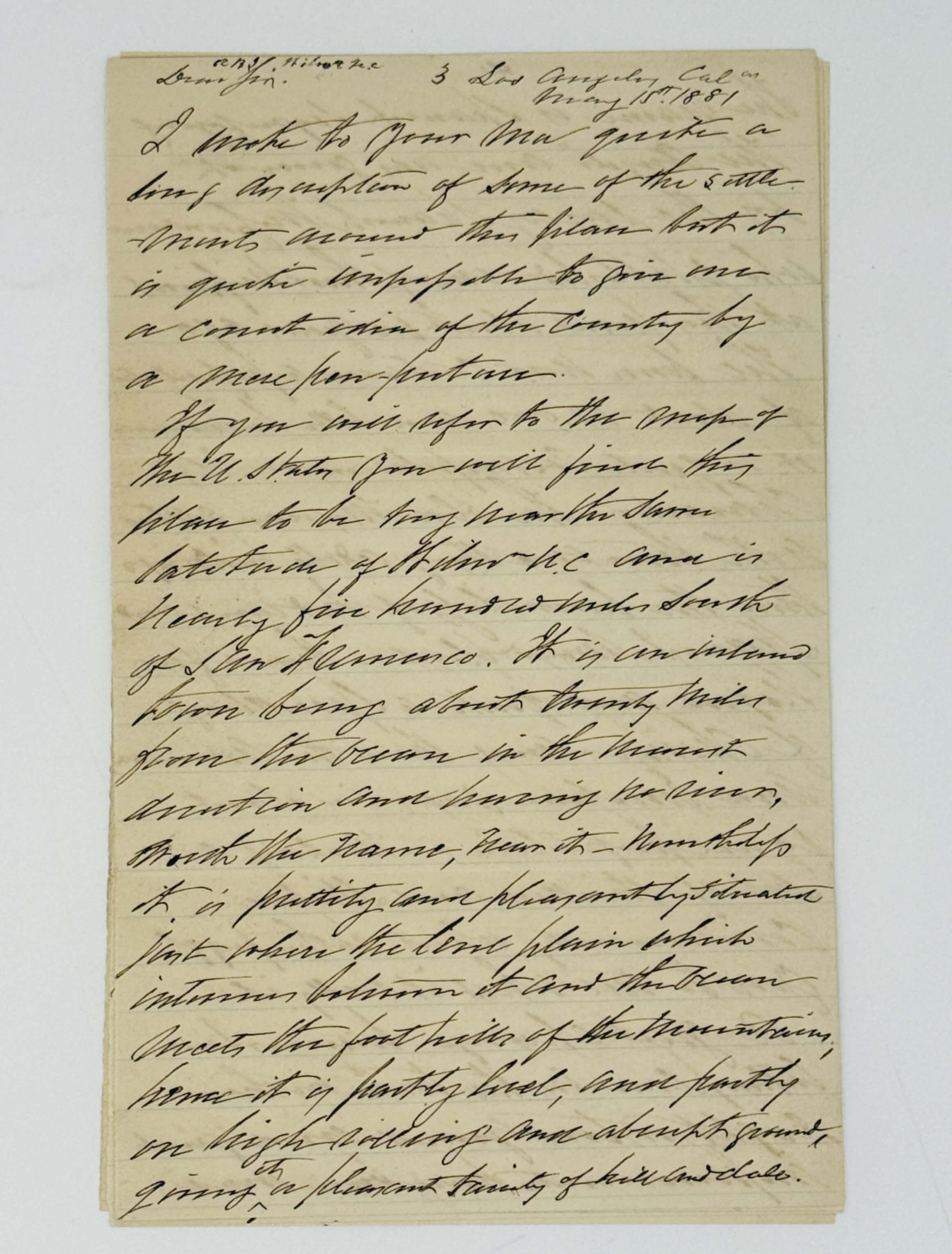
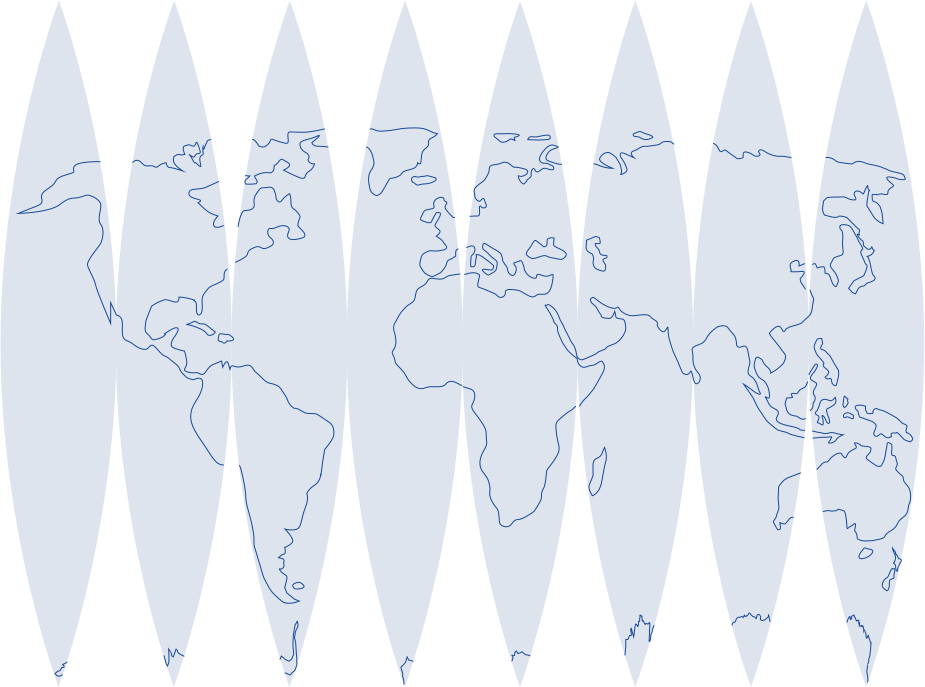
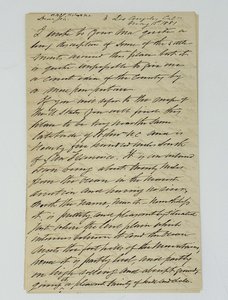
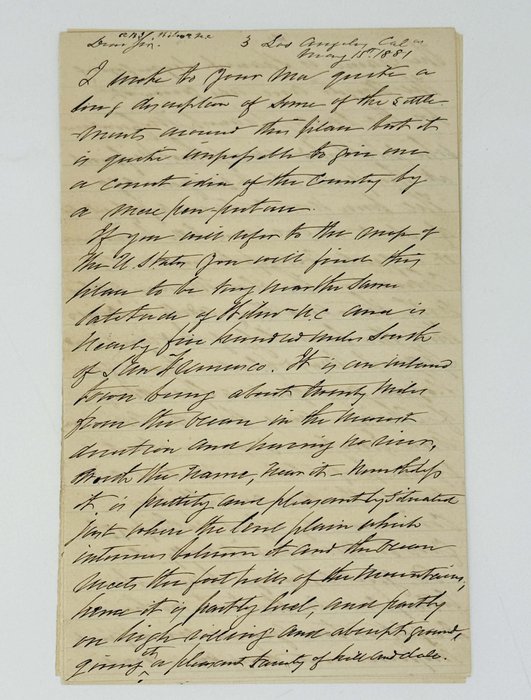
Excerpt from the letter: “If you will refer to the map of the U States you will find this place to be ling near the same latitude of Wilson, N.C. and is nearly five hundred miles south of San Francisco. It is an inland town being about twenty miles from the Ocean in the nearest direction and having no river, worth the name, near it. The name is Spanish signifying “the Angels” and was given by the early Spanish missionaries who established some of their missions at this point about two years ago. The town now contains a population of about 12000 and both San Francisco it is quite cosmopolitan in its character. The old Mexican settlers with their one strong adobe business, then the lower class of Indians and Spanish mixed blood then a few negroes and quite a sprinkling of Chinese and then the Americans and European – in about equal proportions – making a sort of streaked and striped community which rather puzzles you to tell what it really is.
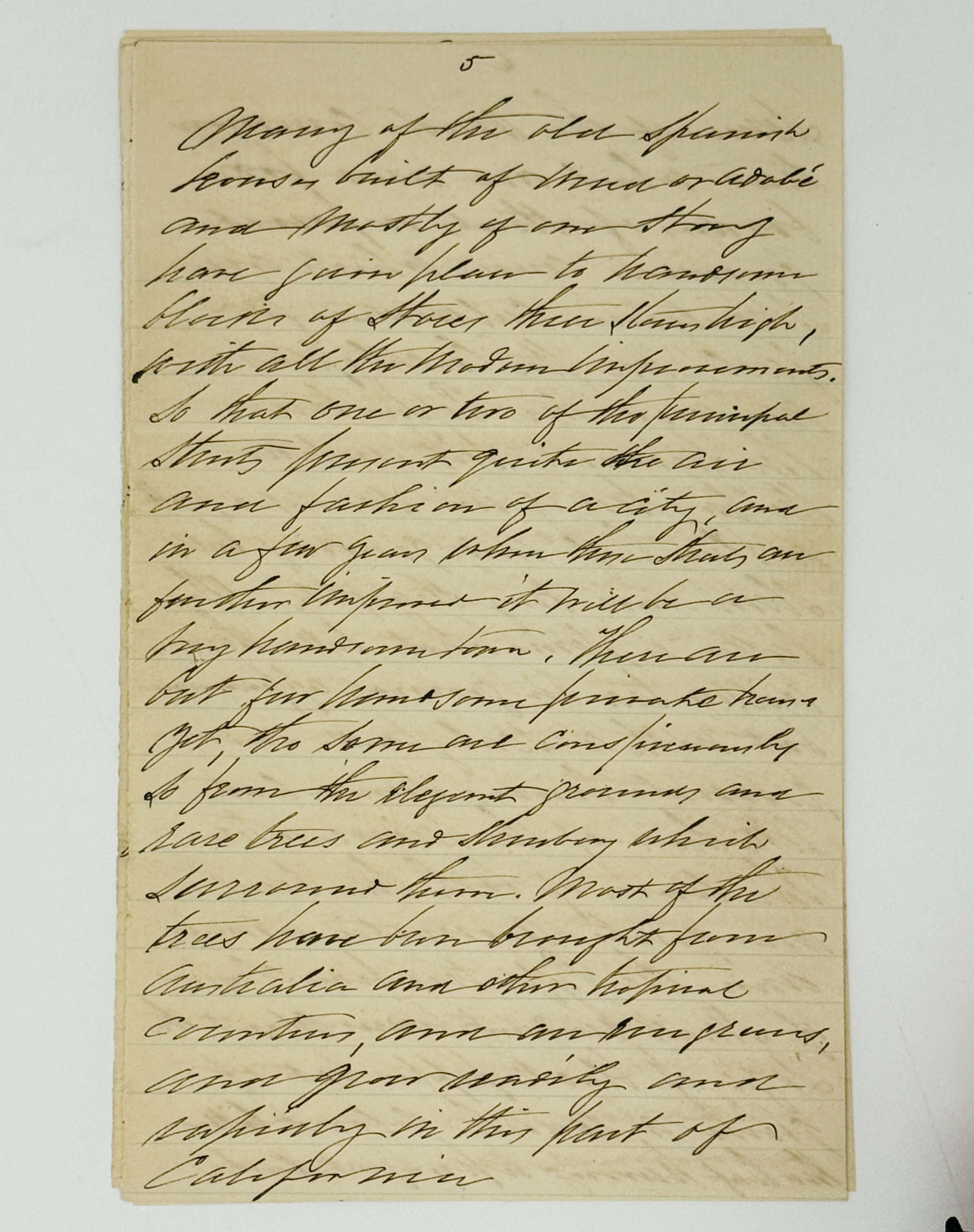
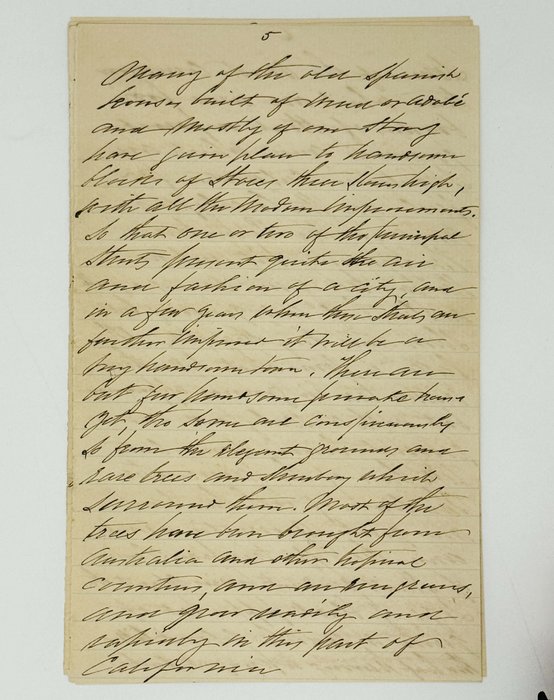
A great change however has taken place in the town within eight or ten years and such improvements have been made many of the old Spanish houses built of mud or adobe and mostly of one story have given way to handsome blocks of stores three stories high, with all the modern improvements. So that one or two of the principal streets present quite air and fashion of a city, and in a few years when – streets further improve it will be a – handsome town. There are but few handsome private houses yet, tho some are conspicuously so from the elegant grounds and rare trees and shrubbery which surround them. Most of the trees have been brought from Australia and other tropical countries, and are evergreens and grow easily and rapidly in this part of California.
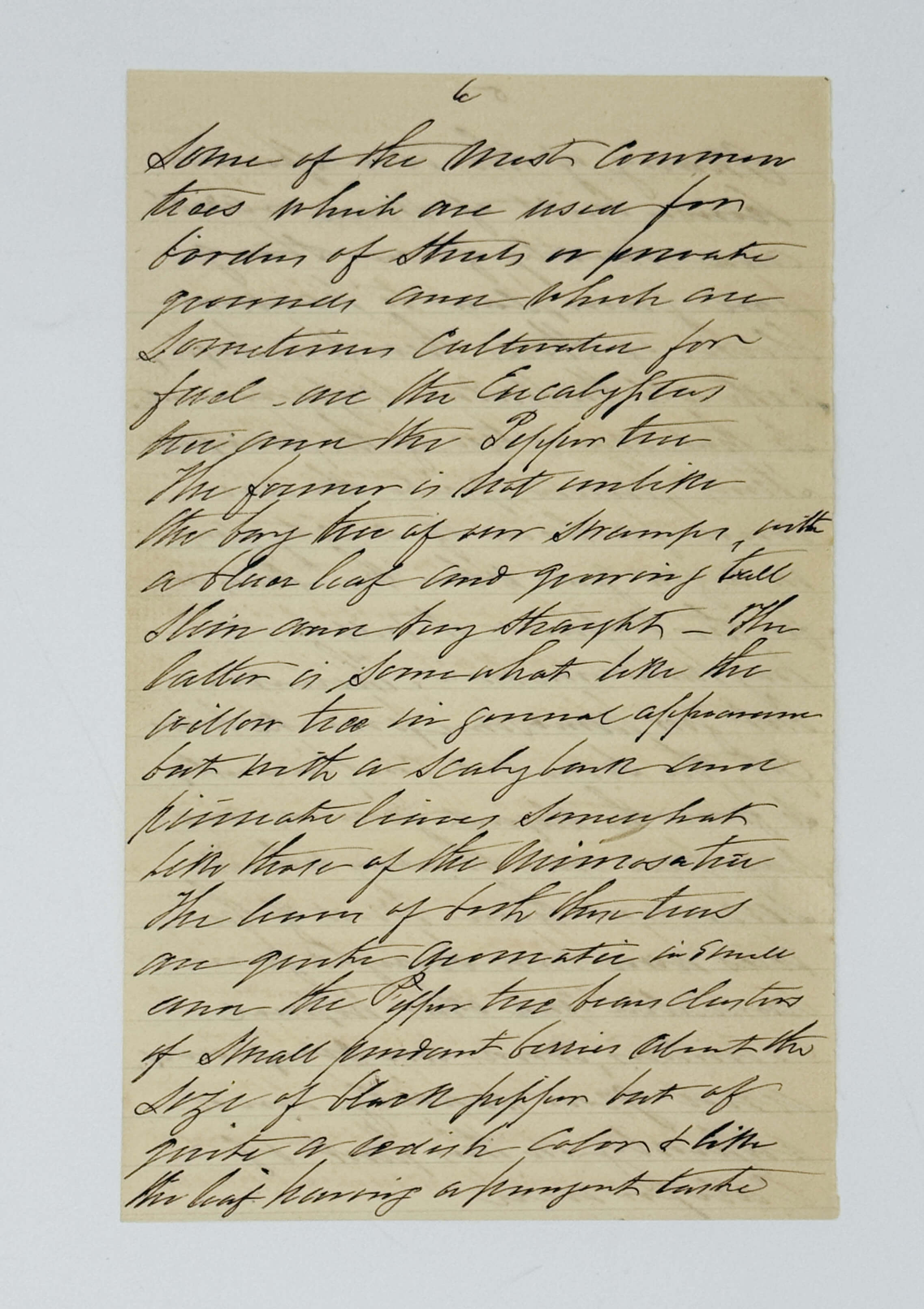
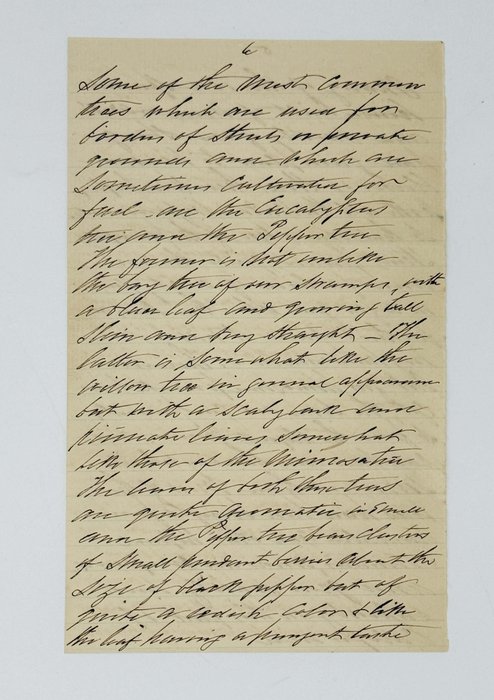
Some of the most common trees which are used for borders of streets or private grounds and which are sometimes cultivated for food are the Eucalyptus tree and the Pepper tree. The former is not unlike the bay tree of our swamps, with a bluer leaf and growing tall slim and busy straight. The latter is somewhat like the willow tree in general appearance but with a scaly bark and pinnate leaves somewhat like that of the mimosa tree. The leaves of both these trees are quite aromatic in smell and the Pepper tree bears clusters of small pendant berries about the size of black pepper but of quite a redish color + like the leaf having a pungent taste.
Then come the numerous family of acacia trees – then the various species of pine some very beautiful then the cedars and what they call cypress and a kind of tree used for hedges. Then the Willow which is also cultivated for food. Then the purely ornamental trees including several varieties of the palm tree and then in endless variety and beauty the family of Citrus trees. The Orange, the lemon, the lime, the mandarin, orange, etc etc. This family in connection with the grape constitute the staple production of the Country, and thousands of acres in this and the other counties of Southern California are covered with extensive orchards of beautiful orange trees and vineyards of grapes.
The oranges are picked by hand carefully put up in nice light boxes containing some 150 or 200 and shipped by rail to San Francisco + to Arizona as far east as the rail road monopoly will allow the producer to send them. Los Angeles County has nearly 1000 acres in vineyard owned by about three hundred owners. The wine product of the country is estimated 2,500,000 gals besides which there is now on hand 300,000 gals of brandy made pure from the grape and in addition to this quite a large quantity of grapes are converted into raisins and perhaps as many more used for the table. The value of the whole wine brandy and raisin crop is esteem 1,150,000 $.”