
#RA72
1847
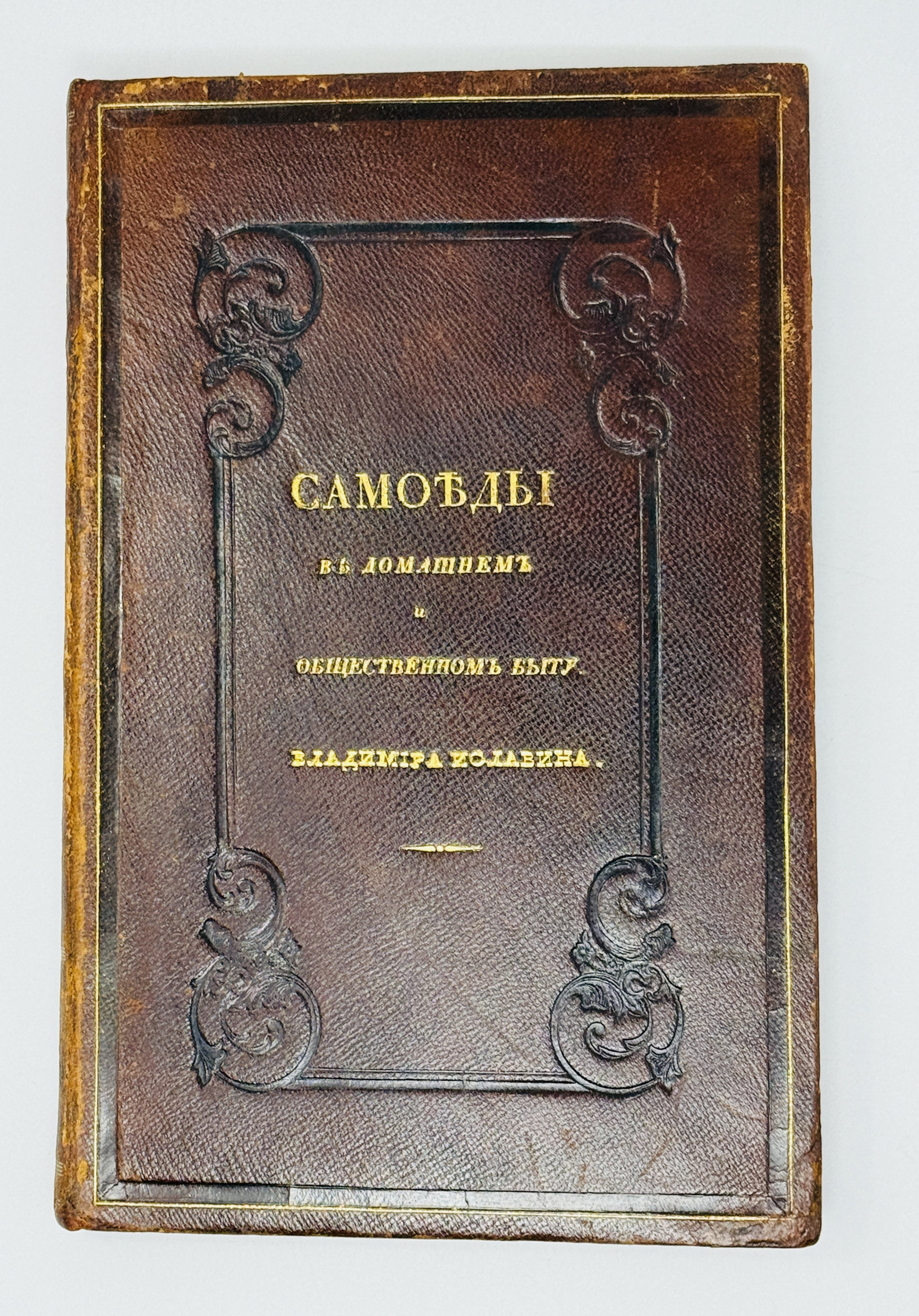
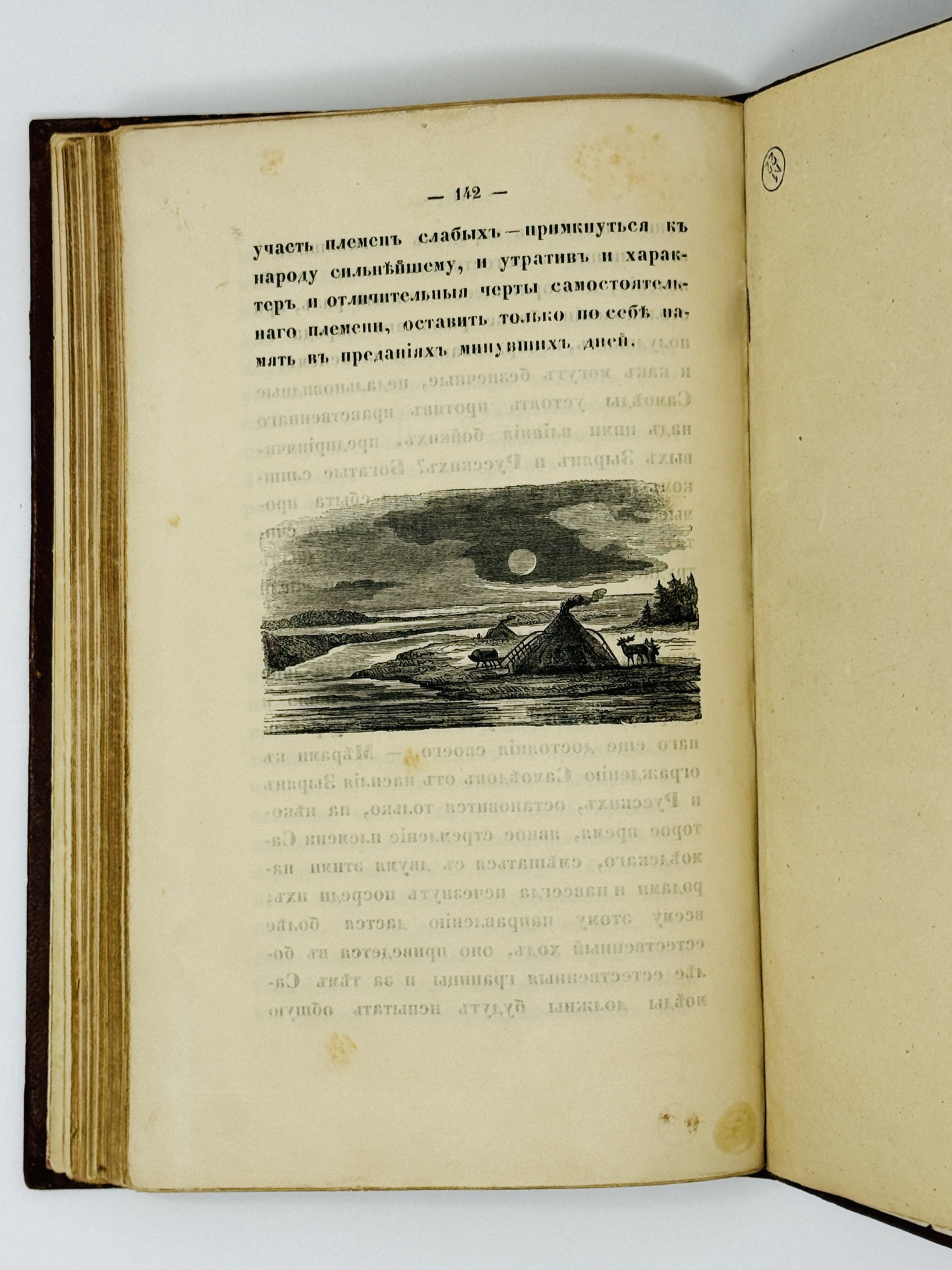
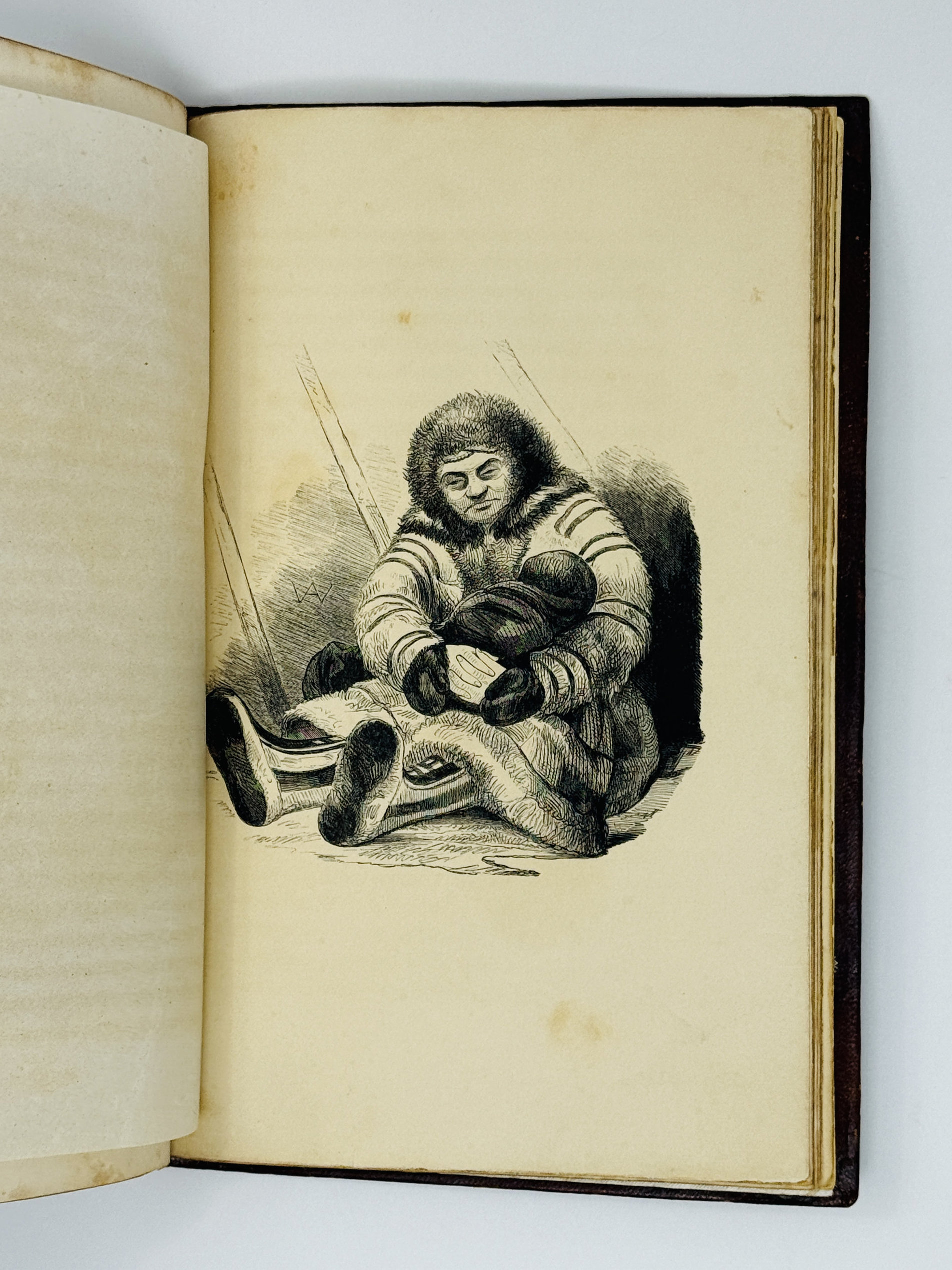
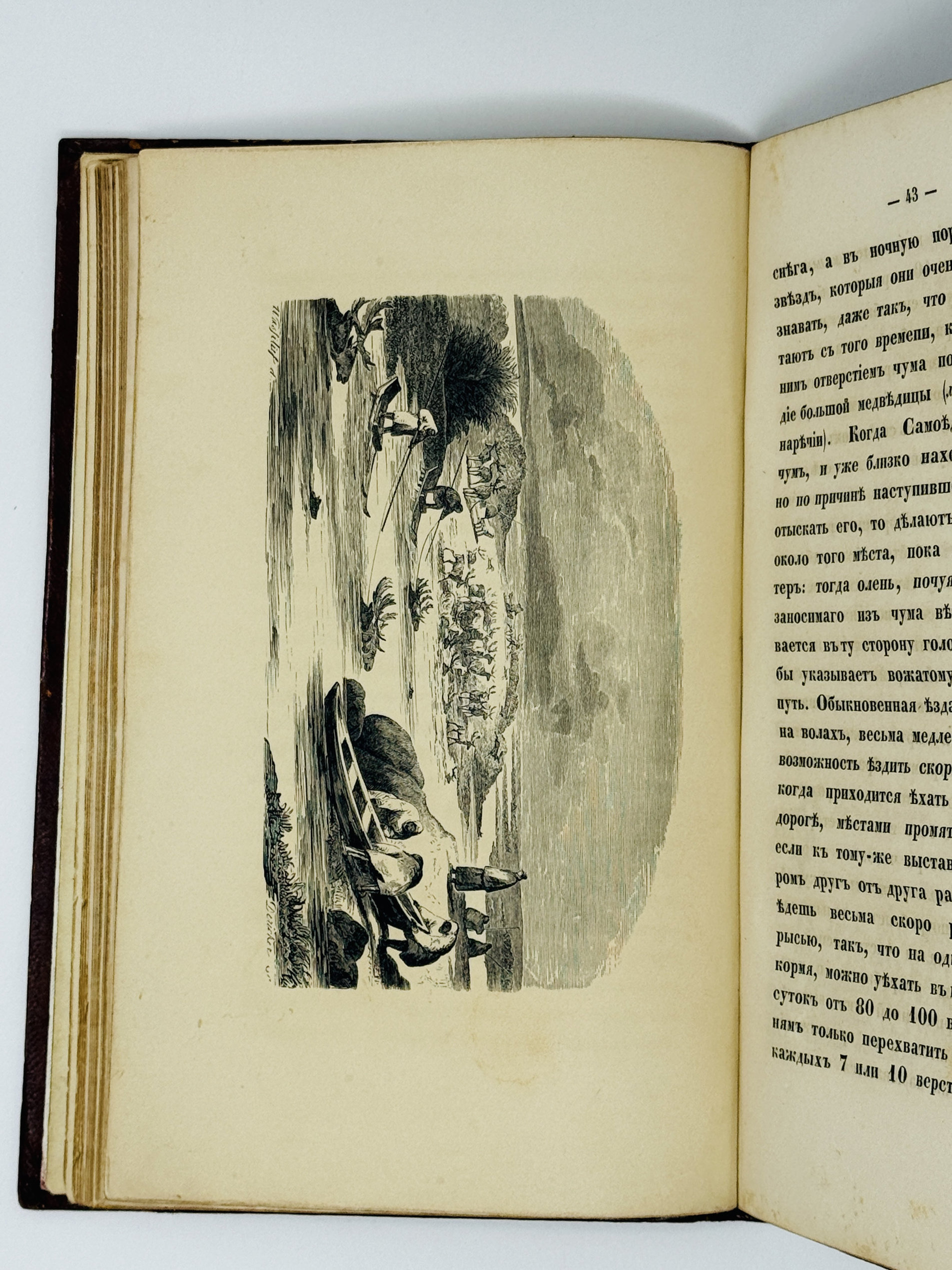
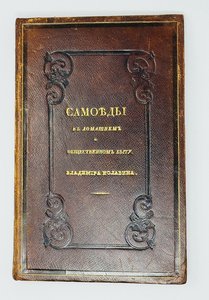
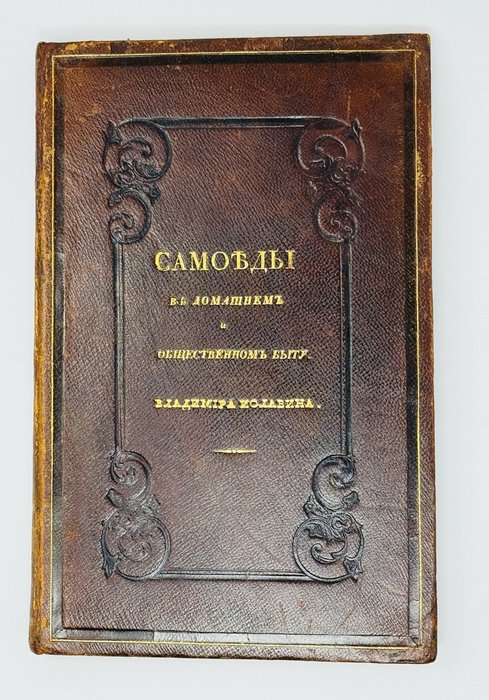
First and only edition. Octavo (ca. 23,5x14,5 cm). [2], iv, 142 pp. With a woodcut frontispiece; the artist’s initials (“A.B.” or “A.V.” in Cyrillic spelling) in the right lower corner. Also with four additional woodcut plates and a large folding lithographed map at rear; two woodcut vignettes (on the title page and p. 142); four woodcut initials in text. Two plates identify the artist and engraver on the lower margin: “Wassilieff d., Dericker sc.” Gilt edges, half-faded. Contemporary Russian full-leather original binding. Binding is slightly rubbed, block is moderately foxed, otherwise in very good condition.
Very Rare Russian imprint. The book was never republished in Russian or translated into other languages.
Early original Russian work on the ethnography of the Nenets people from the Mezensky uyezd of the Russian Empire (a part of the Imperial Arkhangelsk governorate, occupying the territories of modern-day Nenets Autonomous Region and parts of Arkhangelsk Oblast, Komi Republic and Yamalo-Nenets Autonomous Region). The book was written by an official representative of the Russian Ministry of State Properties (Ministerstvo Gosudarstvennykh Imushchestv), Vladimir Islavin, who was sent to the Mezen tundra in June 1844 and spent there half a year studying the Nenets way of life, occupations, manners and customs, trades, &c., with the purpose to “make suggestions about the future of these peoples” (p. ii).
The book consists of four chapters: 1) “Topographical sketch of the tundra,” defining its borders and characterizing main geographical objects; 2) “[A history of] tundra’s gradual settlement” by the Samoyeds/Nenets, Russians and Zyryan/Komi (based on Russian chronicles and archival documents); 3) “Domestic life, reindeer herding and trades”: detailed notes on Nenets dwellings, clothes, food, reindeer herding (with the reproduction of several Nenets stamps marking reindeer ownership), fishing, hunting; approximate number of Nenets people in the Mezen district; 4) “Samoyeds in their moral and religious principles”: notes about Nenets languages, Russian Orthodox mission and schools, shamanism and pagan rituals, Nenets customs related to birth, marriage and death, common diseases and native medicine; main family groups, &c.
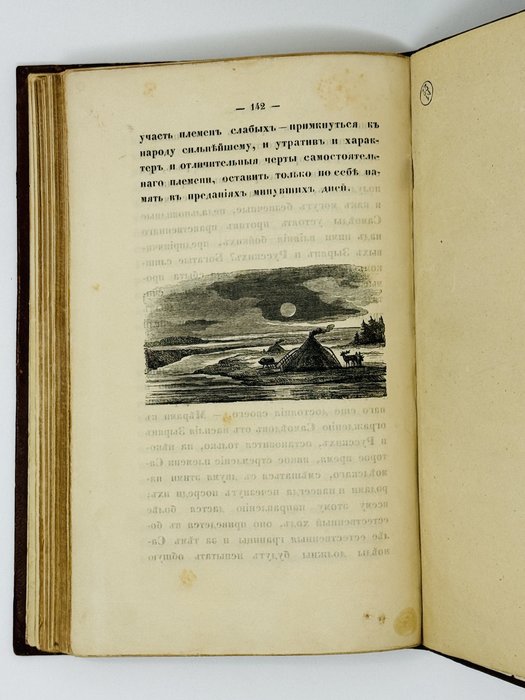
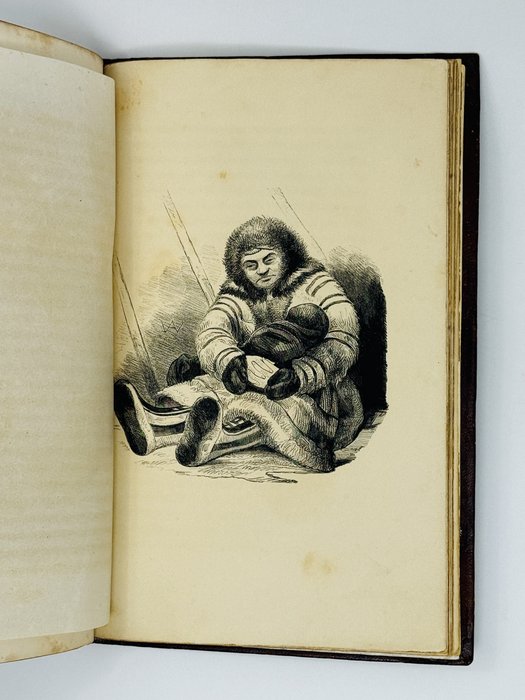
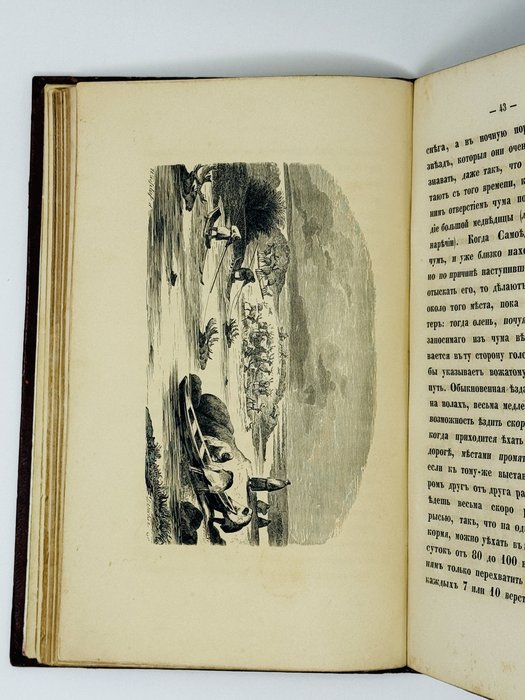
The book is supplemented with a large folding map and is beautifully illustrated with several woodcut plates, vignettes and initials. The frontispiece and four large plates are made after the original drawings of one Alexander Vasiliev, who most likely took them from life (apparently, he accompanied Islavin on his journey). One of the plates, showing the interior of a Nenets chum (tent), features the artist with a pencil and a notepad. The other plates show a scene in a Nenets camp with chums, people and reindeer, a scene with Nenets people and reindeer crossing a river, and a portrait of a Nenets mother and child. The frontispiece portrays a Nenets man wearing a traditional dress and boots.
Vasiliev’s drawings were engraved on wood by one of the best Russian book illustrators of the time, Georgy Dericker. His father was one of the engravers employed by the “Ekspeditsiya Zagotovleniya Gosudarstvennykh Bumag” – the best state typography in 19th-century Russia, which printed paper money and securities. Dericker studied at the special school for the children of the Ekspeditsia workers, where he learned drawing and engraving techniques. In 1840, Dericker became a student of baron Konstantin von Сlodt (1807-1879), the first Russian wood engraver, and received financial support from the Russian Society of Encouragement of Arts. Together with Clodt and his students, Dericker illustrated the best and most known Russian books of the 1840s, including “Sensatsii i zamechaniya gospozhi Kurdiukovoi za granitsei” by Ivan Myatlev (1840-42), “Nashi, spisannye s natury russkimi” (1841), “Kartinki russkikh nravov” (1842), “Tarantas” by Vladimir Sollogub (145), the famous second edition of Alexander Smirdin’s almanac “Novoselie” (1845-46), and others. He also actively worked for the “Illustratsia” magazine, published by N. Kukolnik. “Samoyedy v domashnyem i obshchestvennom bytu” became the last book illustrated by Dericker, who died of tuberculosis the same year it was published (1847). Apart from the large plates, Dericker drew and engraved two vignettes and four initials for the book, combining scenes from Nenets life with images of Arctic animals and birds.
The “Map of the tundra of the Mezensk uyezd of the Arkhangelsk province” covers the region from the Kanin Peninsula and the city of Mezen in the east to the “Karskaya Guba” (Baidaratskaya Bay) and the Ob River in the west, from the Vaygach and Kolguyev Islands in the north to the Pizhma River and Beryozov in the south. Based on the earlier maps by Friedric Luetke and other explorers, but supplemented with new topographical data gathered by Islavin (see Preface, p. iii), the map marks main towns and villages (often indicating the number of habitations there), solitary habitations (“izba Aniki Vokuyeva”), monasteries, rivers and lakes, mountains and hills (“Mouse range”), forests (“Sinful forest”), ocean bays, capes, and islands. Islavin also outlines the road from Mezen to Pustozyorsk, and the “Siberian tract” from the Izhma River towards the Ural Mountains.
Overall an early Russian work on the life of the Nenets people, beautifully illustrated by one of the best Russian engravers and supplemented with a large content-rich map.
A member of an influential Russian noble family, Vladimir Islavin made a career in the Russian Ministry of Agriculture and State Properties, starting his service in 1841 and finishing as a member of the Minister’s Council. He became known as an ethnographer after his work on the “Samoyeds” published in 1847. In the 1870s, Islavin also issued two books on coal mining in the Donets region and Europe. Islavin was a close friend of Leo Tolstoy, who most likely made him a prototype of “Volodya Irtenyev” – a brother of the main hero from the novella “Detstvo” (“Childhood,” 1852).