

$4500.00
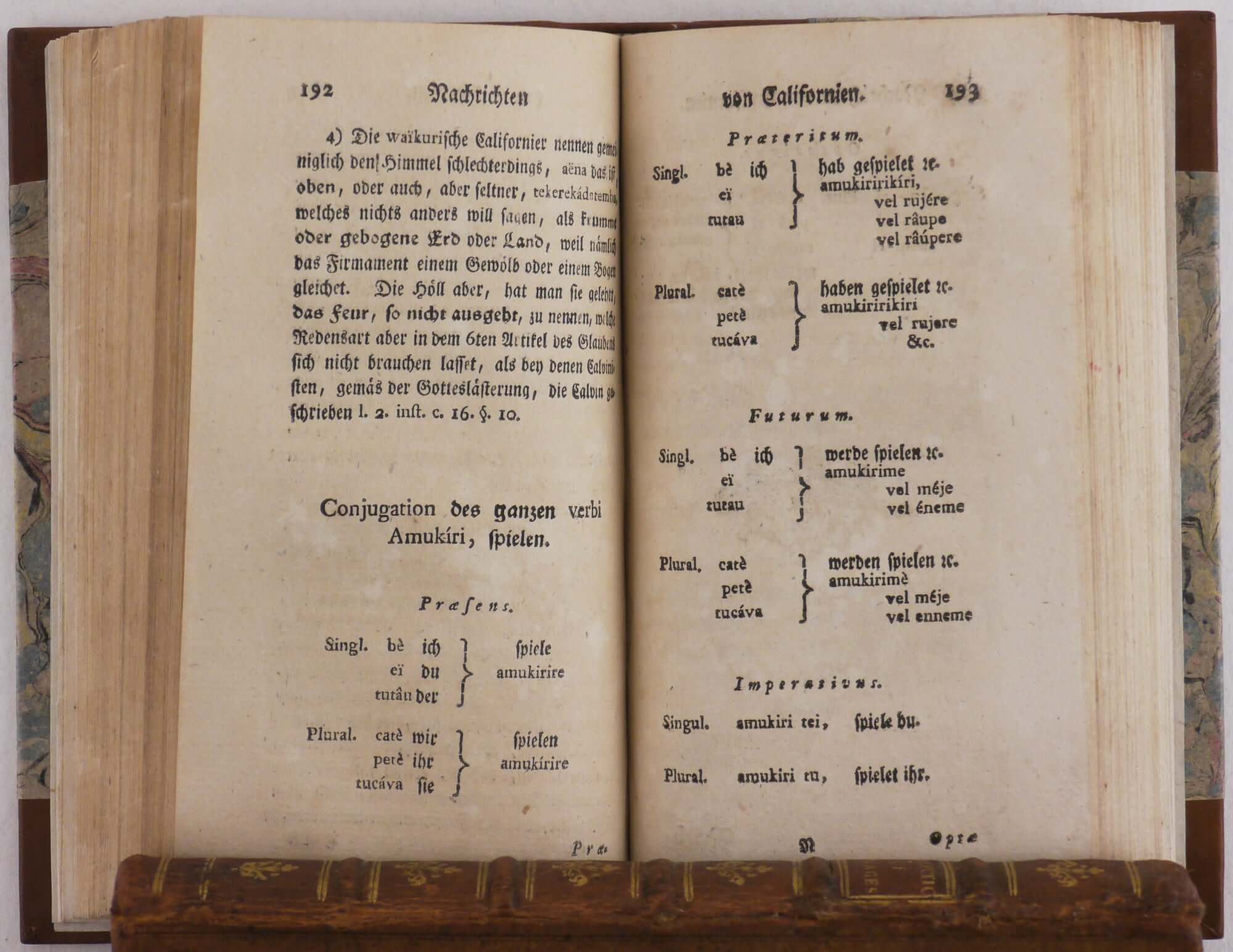
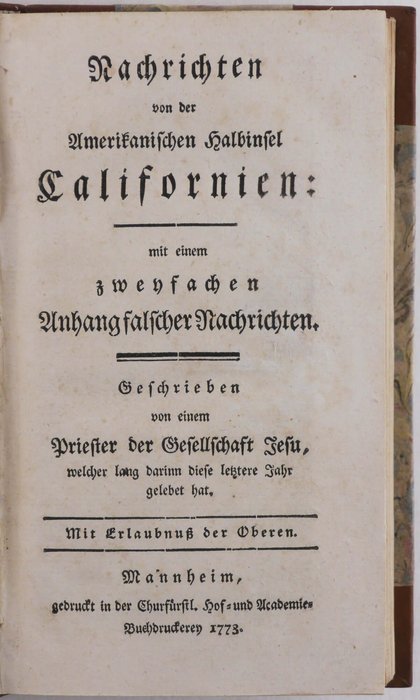
[Baegert, Johann Jakob] (1717-1772). Nachrichten von der Amerikanischen Halbinsel Californien: mit einem zweyfachen Anhang falscher Nachrichten. Geschrieben von einem Priester der Gesellschaft Jesu, welcher lang darinn diese letztere Jahr gelebet hat. [News from the American Peninsula California..,] Mannheim: Churfürstl. Hof- und Academie-Buchdruckerey, 1773.
#O28
1773
Second Edition (With Corrections). Small Octavo (17.5 x 10.5 cm), [xvi], 358, With one copper engraved folding map and two copper engraved plates on one leaf. Recent handsome period style brown gilt tooled half sheep with marbled boards and a red gilt title label. Some leaves with very mild browning, otherwise a very good copy.
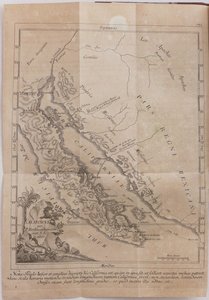
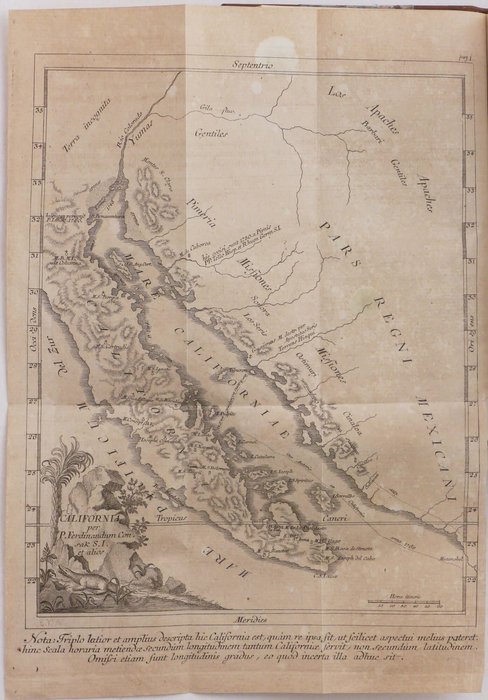
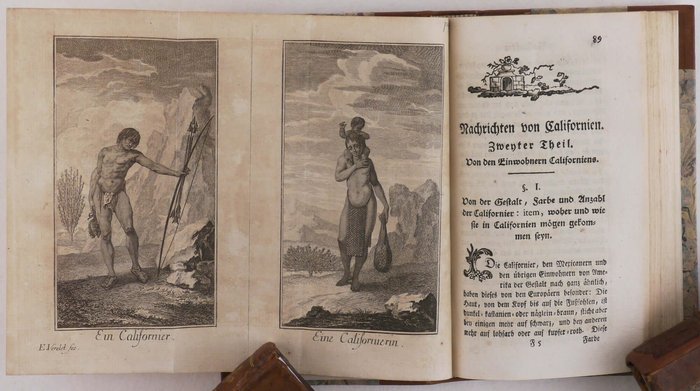
"Baegert, a German Jesuit missionary and resident of Baja California for eighteen years, wrote an interesting but by no means glowing account of the natives and of the country. He served at the mission of San Luis Gonzaga. The map is most helpful in giving the location of the many Jesuit missions in Lower California. It also shows the route along the west coast of Mexico followed by Baegert in going to California in 1751, and his route out in 1768, after the expulsion of the Jesuits. The two plates, which are not found with all copies, depict California natives"(Hill 46); Barrett 129;"According to his accounts the country was absolutely unfitted for habitation; it was inhabited by wild and ferocious beasts; peopled by inhospitable and cruel savages; water was unfit for use; wood was scarce; and the soil would not sustain life"(Cowan p.27); Graff 137; Howgego B1; Howes B29; Sabin 4363 "Some corrections made [in the second edition)» (Streeter IV 2442); Wagner 157.
Baegert gives a vivid account of the Jesuit presence in the region and of the local way of life:
‘One does not imagine an inhabited world without Jesuit missions’ (p.101)
‘Apart from the churches and the dwellings of the missionaries, nothing in California resembles a village, so all the people here, including boatmen, the cowboys, the cattle herders, the gold miners and Indians all slept always and forever under the open sky or on bare ground. The wind is particularly sharp here, so they make two blankets and keep a half-moon shape among themselves, but only from the side the cold is coming on’ (p.102)
‘Pitahaja (Pitaya) seeds are being collected and consumed by Californians out of necessity, however it’s fair to report that unlike other parts of Americas they have abstained from Cannibalism… if anyone decides to send some wine to these shores, I urge you not to waste your time as Californias generally do not drink anything but the water - so poor the conditions are, even as in other parts of Americas the fermented drinks from aloe and corn are not made to get drunk’. (p.120)
'Californians know nothing of boiling, simmering, or roasting as these terms are understood here; partly because they lack the necessary utensils, nor have had any knowledge of them, and partly because the time was far too long for them to wait three or four hours until a stick of meat was thoroughly cooked or roasted. Therefore, they burn, singe, and roast in and on the bloper inside the fire everything they do not eat raw. Then they throw the meat, the fish, the bird in Schlang, like a piece of wood, right into the fire and flames or onto the hot coals, and let it smoke and smolder for a quarter of an hour, after which they throw the roast, black and burnt on the outside, red and bloody, dripping, until the fire has died down, onto the earth in the sand or dust, soon after shaking it off a little, and enjoying themselves in the process. Everything that can be considered meat, according to the above note, they prepare in this way’ (p.129)
Childbirth comes easily to Californian women. They do it consistently without assistance, and on the very same day when their time away from missionary work overtakes them, they bring their newborn children, two or more hours away, themselves to baptism. That many of their children die is no wonder; it was a wonder when they lived long, and many of them survived. (p..133)
Page 270-280 describes the recent conflicts between the missions and the natives, mentioning the leaders of the largest rebellion Boton and Chicori, who wanted, according to the author, to kill all the priests and abandon any notion of the Christianity, and live free of it. In the process two jesuit priests were murdered, but the rebels were caught and executed soon after. Interesting how the author talks about the decline of the local population:
‘Originally they were drawn from 4000 men at the beginning of the uprising over Californians, but elsewhere, partly through the ugly diseases and corruption among themselves, reduced to 400 and melted away. Among these 400, there are few today who are free from the general plague and may boast of having a healthy body...'
The author concludes on the relationship of the missionaries and the locals:
'On the other hand, a thousand thanks be given to divine goodness, which has not ceased to awaken, among the Catholic priesthood, and especially among those of the Society of Jesus, even to these our dearest, who, without the slightest hint of self-interest, have enough heart and courage to spread the Christian faith, not only to venture among all kinds of barbarians and into all dangers of death, but also to shed their blood, when the opportunity arises, in a great manner. For these two Californian missionaries are by no means all who, even from this Society alone, who fell victims..’
Overall an interesting early first-hand account of California and its missions.
Item #O28
Price: $4500.00